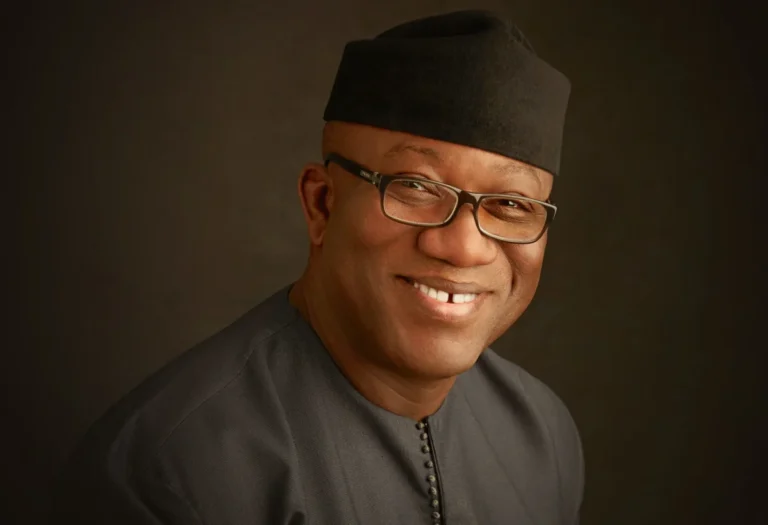
Former Governor of Ekiti State, Dr. Kayode Fayemi, has issued a stern call to action to Catholic faithful across Nigeria, urging them to look beyond primordial sentiments, financial inducements, and partisan loyalty when making electoral choices in the upcoming 2027 general elections. Delivering a profound message on the intersection of faith and governance, Fayemi emphasized that the spiritual duty of citizens extends directly into the polling booths, where choices must be anchored on the principles of human dignity, justice, and the common good.
The former governor made these remarks while addressing the September 2026 Plenary of the Catholic Bishops Conference of Nigeria (CBCN). The high-profile gathering took place at the Our Lady and St Kizito Pastoral Centre, located in Oke-Gada, Ede, Osun State. Against the backdrop of Nigeria’s complex socio-political landscape, Fayemi’s address resonated deeply with the clergy, lay leaders, and delegates in attendance, sparking crucial conversations about the moral imperatives of civic participation.
Faith in Action: The Core Message at the CBCN Plenary
Standing before the Catholic hierarchy and laity, Dr. Fayemi delivered a comprehensive lecture titled, “Faith in Action: Empowering the Catholic Laity for Active Political Participation Ahead of the 2027 General Elections.” In his address, he dissected the habitual pitfalls that have historically plagued Nigerian elections, specifically warning the faithful against falling prey to transactional politics.
Fayemi maintained that the electorate must deliberately detach their voting behavior from ethnic chauvinism, religious bigotry, monetary inducements, political patronage, and uncritical party loyalty. According to him, these divisive elements have continuously undermined national development and robbed citizens of effective leadership. Instead, he challenged Catholic voters to subject every candidate and political manifesto to rigorous moral scrutiny.
“Ahead of the 2027 general elections, our participation as Catholics must not be driven primarily by ethnicity, religion, personal financial gain, political patronage, friendship, family connections, fear, misinformation, or blind loyalty to political parties,” Fayemi stated.
He further noted that the fundamental question in the minds of voters should center on competence and ideological alignment with human progress. “The fundamental question must be which candidate and which policies are most capable of advancing human dignity, justice, peace, security, development, and the common good? Catholics must approach the 2027 elections bearing in mind that our political and electoral choices have huge consequences for the common good and wellbeing of the society,” he added.
Elevating Elections from Civic Duty to Moral Imperative
Expanding on the social teachings of the Catholic Church, the former governor argued that voting should not be treated as a mere civic obligation performed out of routine. Rather, he framed it as a sacred opportunity to shape the moral architecture of the nation.
Fayemi reminded the audience that political choices directly impact the quality of life enjoyed by ordinary citizens. When bad leaders are elected due to voter apathy or financial compromise, the entire society suffers the consequences through insecurity, economic hardship, and institutional decay. Therefore, active participation in the democratic process is a moral obligation for every believer.
“We must therefore not lose sight of the church’s consistent teaching that our participation in political and electoral processes is not merely a civic responsibility but also an opportunity to promote, protect, and advance the common good,” Fayemi stressed.
The lecture outlined a practical roadmap for the Catholic laity to move from passive observers to active drivers of democratic accountability. Fayemi urged all eligible citizens to ensure they are adequately prepared for the electoral cycle by registering early and collecting their permanent voter cards (PVCs). Beyond voting, he encouraged the faithful to deepen their engagement by understanding the track records and manifestos of various political contenders.
A Blueprint for Grassroots Democratic Engagement
Dr. Fayemi’s presentation went beyond theoretical theology, offering a detailed blueprint for grassroots political involvement. He challenged the laity to take up diverse roles within the democratic ecosystem to safeguard the integrity of the electoral process.
Among the actionable steps recommended by the former governor are volunteering for election monitoring and observation duties, participating actively in political party structures, serving as independent electoral officials, and even contesting for elective political offices. He also underscored the importance of continuous civic education, resisting electoral malpractices such as vote-buying, promoting peaceful conduct before, during, and after the polls, and robustly defending democratic institutions against executive or judicial overreach.
Furthermore, Fayemi tasked citizens with the responsibility of holding elected officials accountable long after the ballots have been cast and the winners have assumed office. Constructive engagement with government officials at the local, state, and federal levels, he noted, is essential for ensuring that governance remains responsive to the needs of the people.
Moral Benchmarks: Judging Policies by Human Impact
As the political atmosphere heats up ahead of 2027, the former governor advised voters to evaluate every political platform through the lens of human welfare. He stressed that campaign promises must be weighed against their practical impact on critical socio-economic indicators.
“As the election draws close, every political programme must be judged by how it affects human beings,” Fayemi asserted. He highlighted that the laity must pay particular attention to how prospective leaders intend to tackle pressing national challenges, including widespread poverty, high unemployment rates, the crisis in the educational sector, deficiencies in healthcare delivery, persistent insecurity, systemic injustice, the preservation of family values, and the protection of vulnerable populations.
For the Catholic community, Fayemi concluded, these are not merely economic or political talking points; they are profound moral issues that demand active, deliberate intervention through the ballot box.
Broader Context and Background of the 2026 CBCN Plenary
The choice of Ede, Osun State, as the venue for the September 2026 Plenary of the Catholic Bishops Conference of Nigeria placed the ancient town at the epicenter of national political discourse. The CBCN plenary is a high-level biannual gathering where the apex body of Catholic bishops in Nigeria deliberates on matters concerning faith, morals, and the general welfare of the country.
Coming roughly a year before the scheduled 2027 general elections, the timing of the conference was strategically significant. Civil society organizations, political analysts, and international observers have increasingly looked to religious institutions in Nigeria to provide moral leadership and voter education. With religious and ethnic fault lines frequently exploited by political actors, interventions from respected national figures like Dr. Kayode Fayemi at such platforms carry substantial weight in shaping public consciousness.
The Catholic Church in Nigeria commands a vast demographic footprint, with millions of faithful spread across the country’s six geopolitical zones. Mobilizing this massive constituency toward conscious, value-driven political participation has the potential to alter traditional voting patterns and challenge the dominance of money politics.
Political Implications and Public Reactions
Dr. Fayemi’s remarks have already begun generating intense debate among political stakeholders, civil society groups, and ordinary citizens. Analysts note that his warning against blind party loyalty and financial inducement strikes at the very heart of Nigerian party politics, where primaries and general elections are frequently influenced by heavy financial war chests.
While some political commentators express skepticism regarding the immediate feasibility of shifting voter behavior away from entrenched patronage networks, others believe that sustained civic education by religious bodies can yield gradual, transformative results. Civil society organizations have largely lauded the intervention, describing it as a timely wake-up call against voter apathy and electoral malpractice.
As the nation marches closer to the 2027 general elections, the challenge remains on how institutions like the CBCN will translate these moral teachings into grassroots mobilization. With leaders like Fayemi setting the tone, the conversation surrounding leadership selection in Nigeria is steadily pivoting toward competence, character, and accountability.