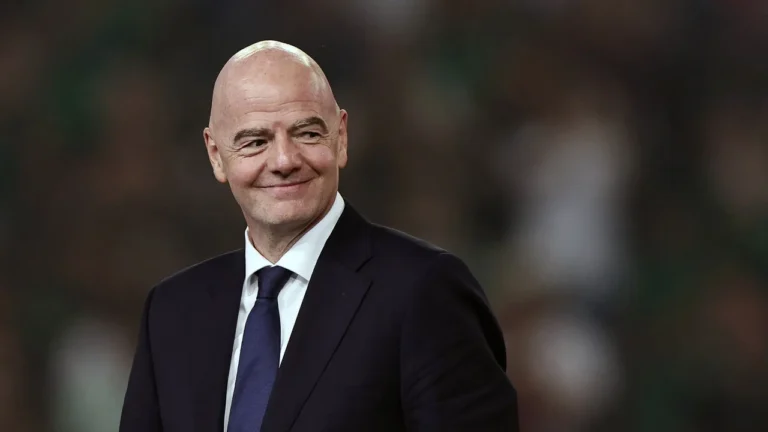
The governance of world football has once again been thrust into the spotlight following an explosive interview given by former FIFA President Sepp Blatter to the German publication Der Spiegel. In the wide-ranging conversation, the 90-year-old Swiss administrator launched a blistering attack on his successor, Gianni Infantino, labeling him a "dictator," questioning his mental fitness, and sharply criticizing several high-profile administrative, commercial, and disciplinary decisions made under his leadership.
The remarks come at a sensitive geopolitical and sporting juncture as FIFA prepares for the aftermath of the expanded World Cup hosted jointly by the United States, Canada, and Mexico. Blatter’s unprecedented critique not only underscores the deep personal and ideological animosity between the past and present chiefs of global football but also highlights mounting institutional friction as the race for the FIFA presidency begins to attract heavyweight contenders.
A Scathing Indictment of Leadership and Governance
Blatter, who led world football from 1998 until his unceremonious departure in 2015, did not hold back in his assessment of how Infantino currently runs the governing body. Accusing the current president of being "blinded" by power, Blatter asserted that FIFA is suffering under a regime of absolute control and isolation.
"FIFA is suffering. It is currently led by a person who has allowed himself to be blinded," Blatter told Der Spiegel. Going further into his critique of the internal corporate culture at the Zurich-based headquarters, Blatter added, "He is a dictator. People in FIFA tell me that no one is allowed to ride in the elevator with him. He is ‘untouchable’."
The former president also took aim at Infantino’s strategy for maintaining power, suggesting that the current administration relies heavily on financial incentives to secure unwavering loyalty from the 211 national football associations. According to Blatter, the typical pitch to member federations revolves around fiscal growth: "’If you vote for me,’ he tells the national associations, ‘you will get much more money than before.’"
The commentary extended into deeply personal territory when Blatter addressed Infantino’s policy initiatives and public-facing maneuvers, remarking that the incumbent "no longer knows any borders" and concluding with the sharp suggestion that "maybe Infantino should be sent to a psychiatric ward one day."
Controversies Surrounding the US World Cup and the Trump Peace Prize
At the core of Blatter’s grievance are specific controversies that materialized around this summer’s North American World Cup. Among them, Blatter heavily criticized the creation and bestowal of the newly minted FIFA Peace Prize upon United States President Donald Trump in the lead-up to the tournament.
Blatter called the gesture "embarrassing" and questioned the geopolitical coherence and timing of the award. "Why would he do something like that?" Blatter asked, pointing to subsequent military escalations. "Infantino awards a peace prize to someone who wages war against Iran shortly afterwards? That’s madness."
Compounding his frustration with political interference in the sport, Blatter trained his sights on a major disciplinary controversy during the tournament involving United States striker Folarin Balogun. Following a direct red card issued to Balogun during a critical match, FIFA’s judicial bodies ultimately suspended the red card following high-profile intervention by the White House.
Blatter expressed utter dismay at the decision, drawing a strict line between statutory interpretation and the core laws of the sport. "The red card. That’s the worst. Statutes can be interpreted. But rules of the game must apply to everyone; you can’t interpret them."
Furthermore, Blatter criticized Infantino’s ambitious post-World Cup proposals to sell off a substantial portion of the competition’s commercial rights to private equity and external investors—a plan that was ultimately shelved following fierce backlash from European football stakeholders, fan groups, and traditionalists who feared the commercialization of the global game’s crown jewel.
FIFA’s Official Counter-Response
In the wake of the publication, international news agency AFP reached out to FIFA for comment. The organization pointedly referred back to its previous robust rebuttals issued directly to Der Spiegel, firmly rejecting Blatter’s characterization of Infantino’s leadership style, operational conduct, and integrity.

Countering the allegations of autocracy and erratic behavior, FIFA defended the president’s rigorous schedule and internal demeanor. "Mr Infantino is fulfilling his duties as president through his travels," the official statement read, addressing the critique of his global movements. Regarding the specific claim about office isolation, the organization offered a deadpan denial: "Mr Infantino does indeed use the elevator at FIFA, but does so when other people are present."
On the sporting front, FIFA defended the reversal of the disciplinary action regarding the American forward, reiterating that standard institutional protocols were followed. "The suspension imposed on Folarin Balogun following a red card was lifted by independent FIFA judicial bodies," the statement clarified, emphasizing the separation of powers between the executive office and the independent judicial committees.
Background and Context: Blatter’s Legacy and Downfall
To fully understand the gravity of Blatter’s intervention, it is essential to examine the historical context of his own tenure and departure. Elected in 1998 as the successor to João Havelange, Blatter presided over an era of unprecedented financial globalization and commercial expansion for football. However, his administration was perpetually dogged by allegations of systemic corruption, culminating in the watershed 2015 U.S. Department of Justice and Swiss federal investigations into FIFA officials.
Amid mounting criminal investigations and intense political pressure, Blatter announced his resignation in June 2015, just days after winning a fifth term. Although he was subsequently cleared of criminal wrongdoing across two separate Swiss trials, he was handed a lengthy ban from football-related activities by the FIFA Ethics Committee for breaches of ethics regarding a disloyal payment made to former UEFA President Michel Platini.
Despite the tumultuous end to his reign and the cloud under which he departed, Blatter maintained to Der Spiegel that he harbors "no regrets" regarding his decades at the helm of world football. He has not spoken directly to Infantino since early 2016, marking a complete severance of communication between the old guard and the current administration.
The Emerging Presidential Election Landscape
Blatter’s public intervention arrives at a crucial moment for global football politics, with the landscape for the upcoming FIFA presidential election beginning to take shape. While Infantino is widely expected to seek another term, opposition is steadily mounting from figures within and outside the traditional administrative pipeline.
Japanese football official Kozo Tashima has formally announced his intentions to mount a challenge against Infantino. Additionally, high-profile reports—including coverage by PUNCH Online—indicate that former Arsenal manager Arsène Wenger, who has served as FIFA’s Chief of Global Football Development since 2019, is seriously considering a run for the presidency. Wenger has reportedly faced persistent urging from senior European football administrators over the past several weeks to enter the electoral fray.
When asked about potential candidates to unseat the incumbent, Blatter deflected questions regarding specific contenders, focusing instead on the broader institutional necessity for change. "It is not important who is running. What is important is that the incumbent president is no longer elected," Blatter stated.
When pressed on his personal preference for the top job, Blatter endorsed World Athletics President Sebastian Coe. Highlighting Coe’s administrative pedigree—which includes serving as chairman of the FIFA Ethics Committee and leading the successful delivery of the 2012 London Olympic Games—Blatter praised his strong leadership qualities. "Coe was also chairman of the FIFA Ethics Committee. He is a strong personality. A president from the motherland of football, England, would be good," Blatter noted.
Implications for Global Football Governance
The war of words between Blatter and Infantino highlights deep, persistent structural divisions within international sports administration. While Infantino commands strong majorities across many of Africa, Asia, Oceania, and the Americas by leveraging financial support, development programs, and expansion models like the newly formatted 32-team Club World Cup, his administration faces fierce resistance from European powerhouses and traditionalists.
Critics argue that Infantino’s governance style increasingly mirrors corporate authoritarianism, prioritizing commercial expansion, geopolitical maneuvering, and political appeasement over sporting integrity and regulatory transparency. Conversely, supporters maintain that Infantino has successfully democratized global football wealth, increased participation opportunities for smaller nations through the expanded 48-team World Cup format, and modernized FIFA’s financial standing.
As the election cycle draws nearer, the public intervention by a towering, albeit polarizing, figure like Sepp Blatter serves to galvanize opposition forces. Whether these criticisms will translate into a coordinated electoral challenge capable of disrupting Infantino’s grip on power remains one of the most compelling narratives in modern sports administration.