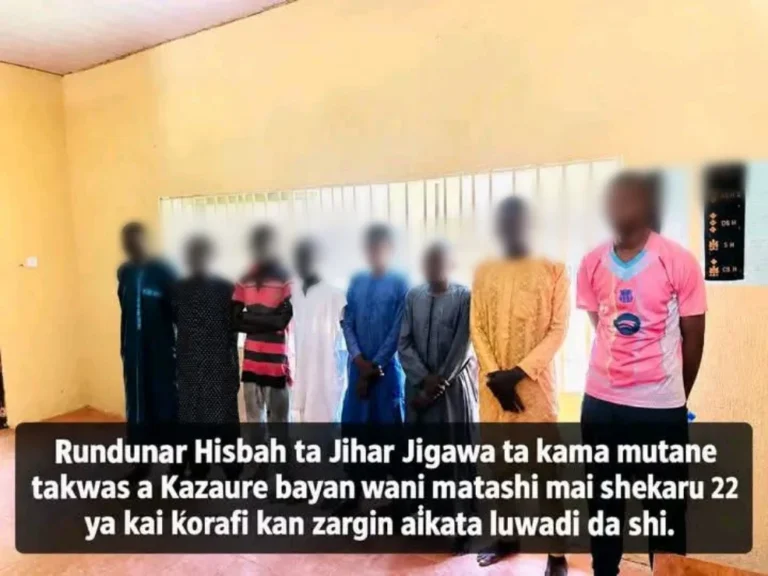
The Jigawa State Hisbah Board, the state’s Islamic law enforcement agency, has confirmed the arrest of eight individuals in the Kazaure Local Government Area following allegations of involvement in homosexual acts. The operation, which took place in late September 2026, was initiated after a 22-year-old man formally reported the alleged activities to the board, claiming that he had been coerced into multiple sexual encounters, which he subsequently blamed for his contraction of HIV.
The arrest has once again spotlighted the role of the Hisbah in Northern Nigeria, an agency tasked with enforcing Sharia law, which remains a significant legal and social force in several states across the region. As the investigation continues, the case has sparked renewed discussions regarding public health, legal jurisdiction, and the oversight of moral conduct in conservative Nigerian states.
Chronology of the Investigation
The investigation began following a formal complaint lodged by a 22-year-old resident of Kazaure. According to the Public Relations Officer of the Jigawa State Hisbah Board, Dauda Hadejia, the complainant provided authorities with a detailed account involving nine specific individuals. The complainant alleged that these encounters occurred over a period of time and expressed a desire for legal redress, citing both the deceptive nature of the interactions and the resulting impact on his health status.
Upon receiving the complaint, Hisbah operatives were mobilized to track the individuals named. In a statement released on Saturday, September 26, 2026, Hadejia confirmed that eight of the nine suspects had been successfully apprehended. During preliminary interrogations, the suspects reportedly admitted to the allegations brought against them. The board is currently pursuing the ninth individual, who remains at large, while simultaneously compiling a comprehensive dossier of evidence to be presented to the judicial authorities.
The Role and Mandate of the Hisbah Board
The Hisbah Board serves as a unique institution within the Nigerian legal landscape. Established under state legislation in several Northern Nigerian states, including Jigawa, Kano, and Bauchi, the agency is empowered to ensure compliance with Sharia law. While its mandate primarily focuses on moral policing—such as regulating the consumption of alcohol, overseeing dress codes, and mediating domestic disputes—it also operates as a quasi-judicial arm that collaborates closely with local police and traditional leadership.

In Jigawa State, the Hisbah has frequently intervened in matters concerning public morality. The board operates under the supervision of the state government, which provides funding and logistical support. The Deputy Commander-General of the Jigawa State Hisbah Board, Dr. Hussain Baban, has emphasized that the current arrests are part of a broader commitment to maintaining the social fabric of the state, urging parents and community leaders to play an active role in monitoring the behavioral patterns and social associations of the youth.
Legal and Human Rights Context
The legal framework surrounding same-sex relationships in Nigeria is defined by the Same-Sex Marriage (Prohibition) Act of 2013, which criminalizes the participation in, or support of, same-sex relationships. The law stipulates severe penalties for those convicted, including lengthy imprisonment. In states where Sharia law is concurrently practiced, such acts are also considered grave violations of religious and moral codes, leading to a dual layer of potential prosecution.
Critics of the Hisbah’s approach often point to the intersection of Sharia-based moral enforcement and constitutional human rights. While the Nigerian Constitution guarantees the right to privacy and freedom from discrimination, the application of Sharia law in the North creates a complex jurisdictional overlap. In cases involving public health concerns, such as the transmission of communicable diseases, the state often frames its intervention as a matter of public safety, attempting to bypass debates regarding individual liberty by focusing on the criminal aspects of the alleged conduct.
Public Health Implications
The complainant’s claim regarding the contraction of HIV highlights a critical, often overlooked aspect of public health in conservative regions: the stigma surrounding HIV/AIDS and its correlation with criminalized activities. Health experts often argue that when certain behaviors are heavily criminalized, individuals are less likely to seek medical testing or counseling for fear of legal repercussions.
By bringing the issue into the public domain through the Hisbah, the complainant has inadvertently triggered a conversation about the accessibility of sexual health services. In Jigawa, as in much of the region, the lack of anonymous or non-judgmental sexual health clinics remains a hurdle. If the state’s primary response to health-related grievances is punitive, there is a risk that marginalized groups will further retreat from public health initiatives, potentially increasing the prevalence of untreated infections within the community.
Official Responses and Community Impact
Dr. Hussain Baban, representing the Hisbah leadership, has utilized the incident as a platform to reiterate the board’s stance on social responsibility. The appeal to parents to be "more vigilant" is a recurring theme in the board’s public communications, reflecting a belief that moral decay is often a result of domestic oversight.

"We are committed to our mandate as defined by the laws of Jigawa State," Hadejia stated during the briefing. "The board is not merely an enforcement agency; we are stakeholders in the moral and social development of our state. We appreciate the cooperation of the Jigawa State Government, which enables us to function effectively."
The government’s support for the Hisbah is viewed by many as a reflection of the popular will in Northern Nigeria, where there is widespread support for religious-based legal frameworks. However, the international community and various civil society organizations continue to monitor these developments, raising concerns about due process, the rights of the accused, and the treatment of detainees in Hisbah facilities.
Analysis of Future Legal Proceedings
As the Jigawa State Hisbah Board prepares to transfer the suspects to the formal court system, several legal questions remain. First, the court will need to verify the admissibility of the evidence collected by the Hisbah, which operates differently from the standard Nigerian Police Force. The distinction between a "confession" obtained during preliminary Hisbah interrogation and one provided before a judge will be a focal point for the defense.
Furthermore, the outcome of this case could set a precedent for how future allegations of this nature are handled in Jigawa. If the court hands down a severe sentence, it may embolden the Hisbah to intensify its surveillance and enforcement operations. Conversely, any legal procedural challenges—such as questions regarding the legality of the initial arrest or the handling of evidence—could force a review of the board’s operational protocols.
Conclusion: A State in Transition
The arrest of eight individuals in Kazaure is emblematic of the broader tension between traditional, faith-based governance and the evolving social realities of modern Nigeria. The incident touches upon sensitive issues of public morality, healthcare, and the reach of state power. As the judicial process unfolds, the case will likely serve as a litmus test for the effectiveness and reach of the Hisbah in the current sociopolitical climate of Jigawa State.
The state government, having publicly supported the Hisbah’s efforts, is effectively tethering its administration to the success of these prosecutions. For the residents of Jigawa, the case serves as a stark reminder of the legal consequences of non-conformity, while for policymakers, it highlights the ongoing challenges of balancing religious mandates with the complexities of human rights and public health management in a diverse federal republic. The completion of the investigation and the subsequent court hearings are expected to dominate local discourse in the coming months, as the state seeks to conclude a case that has touched on deeply sensitive cultural and legal nerves.