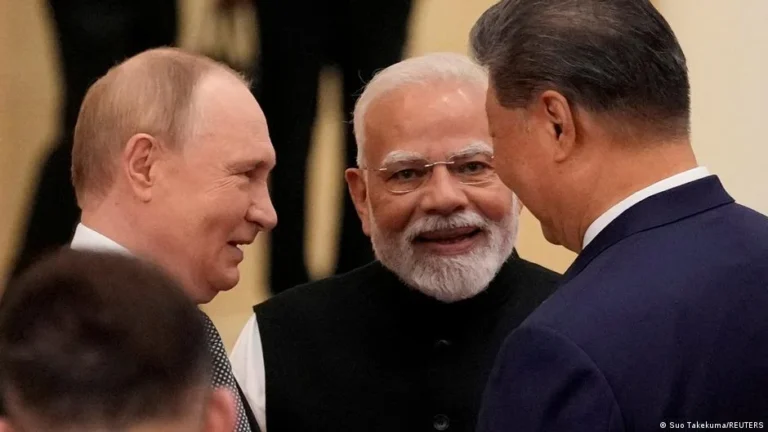
As the global geopolitical landscape undergoes a profound transformation, New Delhi prepares to host the 18th BRICS summit this weekend, marking a critical juncture for Indian diplomacy. Prime Minister Narendra Modi will welcome leaders from the bloc, most notably Chinese President Xi Jinping—marking the latter’s first visit to India since 2019—and Russian President Vladimir Putin. This gathering serves as the culmination of India’s year-long presidency of the group, a tenure defined by the intricate task of balancing competing national interests within an expanding coalition of eleven nations.
The summit arrives at a moment of acute sensitivity. With the international order increasingly polarized, India is attempting to navigate what analysts describe as an "America Plus" strategy, seeking to maintain its robust economic and strategic ties with the West while engaging with traditional partners like Russia and rivals like China. As the host, India faces the daunting challenge of ensuring the bloc remains a platform for the Global South’s economic empowerment rather than a vessel for anti-Western sentiment or Chinese geopolitical hegemony.
A Chronology of Diplomatic Engagements
The road to this weekend’s summit has been paved with intense diplomatic footwork. Following years of frozen high-level communication between New Delhi and Beijing, the 2024 border patrol agreement provided a necessary, if fragile, thaw.
- 2020–2024: A period characterized by a severe military standoff along the Line of Actual Control (LAC), resulting in stalled trade talks and heightened nationalist rhetoric.
- Late 2024: Formalization of a border de-escalation agreement, allowing for the gradual resumption of international flights, the reopening of the Kailash Mansarovar pilgrimage route, and a modest easing of visa restrictions for business travelers.
- August 31 – September 1, 2026: Prime Minister Modi engaged in side-line meetings with President Xi and President Putin during the Shanghai Cooperation Organisation (SCO) summit in Bishkek, Kyrgyzstan. These meetings served as the final preparatory groundwork for the current BRICS summit.
- September 2026: The 18th BRICS Summit in New Delhi, featuring the first state-level visit of the Chinese leadership to India in seven years.
Economic Realities and the Trade Deficit
While diplomatic protocols remain the focus of public optics, the underlying economic reality is stark. India currently faces a trade deficit with China exceeding $112 billion. This fiscal imbalance remains a primary friction point. Indian industry leaders and government officials have repeatedly signaled that sustainable progress in bilateral relations is contingent upon improved market access for Indian goods, particularly in the pharmaceutical, agricultural, and information technology sectors.
During the summit, experts anticipate that India will push for a framework that prioritizes "resilience" in supply chains. By advocating for increased use of national currencies in cross-border trade—a move intended to lower transaction costs and reduce dependency on the US dollar—India is attempting to satisfy the bloc’s desire for financial sovereignty without triggering a formal de-dollarization conflict with Washington.
The Challenge of Internal Cohesion
The expansion of BRICS from its original five members (Brazil, Russia, India, China, and South Africa) to its current 11-member iteration has introduced significant complexities. The inclusion of Iran and the United Arab Emirates, in particular, has highlighted the ideological fault lines within the group.
Earlier this year, the failure of BRICS foreign ministers to issue a unified statement regarding the ongoing crisis in the Middle East necessitated a unilateral chair’s statement from India. This episode served as a microcosm of the group’s internal struggles. With the attendance of Iranian President Masoud Pezeshkian, observers expect the Delhi summit to be a litmus test for the bloc’s ability to maintain a veneer of consensus when the interests of its members are fundamentally at odds.

Harsh Pant, vice president for Studies and Foreign Policy at the Observer Research Foundation, notes that the efficacy of the group is being strained by its own growth. "BRICS is increasingly becoming a forum where members share a desire for reformed global governance, but struggle to agree on the fundamental nature of the international order," Pant stated. He suggests that while consensus on IMF or World Bank reform is achievable, the group’s ability to act as a cohesive security or political bloc is diminishing.
Strategic Autonomy: The ‘America Plus’ Doctrine
India’s foreign policy framework, as articulated by scholars like Professor C. Raja Mohan, has moved beyond the traditional concept of "non-alignment." The current "America Plus" strategy acknowledges that India’s growth trajectory is inextricably linked to Western capital, technology, and security partnerships. Simultaneously, New Delhi views its membership in BRICS and the SCO as vital for maintaining strategic autonomy—ensuring that India is not locked into a single geopolitical orbit.
However, this balancing act is growing more precarious. The risk, as outlined by geopolitical analysts, is that a rapprochement between Washington and Beijing could leave India isolated, or conversely, that a deepening alliance between Moscow and Beijing could force India into a position where it must explicitly choose between its Western partners and its BRICS commitments.
Future Implications for Global Governance
As the Delhi summit concludes, the world will be watching for signals regarding the future of the bloc. The primary question is whether India can successfully steer BRICS toward a focus on the developmental needs of the Global South—such as sustainable energy transitions, digital infrastructure, and debt sustainability—or if the bloc will succumb to internal competition.
For Prime Minister Modi, the successful management of this summit is a matter of prestige and pragmatic necessity. India needs a stable relationship with China to allow for domestic economic growth, but it must achieve this without compromising its territorial integrity or its long-term strategic alignment with the West. The "armed coexistence" between New Delhi and Beijing will likely remain the defining feature of this relationship for the foreseeable future.
In the final assessment, the 18th BRICS summit is unlikely to produce a radical shift in the global order. Instead, it is expected to function as a pressure-relief valve for a group of nations that, while increasingly influential, remain divided by history, geography, and ideological ambition. If India can leverage its presidency to move the group toward functional, issue-based cooperation rather than inflammatory, anti-Western rhetoric, it will have achieved a significant diplomatic success that stabilizes its position in a volatile, multipolar world.
The event, which is expected to draw hundreds of international delegates and media representatives, will be heavily monitored by intelligence agencies and policy think tanks globally. The outcomes of the side-line bilateral meetings—particularly between New Delhi and Beijing—will set the tone for the G20 and other multilateral forums in the coming months. For now, the world waits to see if the "elephant and the dragon" can find a path that avoids collision, providing a template for how major powers might coexist in an era of intensifying, managed competition.