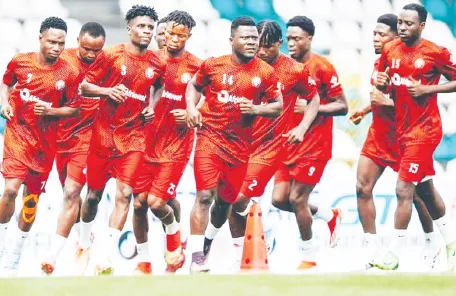
Nigerian Professional Football League heavyweights Enugu Rangers secured their passage to the second qualifying round of the prestigious CAF Champions League following a nerve-wracking penalty shootout victory over Beninese outfit AS Sobemap. The decisive encounter, held in Lomé, Togo, due to infrastructure limitations in Benin Republic, ended 1-1 on the day and 2-2 on aggregate, before the Nigerian side triumphed 5-4 from the spot. This hard-fought qualification keeps alive the dreams of the Enugu-based club to replicate the historic continental success last achieved by a Nigerian team two decades ago.
The fixture underscored the unpredictable and tense nature of early-round continental football, where tactical discipline, mental fortitude, and composure under pressure often outweigh sheer technical superiority. For Enugu Rangers, affectionately known as the Flying Antelopes, the victory represents a critical step forward in their quest to restore Nigerian dominance on the African club football landscape. Meanwhile, in another gripping fixture of the weekend, Rwandan champions APR staged a brilliant comeback in Kigali, overturning a first-leg deficit to eliminate the Democratic Republic of Congo’s Aigles du Congo with a commanding 3-0 victory.
Main Facts and Match Overview
The dramatic showdown between Enugu Rangers and AS Sobemap delivered high drama from start to finish. Having held a slender advantage or fought from behind across the two legs, neither side could decisively separate themselves during regulation time in Togo. The neutral venue played host to a tactical battle that saw both teams trade goals before deadlocking on aggregate.
In the return leg of the first round, Enugu Rangers broke the deadlock midway through the first half when Chidozie Iwundu capitalized on a defensive lapse to slot home, putting the Nigerian side ahead and seemingly in control of the tie. However, AS Sobemap, making their debut appearance on the continental stage, demonstrated immense resilience. Mid-way through the second period, Emmanuel Ali drew the Beninese side level, capitalizing on a loose ball in the box to beat the Rangers goalkeeper and restore parity on the night.
With the aggregate score locked at 2-2 after 180 minutes of competitive football, the match proceeded straight to a penalty shootout without extra time, in accordance with tournament regulations for preliminary rounds where travel and scheduling constraints are prioritized. The tension inside the stadium was palpable as players stepped up to take their kicks. Drama ensued immediately when Enugu Rangers missed their very first spot-kick, putting them on the back foot. However, the Nigerian side displayed remarkable psychological recovery, converting their next five consecutive penalties. AS Sobemap, despite their commendable debut run, cracked under the pressure, missing both their third and sixth kicks to hand Rangers the 5-4 victory and a ticket to the next phase.
Chronology of the CAF Champions League Preliminary Rounds
The path to the group stage of the CAF Champions League is fraught with challenges for clubs from across the African continent. Understanding the chronology of these preliminary fixtures highlights the physical and logistical demands placed on the competing teams.
The journey for the 2024/2025 CAF Champions League preliminary rounds commenced in mid-August with the first-leg encounters. Enugu Rangers traveled to face AS Sobemap. Because Benin Republic currently lacks a stadium approved by the Confederation of African Football (CAF) to host international-standard matches, the Beninese club was forced to look outside its borders for a home venue. This logistical hurdle is increasingly common in African football, where infrastructural deficits frequently strip clubs of traditional home-court advantages.
The first leg yielded a tightly contested affair, ending in a scoreline that left the tie delicately balanced and forcing both teams to throw caution to the wind for the second leg. Shifting the return fixture to Lomé, Togo, added another layer of complexity, transforming what should have been a home game for Sobemap into a truly neutral encounter.
Following the conclusion of the second leg on Friday, the timeline shifts rapidly toward the final qualifying round. Scheduled to take place in October, this upcoming phase represents the ultimate barrier between the preliminary survivors and the lucrative, highly coveted group stage of the tournament. Enugu Rangers will now turn their immediate attention to recovery, domestic preparations, and scouting their next opponents, who will emerge from the tie between Algerian powerhouse Mouloudia Alger and Niger’s Nigelec.
Supporting Data and Comparative Analysis
A deeper examination of the statistics surrounding Nigerian clubs in the CAF Champions League reveals a glaring drought that weighs heavily on the nation’s football faithful. The last time a Nigerian club lifted the coveted African Champions League trophy was in 2004, when Enyimba International of Aba successfully defended the title they had won the previous year in 2003. Since then, despite numerous attempts by elite Nigerian Professional Football League (NPFL) sides, the ultimate prize has remained elusive, often slipping away due to financial constraints, early-round tactical naivety, or the immense financial muscle of North and South African football powerhouses.
Enugu Rangers’ victory keeps alive the institutional ambition to break this 20-year jinx. Historically, Enugu Rangers are one of Nigeria’s most storied clubs, boasting a rich tradition of domestic success and continental participation. However, modern African club football is heavily dominated by clubs from North Africa (such as Al Ahly, Zamalek, and Esperance) and select East and South African powerhouses that benefit from stable corporate funding and superior infrastructure.
In parallel, the performance of Rwandan side APR against DR Congo’s Aigles highlights the shifting competitive balance in East Africa. Trailing 1-0 from the first leg, APR utilized home advantage in Kigali to orchestrate a comprehensive 3-0 turnaround. Burkinabe forward Djibril Ouattara was the star of the show, bagging a brace that included a crucial opening goal in the 32nd minute and a calmly converted 75th-minute penalty. Sandwiched between Ouattara’s strikes was a 58th-minute goal by Christian Ishimwe. This statistical dominance over two legs sends a strong warning to their prospective opponents in the next round, five-time African champions Zamalek of Egypt.
Official Responses and Tactical Implications
While formal post-match press conferences often yield diplomatic platitudes, the underlying reactions from the technical crews and club management reflect a mixture of immense relief and acute awareness of the challenges ahead. Insiders close to the Enugu Rangers camp acknowledged that escaping the fixture with a win was more about character than tactical brilliance. Surviving a penalty shootout after missing the opening kick requires an extraordinary level of mental toughness—a quality that coaching staffs value immensely in knockout competitions.
Tactical analysts observing the match noted critical vulnerabilities that Enugu Rangers must address before their October showdowns. The inability to protect leads in both legs—culminating in Emmanuel Ali’s equalizer for Sobemap—points to defensive frailties during transitions and lapses in concentration during the latter stages of halves. Against more sophisticated opponents in the final qualifying round, such as Mouloudia Alger or Nigelec, similar defensive lapses could prove fatal.
Furthermore, the physical toll of a high-intensity match decided by sudden-death penalties cannot be understated. The Rangers squad will require careful medical management and load monitoring as they balance their continental ambitions with the demands of the domestic league season. The technical crew is expected to utilize the intervening weeks to refine their defensive shape, improve midfield ball retention, and sharpen their clinical execution in the final third.
Broader Impact and Implications for Nigerian Football
The stakes of the CAF Champions League extend far beyond club prestige; they have profound implications for the collective coefficient of Nigerian club football and the economic viability of the domestic league. Success in Africa enhances the global marketability of NPFL players, elevates the financial standing of participating clubs through CAF prize money, and restores national pride.
For decades, the NPFL has struggled with structural challenges, including inadequate broadcasting revenues, inconsistent refereeing standards, and financial instability among club owners. A deep run by Enugu Rangers in Africa’s premier club competition could serve as a vital catalyst, drawing increased corporate sponsorship and media attention back to the domestic game. It proves that despite systemic hurdles, Nigerian clubs retain the raw talent and competitive pedigree to compete among the continent’s elite.
However, the narrow margin by which Enugu Rangers scraped past AS Sobemap serves as a sobering reminder of the narrowing gap between traditional football powerhouses and emerging nations in African football. Football development across the continent has accelerated rapidly, with smaller nations investing heavily in youth structures and tactical organization. Teams like AS Sobemap, despite domestic infrastructural limitations, can no longer be taken lightly.
As Enugu Rangers prepare for the final qualifying round in October, the entire Nigerian football fraternity will be watching closely. Whether the Flying Antelopes can channel the spirit of Enyimba’s 2004 vintage and navigate the treacherous waters ahead remains one of the most compelling storylines of the current African football season. For now, the immediate focus shifts to recovery, tactical recalibration, and the rigorous preparation required to conquer the next hurdle on the road to continental glory.