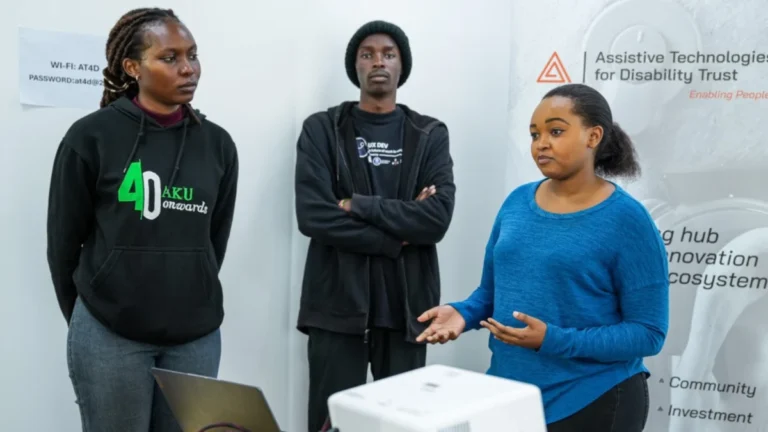
The Kenya-based accelerator Innovate Now has officially announced the selection of 19 startups for its latest program, marking the largest cohort in the organization’s history and signaling a significant expansion in the development of assistive technologies (AT) across the African continent. This latest initiative, implemented by the Assistive Technologies for Disability Trust (AT4D), represents a strategic doubling down on a unique "Live Labs" development model that prioritizes the lived experiences of persons with disabilities in the creation of hardware and software solutions. By embedding end-users directly into the research and development phase, the accelerator aims to bridge the gap between high-tech innovation and the practical, often harsh, realities of accessibility in emerging markets.
The selected startups represent a diverse cross-section of the assistive technology sector, with a heavy emphasis on speech therapy, mobility enhancement, inclusive education, and caregiver support. These sectors are currently experiencing a surge in demand as awareness of disability rights grows across Africa, yet they remain underserved by a market where locally adapted solutions are historically scarce. The inclusion of 19 distinct ventures underscores a growing maturity in the regional startup ecosystem, moving beyond general fintech and e-commerce toward specialized, impact-driven engineering and artificial intelligence.
The Assistive Technology Gap in Africa
To understand the significance of this cohort, one must look at the broader continental context. According to data from the World Health Organization (WHO) and UNICEF, an estimated 200 million people across Africa require at least one form of assistive product to lead productive and independent lives. However, access remains a luxury for the few. In many sub-Saharan African nations, only 5% to 15% of those in need have access to the devices they require. This disparity is driven by a trifecta of challenges: prohibitive costs, lack of localized manufacturing, and design flaws that ignore the environmental realities of the continent.
Historically, the majority of assistive devices available in African markets have been imported from Europe, North America, or East Asia. While these products are often high-quality, they frequently fail to account for local infrastructure—such as unpaved roads for wheelchairs—or the lack of specialized maintenance technicians. Furthermore, many digital tools are designed for English or other European languages, neglecting the linguistic diversity of African populations. By fostering a local ecosystem of innovators, Innovate Now is attempting to dismantle these barriers, ensuring that the next generation of AT is "made in Africa, for Africa."
The Live Labs Model: Co-Creation as a Requirement
At the heart of the Innovate Now methodology is the "Live Labs" concept. Unlike traditional tech accelerators that may focus primarily on business scaling and venture capital readiness, Innovate Now demands that persons with disabilities be central to the product design process from day one. This approach addresses a systemic issue in the global AT industry where products are frequently designed "for" persons with disabilities rather than "with" them.
In the Live Labs environment, persons with disabilities act as co-creators rather than mere subjects of study. They test early-stage prototypes, flag usability issues that engineers might overlook, and provide feedback on cultural relevance. Bernard Chiira, the founder of AT4D, emphasizes that this inclusive design is not a philanthropic gesture but a fundamental business requirement. According to Chiira, building with persons with disabilities at the center ensures that the resulting solutions are not only innovative but are also truly relevant, accessible, and affordable for the end-user. This methodology significantly reduces the risk of market failure by ensuring product-market fit long before a commercial launch.
Chronology of the Selection: From Hackathon to Incubation
The path to selecting this record-breaking cohort involved a rigorous multi-stage process that combined open calls for existing startups with intensive "from-scratch" co-creation events. A pivotal moment in this timeline was the 72-hour "AI for Accessibility" hackathon held from March 5 to 7. This event brought together a diverse group of stakeholders, including software developers, university students, and persons with disabilities, tasked with leveraging artificial intelligence to solve specific accessibility challenges.
The hackathon served as a high-pressure environment for rapid prototyping. Over the course of three days, participants moved from problem identification to functional demos. Out of the numerous ideas pitched during the event, fifteen projects emerged as viable contenders. Following a vetting process by a panel of technical and disability experts, ten of these hackathon-born projects were selected to progress into the formal incubation phase. These ten projects joined nine established startups that were selected through a separate, competitive open call, culminating in the final cohort of 19.
Case Study in Impact: The Rise of Chacha
One of the standout participants from the March hackathon is Chacha, a Kenyan AI-powered platform specifically designed to address the shortage of speech and language therapy services. In many African countries, the ratio of speech-language pathologists to the general population is alarmingly low—sometimes as few as one therapist for every several million people. This leaves parents of children with speech impairments with few options, often resulting in children falling behind in education and social integration.
Chacha targets children between the ages of 0 and 8 with mild speech impairments. The platform provides real-time feedback and guided exercises through a mobile interface, allowing for consistent practice at home. Peninah Gituku, the founder of Chacha, noted that the co-creation process during the Innovate Now hackathon was transformative for the product’s direction. By consulting directly with caregivers, the development team realized that the primary barrier was not just a lack of exercises, but the daily frustration and time constraints faced by families.
"Caregivers helped us see where frustration actually lives in daily routines," Gituku explained. This insight led the team to design a tool that supports, rather than attempts to replace, formal therapy, making it a viable supplement for families who can only afford occasional professional visits. This user-led pivot is a hallmark of the Innovate Now philosophy, ensuring that the technology fits into the user’s life rather than forcing the user to adapt to the technology.
Strategic Partnerships and the Eight-Month Roadmap
The 19 startups are now embarking on an intensive eight-month incubation phase designed to move them from prototype to market readiness. This phase is characterized by a blend of technical mentorship, business coaching, and continued user testing. A key partner in this journey is Kilimanjaro Blind Trust Africa (KBTA), an organization with deep roots in disability advocacy and service delivery across the region. KBTA provides the startups with access to a broad network of users for testing and validation, ensuring that the products remain grounded in reality.
The curriculum for the incubation phase covers essential business pillars, including:
- Technical Refinement: Leveraging AI and hardware engineering to improve product performance.
- Regulatory Compliance: Navigating the complex landscape of medical device and accessibility standards in various African jurisdictions.
- Sustainable Business Modeling: Developing pricing structures that remain affordable for low-income users while ensuring the long-term viability of the startup.
- Investor Readiness: Preparing founders to pitch to social impact investors and venture capitalists who are increasingly looking at the "S" (Social) in ESG (Environmental, Social, and Governance) investing.
Historical Success and Economic Implications
Since its inception in 2019, Innovate Now has established itself as a cornerstone of the African AT ecosystem. The accelerator has supported a total of 88 assistive technology ventures and engaged more than 200 founders across 10 cohorts. The impact of these efforts is measurable: to date, the program’s alumni have collectively reached over 40,000 users.
Furthermore, the commercial viability of these ventures is proving to be robust. Approximately 40% of the startups that have passed through the program have successfully brought their products to market, a high success rate for the notoriously difficult AT sector. Additionally, 38% of alumni have secured follow-on funding through a mix of grants, awards, and private investment.
From an economic perspective, the work being done by Innovate Now has profound implications. Research by ATscale, the Global Partnership for Assistive Technology, suggests that for every $1 invested in assistive technology, there is a $9 return through improved educational outcomes, increased workforce participation, and reduced healthcare costs. By enabling persons with disabilities to participate more fully in the economy, these 19 startups are not just providing tools for individuals; they are contributing to the broader macroeconomic growth of the region.
Broader Impact and the Future of Inclusive Innovation
The unveiling of this cohort comes at a time when the global tech industry is increasingly focused on the role of artificial intelligence in social good. The "AI for Accessibility" theme of the recent hackathon reflects a global trend where machine learning is being used to provide vision for the blind, text-to-speech for the non-verbal, and predictive maintenance for prosthetic limbs.
However, the Innovate Now model suggests that the true power of AI lies in its democratization. When local developers in Nairobi or Mombasa use AI to solve local problems, they create a form of "digital sovereignty" that reduces dependence on expensive foreign solutions. For users like Mary, a caregiver who participated in the program, the impact is personal. She noted that being asked about her day-to-day reality before a single line of code was written made her feel "seen and heard," a sentiment that is often missing in the traditional medical-industrial complex.
As these 19 startups move through their incubation period, the eyes of the African tech community will be on them. Their success will likely serve as a blueprint for other specialized accelerators across the continent, proving that inclusive design is not just a moral imperative, but a powerful engine for innovation and economic resilience. The journey from a 72-hour hackathon to a market-ready product is long and fraught with challenges, but with the support of AT4D, KBTA, and the Live Labs model, these innovators are well-positioned to redefine what is possible for millions of people across Africa.