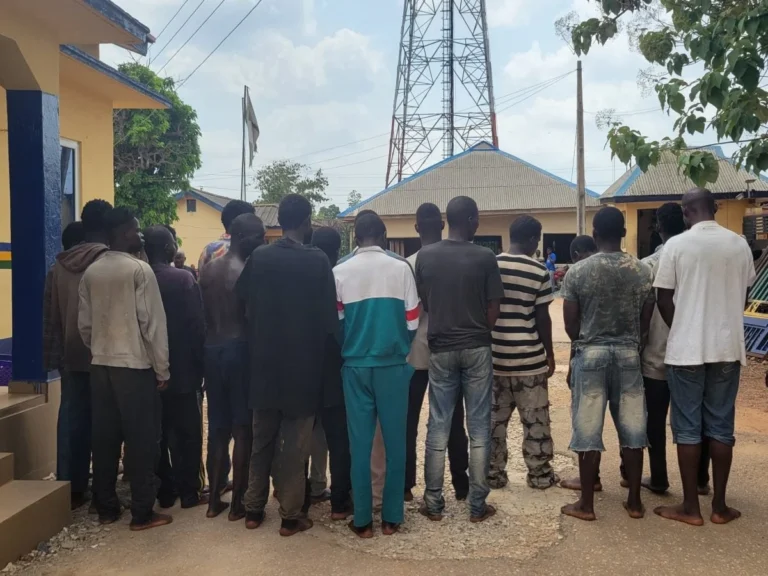
In a decisive move to restore law and order, the Ogun State Police Command, on Tuesday, paraded 146 suspects in connection with a violent protest that rocked Sagamu, a major town in the state, including a reprehensible attack on a health facility. The arrests underscore the authorities’ firm stance against civil unrest that compromises public safety and access to essential services.
Details of the Unrest: A Breach of Public Order
The protests, which reportedly escalated into a widespread disruption, saw a significant number of individuals, primarily commercial motorcycle riders often referred to as ‘Okada’ operators, block major thoroughfares, notably Oba Erinwole GRA Road. This action severely impeded the freedom of movement for residents and motorists alike, bringing daily activities to a standstill. More alarmingly, the unrest culminated in an attack on a local hospital, a critical institution providing healthcare to the community.
Deputy Superintendent of Police Oluseyi Babaseyi, the Police Public Relations Officer (PPRO) for the Ogun State Command, addressed journalists at the Sagamu Divisional Police Headquarters, where the suspects were paraded. He was flanked by key law enforcement figures, including the Divisional Police Officer (DPO) for Sagamu, CSP Fred Ode, his second-in-command, CSP Markus Wantana, and the Vice Chairman of Sagamu Local Government Area, Isiaka Salami, highlighting the collaborative approach to managing the crisis.
DSP Babaseyi unequivocally condemned the actions of the protesters, describing the assault on the healthcare facility as "unlawful and unacceptable." He emphasized the sanctity of medical institutions and the profound ethical breach of denying patients access to vital healthcare. "The men who carried out the unlawful assembly and protest attacked the health centre. If you have a protest, what do medical personnel have to do with your grievances? What does a sick person in the sick bay have to do with your protest?" he questioned, stressing the irrationality and inhumanity of such actions. He reiterated that established channels for expressing grievances exist, urging citizens to engage with appropriate authorities rather than resorting to self-help and violence that victimize innocent citizens.
The Joint Security Operation: A Coordinated Response
In response to the escalating violence and the attack on public infrastructure, a comprehensive, intelligence-led raid was executed on Monday morning, targeting known criminal hideouts and flashpoints within Sagamu. This large-scale operation was a testament to inter-agency cooperation, involving the Nigeria Police Force, the Nigerian military, the Nigeria Security and Civil Defence Corps (NSCDC), the Amotekun Corps, the Ogun State Community Security (So-Safe) Corps, and the Vigilante Group of Nigeria (VGN). This unified front demonstrated the collective resolve of security agencies to quash lawlessness and restore peace.
The PPRO confirmed the operation’s significant success, leading to the apprehension of 146 suspects. He further disclosed that 10 principal suspects, identified as instigators or key participants in the violent acts, had already been swiftly charged to court. The remaining suspects are undergoing rigorous screening processes, and those found culpable will be transferred to the State Criminal Investigation Department (SCID) in Abeokuta for thorough investigation and subsequent prosecution in accordance with the law. This two-tiered approach signifies both immediate action against key offenders and meticulous investigation for others involved.
Chronology of Events: From Grievance to Confrontation
The events leading to the mass arrests unfolded rapidly, though the underlying tensions may have simmered for longer. While the specific trigger for this particular protest was not explicitly detailed, such demonstrations by commercial motorcyclists in various Nigerian cities often stem from issues such as increased levies, operational restrictions, fuel price hikes, or perceived harassment by law enforcement and local government officials.
- Pre-Protest Period: Unspecified grievances likely accumulated among a segment of commercial motorcyclists in Sagamu.
- Day of Protest (Likely Early Monday): The protest began, with participants blocking Oba Erinwole GRA Road and other strategic points, causing significant traffic disruption and inconveniencing residents.
- Escalation to Violence: The protest quickly devolved into lawlessness, marked by the attack on a health facility. This act crossed a critical line, shifting the nature of the demonstration from a grievance expression to outright criminality, endangering lives and vital services.
- Security Mobilization: Following reports of the escalating violence and the attack on the hospital, security agencies, recognizing the gravity of the situation, swiftly activated a joint operational plan.
- Intelligence-Led Raid (Monday Morning): Based on intelligence gathered, the multi-agency task force launched coordinated raids on identified hotspots and hideouts associated with the protesters.
- Mass Arrests (Monday): The raid resulted in the apprehension of 146 individuals suspected of involvement in the unrest.
- Identification and Charging of Principal Suspects (Monday/Tuesday): Ten key individuals deemed most culpable were identified and promptly charged to court.
- Parade of Suspects (Tuesday): The remaining 146 suspects were paraded before the media, signifying the transparency and accountability of the police operation.
- Ongoing Screening and Investigation (Post-Parade): The screening process commenced for all arrested individuals, with plans to transfer culpable ones to SCID Abeokuta for further investigation and prosecution.
The Genesis of Discontent: Understanding Sagamu’s Socio-Economic Landscape
Sagamu, a bustling commercial and industrial town in Ogun State, serves as a significant hub within the South-Western region of Nigeria. Its strategic location often makes it a focal point for economic activities, but also for socio-economic challenges common across the country. The commercial motorcycle sector ("Okada") plays a vital role in urban transportation, especially in areas with inadequate public transport infrastructure. However, it is also a sector often characterized by a large, informal workforce, many of whom are young, and who can be susceptible to mobilization for protests, sometimes turning violent.
The grievances that ignite such protests are multifaceted. Economic hardship, high unemployment rates, and the cost of living crisis often exacerbate feelings of frustration among this demographic. When these economic pressures combine with perceived injustices, such as arbitrary taxation, extortion, or harsh enforcement of regulations, the potential for unrest increases significantly. While the immediate trigger for the Sagamu incident is not fully detailed, it likely stems from a confluence of these underlying socio-economic factors, exploited by individuals who then incited violence.
Impact on Healthcare: A Critical Blow to Vulnerable Patients

The attack on a health facility during a period of civil unrest carries profound and disturbing implications. In a country like Nigeria, where healthcare infrastructure is often stretched thin and access to medical services can be a challenge even in peaceful times, any disruption or damage to a hospital is a severe blow to public welfare. Such attacks not only endanger the lives of patients already receiving care but also deter others from seeking urgent medical attention.
Patients requiring emergency care, pregnant women, the elderly, and those with chronic illnesses are particularly vulnerable when healthcare access is denied. The psychological trauma inflicted on medical staff, who are dedicated to saving lives, cannot be overstated. An environment where medical personnel fear for their safety is an environment where the fundamental right to health is undermined. This incident in Sagamu serves as a stark reminder of the critical importance of protecting healthcare facilities as neutral, life-saving zones, even amidst societal strife.
Official Condemnations and Calls for Order
Beyond the Police PPRO’s strong condemnation, other stakeholders have voiced their concerns.
- Local Government: Isiaka Salami, the Vice Chairman of Sagamu Local Government Area, while present at the parade, would likely have echoed the police’s call for order and condemned the violence. Local government authorities are often on the front lines of addressing community grievances and would emphasize the need for constructive dialogue over destructive protests. They would likely reassure residents of their commitment to peace and support for law enforcement efforts to ensure security.
- Healthcare Professionals (Inferred): Medical associations and healthcare workers’ unions would undoubtedly condemn the attack on the hospital in the strongest terms. They would likely call for greater protection for healthcare facilities and personnel, advocating for the sanctity of medical spaces and stressing that violence against hospitals is an attack on the entire community’s well-being.
- Community Leaders and Elders (Inferred): Respected community leaders and traditional rulers in Sagamu would likely issue calls for calm, urging residents to embrace peace and cooperate with law enforcement. They would also likely emphasize the importance of identifying and addressing the root causes of grievances through peaceful means, possibly offering to mediate between various groups and the authorities.
- Transport Unions (Inferred): While the suspects were largely commercial motorcyclists, responsible transport union leaders would typically distance their organizations from acts of violence. They would likely condemn the destruction of property and attack on healthcare facilities, while perhaps also appealing for their members’ legitimate concerns to be heard through appropriate channels, emphasizing that violence is counterproductive.
The Legal Process: Ensuring Justice and Accountability
The progression from arrest to prosecution is a critical component of upholding the rule of law. The screening process mentioned by DSP Babaseyi is crucial for separating the genuinely culpable from those who might have been caught up in the dragnet or are innocent bystanders. This process involves verifying identities, cross-referencing with intelligence, and taking statements.
Once individuals are transferred to the State Criminal Investigation Department (SCID) in Abeokuta, detectives will conduct in-depth investigations. This includes gathering forensic evidence, interviewing witnesses, and compiling charge sheets. The swift charging of the 10 principal suspects indicates the police’s intent to expedite justice for those deemed most responsible for the violence. For the remaining suspects, the legal framework demands that they are either released if no evidence links them to the crimes or formally charged and brought before a court of competent jurisdiction. This adherence to due process is essential for maintaining public trust in the justice system.
Broader Implications: Upholding the Rule of Law and Public Trust
The Sagamu incident carries several broader implications for public safety, governance, and community relations in Ogun State and Nigeria at large.
- Rule of Law: The decisive action by the joint security forces reinforces the principle that no individual or group is above the law. Resorting to violence, especially targeting essential services, will be met with the full force of the state. This is crucial for maintaining social order and deterring future acts of lawlessness.
- Public Safety and Security: Such violent protests erode public confidence in security and disrupt daily life. The coordinated response by multiple agencies signals a commitment to ensuring the safety and security of citizens, which is fundamental for any functioning society.
- Economic Impact: Beyond the immediate disruption, prolonged unrest can deter investment, harm local businesses, and negatively impact the state’s economy. The damage to property and the interruption of economic activities contribute to a cycle of poverty and instability.
- Healthcare Access: The attack on a hospital highlights the vulnerability of critical infrastructure during civil disturbances. It underscores the urgent need for robust protection mechanisms for healthcare facilities and a societal understanding of their inviolable status.
- Police-Community Relations: While the arrests demonstrate enforcement, effective policing also involves community engagement and dialogue. Addressing the root causes of grievances through legitimate channels can prevent future escalations. The local government’s involvement alongside the police indicates an attempt at a more holistic approach.
- Preventive Measures: This incident serves as a call for proactive governance. Governments at all levels need to establish effective communication channels, listen to citizens’ grievances, and implement policies that address socio-economic challenges, thereby reducing the impetus for violent protests.
Community Reactions and Way Forward
The Sagamu community is likely to experience a mix of relief and lingering apprehension. Relief that law and order are being restored, but apprehension over the underlying issues that sparked the unrest. Civil society organizations and non-governmental bodies often play a crucial role in post-crisis reconciliation. They can facilitate dialogue between community members, aggrieved groups, and the authorities, helping to bridge divides and foster understanding.
Moving forward, a multi-pronged approach is essential. This includes continued security vigilance, fair and transparent judicial processes for the arrested suspects, and, critically, a concerted effort by the local and state governments to engage with community stakeholders, including commercial motorcyclist associations, to understand and address their legitimate concerns. Investing in social welfare programs, youth empowerment initiatives, and improving public transport infrastructure can also help mitigate the conditions that often fuel such discontent.
Conclusion: A Commitment to Peace and Stability
The arrests of 146 suspects in Sagamu following the violent protests and attack on a health facility send a clear message: lawlessness will not be tolerated. The Ogun State Police Command, in collaboration with other security agencies, has demonstrated its capacity and resolve to protect lives and property, and to ensure that essential services remain accessible. As investigations continue and the legal process unfolds, the focus remains on upholding the rule of law, ensuring justice for victims, and fostering an environment of peace and stability for all residents of Sagamu and Ogun State. The incident serves as a poignant reminder of the delicate balance between the right to protest and the imperative to maintain public order and safeguard community well-being.