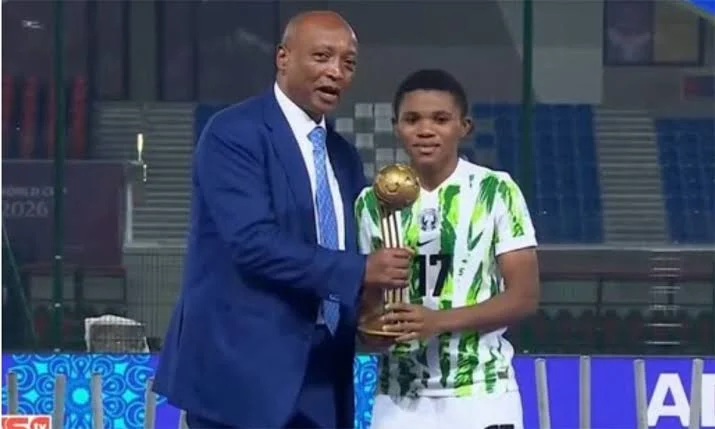
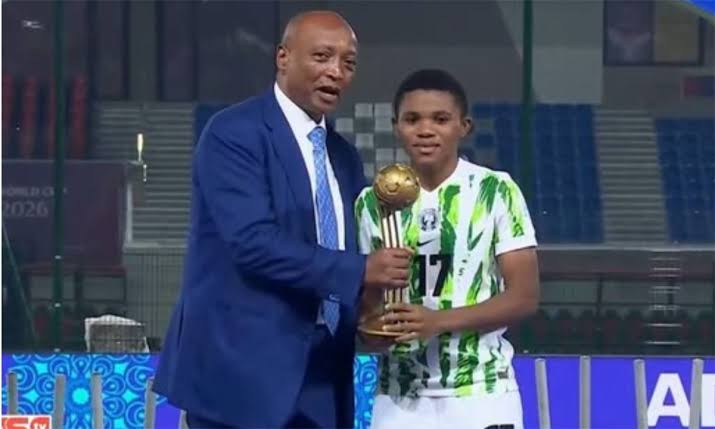
The 2026 FIFA U-17 Women’s World Cup in Morocco has concluded with a seismic shift in the global football hierarchy, as Nigeria’s Flamingos ascended to the pinnacle of youth football for the first time in their history. The tournament, which captivated audiences across the globe, culminated in a dramatic 2-1 victory for the West African side over Japan in the final held in Rabat. At the heart of this triumph was Nigeria’s talismanic forward, Oluebube Umejiaku, whose individual brilliance earned her the tournament’s most coveted individual honor: the adidas Golden Ball.
A Historic Run to Glory
The path to the final for Nigeria was paved with tactical discipline, physical resilience, and clinical attacking displays. Entering the tournament as one of the dark horses, the Flamingos quickly signaled their intent with a series of high-energy performances that neutralized seasoned opponents. Throughout the group stages and the knockout rounds, the team demonstrated a level of cohesion rarely seen in youth football.
For Umejiaku, the tournament served as a coming-of-age narrative. While her overall contribution to the team’s defensive transitions and playmaking was immense, it was her goalscoring prowess that ultimately propelled the team to the trophy. She finished the tournament with four goals, including the decisive strike in the final against a formidable Japanese side that had been considered the tournament favorites.
The final match itself was a testament to the growth of African women’s football. Facing Japan, a nation renowned for technical precision and tactical maturity, Nigeria adopted a high-press strategy that forced early errors. Umejiaku’s goal, which broke the deadlock and eventually secured the victory, was the culmination of a tournament-long display of composure under pressure. By the time the final whistle blew at the Rabat stadium, it was clear that Nigeria had not only won the match but had firmly established a new standard for development in the U-17 category.
The Breakdown of Individual Honors
While Umejiaku claimed the top individual prize, the tournament was characterized by an extraordinary level of talent across all participating nations. FIFA’s technical study group, which evaluates players based on their influence on the game, defensive contributions, and technical output, recognized a diverse group of athletes for their outstanding contributions.
The Silver Ball was awarded to DPR Korea’s Yu Jong-hyang, whose creative input and ability to dictate the tempo of play were pivotal to her team’s success. The Bronze Ball went to Japan’s Fuki Ito, who was consistently recognized for her spatial awareness and tactical versatility in midfield.
In the pursuit of the adidas Golden Boot, the tournament witnessed a staggering performance by United States forward Maddie DiMaria. With 12 goals, DiMaria set a new benchmark for offensive productivity in a single U-17 tournament, dwarfing the contributions of her peers. Her clinical efficiency in front of goal was the primary reason the United States remained competitive throughout the early rounds. Yu Jong-hyang and Ri Ui-gyong of DPR Korea followed in the rankings, securing the Silver and Bronze Boots, respectively, confirming the strength of the Asian developmental system.
The defensive side of the game was equally represented, with DPR Korea goalkeeper Kim Son-gyong receiving the adidas Golden Glove. Her ability to command her penalty area, combined with a high percentage of saves in critical moments, made her the standout shot-stopper of the 2026 edition. Finally, Japan was recognized for their adherence to the spirit of the game, receiving the FIFA Fair Play Trophy for their exemplary conduct on and off the pitch.
Chronology of the 2026 Tournament
The 2026 FIFA U-17 Women’s World Cup followed a rigorous schedule that tested the depth and fitness of every squad. From the opening group matches to the high-stakes knockout phase, the tournament timeline was as follows:
- Group Stage: The opening weeks were defined by high-scoring matches and surprise results. The tournament saw the emergence of several African and Asian nations as powerhouses, while traditional European giants faced an early exit due to the high intensity of the press employed by their opponents.
- Quarter-Finals: The field was narrowed down to the final eight. Nigeria’s defensive stability began to show as they navigated a tough match against a defensively stout European opponent.
- Semi-Finals: The penultimate stage saw Nigeria and Japan emerge as the final contenders, with both teams displaying tactical superiority. DPR Korea and the United States were relegated to the third-place playoff, setting the stage for an epic final.
- Final Day: The culmination of the event in Rabat saw a massive turnout. Nigeria’s 2-1 victory over Japan was not just a win for the country, but a symbolic victory for the Confederation of African Football (CAF).
Official Reactions and Coaching Perspectives
Following the final, coaching staff from across the tournament emphasized the significance of this generation of players. Flamingos coach expressed profound emotion, describing the victory as a "dream come true" for the players who had spent years training in difficult conditions. The victory is widely expected to trigger increased investment from the Nigerian Football Federation (NFF) and private stakeholders to ensure that this generation of talent is transitioned effectively into the U-20 and senior national team setups.
FIFA officials also praised the Moroccan hosts for providing a world-class environment. The infrastructure in Rabat provided the necessary backdrop for high-level football, and the tournament is being cited as a blueprint for how future youth tournaments should be organized to maximize player safety and fan engagement.
The Broader Impact and Implications
The victory of Nigeria and the individual recognition of Oluebube Umejiaku carry significant implications for the future of women’s football. Historically, the U-17 World Cup has been dominated by teams from Europe and East Asia. Nigeria’s success marks a pivotal moment where African tactical sophistication caught up with, and in some cases surpassed, traditional powers.
For the NFF, the immediate challenge is to provide a pathway for these players. Historically, the transition from U-17 to senior level has been the "bottleneck" of African women’s football, where talent often dissipates due to a lack of professional club structures. However, with the rising popularity of the domestic women’s league and the success of the Flamingos, there is renewed momentum for institutional reform.
Furthermore, the Golden Ball win for Umejiaku serves as a global showcase. International scouts from the top European leagues were present in Morocco throughout the tournament, and it is highly likely that several members of the Nigerian squad will soon secure professional contracts abroad. This influx of talent into European leagues is expected to further elevate the standard of the Nigerian national team, potentially making them a contender for the FIFA Women’s World Cup in the coming years.
Statistical Context
The 2026 tournament statistics offer a clear picture of the game’s evolution. The total goal tally across the tournament increased by 15% compared to the 2024 edition, reflecting a global shift toward more aggressive, attacking formations. The average possession time in the final third of the pitch also reached record highs, suggesting that youth academies are prioritizing creative playmaking over rigid, defensive-only structures.
Umejiaku’s four goals in the tournament were not merely quantity; they were quality. Her shooting accuracy of 68% and her success rate in one-on-one dribbling situations (72%) were among the highest in the competition. These metrics reinforce why she was the unanimous choice for the Golden Ball, as she demonstrated the ability to create chances for herself even when the team was under defensive pressure.
Conclusion
As the dust settles on the 2026 FIFA U-17 Women’s World Cup, the legacy of this event will be defined by the emergence of new stars and the tactical evolution of the game. Oluebube Umejiaku’s name is now etched in the annals of football history as a trailblazer for African women’s sports. The tournament in Morocco has proven that with the right investment, infrastructure, and dedication, the gap between the traditional elite and emerging nations is closing rapidly. For Nigeria, the focus now shifts to sustainability, ensuring that the Flamingos of 2026 become the Super Falcons of the future, capable of competing for the ultimate prize in global football.