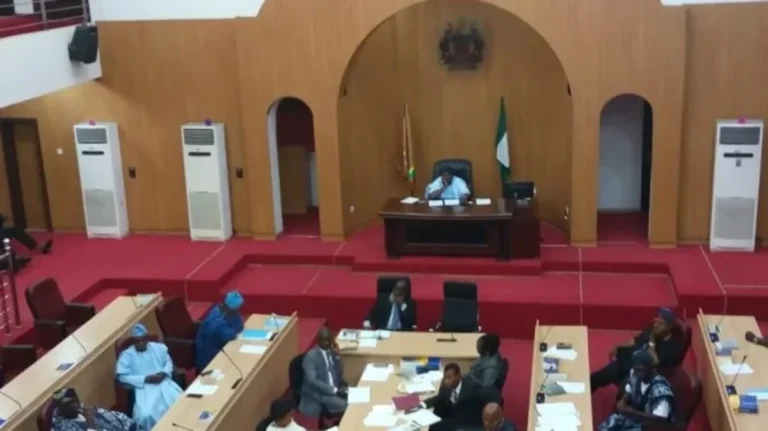
The ongoing national debate surrounding Nigeria’s security architecture reached a significant milestone on Tuesday as the Osun State House of Assembly formally endorsed the constitutional amendment bill seeking to establish state police services. During a robust plenary session presided over by the Speaker, Rt. Hon. Adewale Egbedun, the legislature voted overwhelmingly in favor of decentralizing the country’s security apparatus. This legislative action aligns Osun State with a growing coalition of sub-national entities advocating for a localized policing model designed to address the unique security challenges plaguing different regions of the federation.
The resolution to approve the amendment was formally brought before the floor by the Majority Leader, Hon. Kofoworola Babajide Adewunmi, and was subsequently seconded by Hon. Tajudeen Adeyemi. Following deliberations that highlighted the persistent security vulnerabilities across rural and urban communities, the lawmakers exhaustively reviewed the statutory implications of altering the 1999 Constitution. By giving its green light, the Osun State legislature has added its voice to the decentralized policing movement, emphasizing that centralized security structures have struggled to cope with the evolving dynamics of crime, insurgency, banditry, and kidnapping nationwide.
Background and Historical Context of Nigeria’s Policing Debate
The centralized policing model in Nigeria traces its roots back to the colonial era, evolving through various iterations into the modern Nigeria Police Force (NPF), which operates under the exclusive legislative list of the federal government as enshrined in Item 45 of the Second Schedule of the 1999 Constitution (as amended). For decades, critics, civil society organizations, security experts, and regional socio-political groups have argued that a single, federally controlled police force is fundamentally inadequate for managing the internal security needs of a heterogeneous nation with a population exceeding 220 million people.
Proponents of state police have consistently pointed out that under the current arrangement, the Inspector-General of Police, appointed by the President, holds operational and administrative command over forces deployed across the 36 states and the Federal Capital Territory. Governors, often designated as chief security officers of their respective states, have frequently lamented their lack of operational control over commissioners of police stationed within their domains. This disconnect has often resulted in sluggish responses to localized security threats, as tactical decisions frequently require clearance from force headquarters in Abuja.
The agitation gained renewed momentum following successive waves of insecurity over the past decade, including the Boko Haram insurgency in the Northeast, widespread banditry and cattle rustling in the Northwest, farmer-herder clashes in the North-Central, and rising rates of kidnapping, armed robbery, and separatist agitation in the South. In response to these pressures, various ad-hoc regional security outfits—such as Amotekun in the Southwest, Ebubeagu in the Southeast, and the Benue Guards in the North-Central—were established by state governments to bridge the security gap. However, because these outfits lack statutory backing to bear sophisticated arms and possess limited prosecutorial powers, their effectiveness has been constrained, reinforcing the urgent demand for fully fledged state police services.
The Legislative Journey and the Constitutional Amendment Process
The transmission of the constitutional amendment bill to the 36 state Houses of Assembly by the National Assembly marks a critical phase in Nigeria’s complex legislative amendment procedure. Under Section 9 of the 1999 Constitution, altering any provision of the constitution requires not only a two-thirds majority vote in both the Senate and the House of Representatives but also the concurrent approval of at least two-thirds of the state legislatures—translating to a minimum of 24 out of the 36 states.
Chronology of Key Milestones:
- 1999-2015: Intermittent calls by academics and civil rights advocates for state policing are largely resisted by federal authorities wary of potential abuse by state governors.
- 2018: A technical committee on the restructuring of Nigeria, set up by the ruling political party, strongly recommends the establishment of state police, prompting renewed legislative drafting.
- 2020: The #EndSARS protests highlight deep-seated public dissatisfaction with police brutality and operational inefficiencies, intensifying demands for structural and institutional reforms.
- 2023: Emerging consensus among federal lawmakers and the executive branch leads to the formal introduction of comprehensive constitutional amendment bills aimed at devolving policing powers.
- Mid-2024: The National Assembly harmonizes legislative positions and officially transmits the state police bill to the 36 state Houses of Assembly for consideration and voting.
- Present: State legislatures begin debating and voting on the document, with Osun State becoming one of the early adopters to register its official approval.
Following Tuesday’s vote, Speaker Adewunmi directed the Clerk of the House to formally communicate the resolution to the National Assembly, fulfilling the procedural requirements outlined in the constitutional amendment framework. While Osun’s endorsement is a major victory for the proponents of the bill, the proposed amendment remains contingent upon the actions of other state legislatures. If the threshold of 24 supporting states is achieved, the bill will return to the National Assembly for final processing before being presented to the President for assent.
Official Responses and Stakeholder Perspectives
The decision by the Osun State House of Assembly has elicited diverse reactions from political actors, legal practitioners, and civil society observers across the country. Supporters view the vote as a progressive step toward true federalism and grassroots security management.
Proponents argue that local police officers, who understand the indigenous languages, topography, and cultural nuances of their communities, are inherently better positioned to gather intelligence and preempt criminal activities. Furthermore, advocates maintain that accountability would be enhanced because state police forces would be directly answerable to local populations and sub-national oversight bodies, thereby bridging the trust deficit that has long existed between the public and federal law enforcement agents.
Conversely, skeptics and opponents of state police continue to voice legitimate concerns, primarily revolving around the potential for abuse of power by state governors. Critics worry that cash-strapped state governments might struggle to adequately fund, equip, and pay personnel, leading to compromised security standards. There are also fears that governors might weaponize state police services against political opponents, suppress dissent, and undermine electoral integrity during local and national polls.
To mitigate these risks, legal experts stress that the final legislative framework must incorporate robust institutional safeguards. These include independent oversight commissions, strict recruitment standards, tenure security for police chiefs to insulate them from arbitrary political removal, and clear jurisdictional boundaries separating state police duties from federal responsibilities.
Implications for National Security and Federalism
The formal introduction of a dual policing structure represents a watershed moment in Nigeria’s constitutional history. If successfully enacted, the reform will fundamentally alter the distribution of security powers between the central government and the federating units.
From an operational standpoint, a dual police system will necessitate seamless coordination mechanisms. The Federal Police would likely retain jurisdiction over federal crimes, inter-state offenses, national borders, and offenses carrying federal legislative penalties, while State Police services would manage localized infractions, routine maintenance of law and order, and community-level intelligence gathering.
Economically, the transition will demand substantial budgetary commitments from state governments. Developing and maintaining modern infrastructure, forensic laboratories, communication networks, and continuous training programs will exert considerable pressure on state revenues, making efficient resource management and transparency imperative.
As the legislative chess match continues across the remaining state assemblies, all eyes remain fixed on the sub-national capitals where deliberations on the bill are ongoing. The eventual outcome will not only redefine Nigeria’s approach to crime prevention and law enforcement but will also serve as a definitive test of the nation’s capacity to restructure its governance framework to meet contemporary challenges.