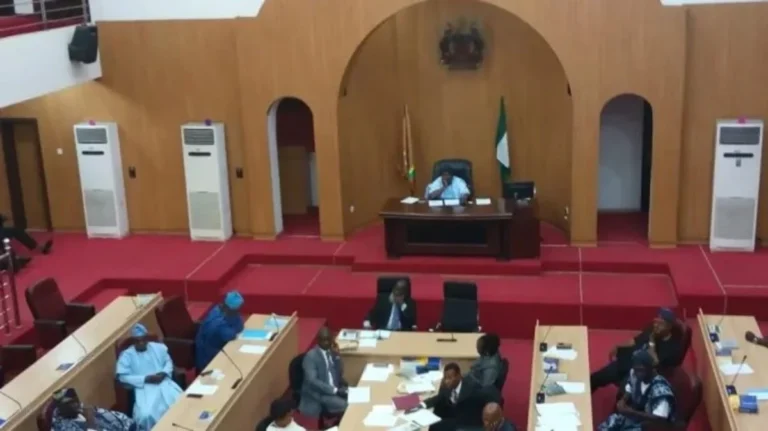
The Osun State House of Assembly has officially thrown its strong legislative weight behind the proposed establishment of state police forces across Nigeria, overwhelmingly approving the critical constitutional amendment bill transmitted to the thirty-six state legislatures for statutory consideration and concurrence. This landmark resolution was successfully reached during a robust plenary session held on Tuesday at the legislative complex in Osogbo, the Osun State capital.
The legislative action was set into motion following a formal and detailed motion moved by the Majority Leader of the House, Honourable Kofoworola Babajide Adewunmi, which was subsequently seconded by Honourable Tajudeen Adeyemi. Following extensive deliberations among the lawmakers regarding the security architecture of the country, the assembly thoroughly considered and endorsed the legislative proposal seeking to alter provisions of the 1999 Constitution of the Federal Republic of Nigeria (as amended). The core objective of this legislative amendment is to legally accommodate the establishment, operation, and regulatory oversight of State Police Services across the federation, thereby fundamentally altering the security landscape of the West African nation.
This vital development forms an integral part of the broader, ongoing constitutional alteration process initiated at the national level by the National Assembly. The overarching goal of this legislative endeavor is to decentralize the nation’s heavily centralized policing system and introduce a workable dual policing structure. Under this envisaged framework, both the Federal Police Service and autonomous State Police Services will operate concurrently, sharing security responsibilities while maintaining distinct operational boundaries, jurisdictions, and command structures.
The National Assembly had earlier transmitted the comprehensive constitutional amendment bill to all thirty-six state Houses of Assembly across the six geopolitical zones of the country for mandatory consideration and voting, as stipulated by Section 9 of the 1999 Constitution.
Following the successful passage of the resolution during the plenary, the Speaker of the Osun State House of Assembly, Right Honourable Adewale Egbedun, addressed his colleagues and formally directed the Clerk of the House to ensure that the official resolution of the assembly is promptly communicated to the National Assembly in Abuja. This administrative step fulfills the constitutional requirement necessary for the compilation of state assembly votes on the matter.
However, political analysts and legal experts have noted that the favorable vote by the Osun State legislature is merely one crucial stage in a rigorous, multi-tiered legislative journey. For the proposed constitutional amendment to successfully scale through, it requires the concurrent endorsement of at least two-thirds of all thirty-six state Houses of Assembly in Nigeria. This mathematical threshold means that a minimum of twenty-four states must independently debate, pass, and transmit their approvals of the bill back to the National Assembly before the proposed legislation can proceed to the final stages of presidential assent and formal codification into law.
The renewed legislative push for state policing is designed to establish a comprehensive and robust constitutional framework. Under this framework, individual state governments would possess the legal backing to recruit, train, fund, and deploy their own specialized police services. These regional or state-level security outfits would operate alongside the federal security apparatus, with carefully detailed statutory provisions covering clear lines of command, democratic oversight, accountability mechanisms, and operational safeguards to prevent potential political overreach or abuse of power by sub-national authorities.
Background Context and Historical Evolution of Nigeria’s Policing Debate
The debate surrounding the creation of state police in Nigeria is far from novel; rather, it is the culmination of decades of intense socio-political discourse, security evaluations, and legislative advocacy. Ever since Nigeria returned to democratic governance in 1999 under the current constitutional dispensation, the country has operated a monolithic, centralized policing system anchored by the Nigeria Police Force (NPF). Headquartered in the Federal Capital Territory of Abuja and under the direct command of the Inspector-General of Police—who is appointed by the President—the NPF holds exclusive constitutional jurisdiction over internal security maintenance across the entire nation.
However, as Nigeria grappled with an escalating wave of multi-faceted security challenges over the past two decades—ranging from insurgency in the Northeast, banditry and kidnapping for ransom in the Northwest and North-Central, violent agitations in the Southeast, to cultism, armed robbery, and communal clashes in the South-South and Southwest—critics and security experts increasingly pointed out the glaring inadequacies of a singular, federalized policing model.
Proponents of state policing have consistently argued that centralized security management is inherently incapable of effectively addressing localized crimes. Local security threats, they argue, require localized intelligence, intimate geographical knowledge, and rapid response capabilities that are best provided by personnel who understand the native languages, cultural nuances, and terrain of the specific communities they are deployed to protect.
The historical precedent for sub-national policing in Nigeria dates back to the pre-independence and immediate post-independence eras, notably under the 1960 and 1963 Republican Constitutions. During those periods, regional governments maintained their own distinct local government police forces alongside the federal police. While those regional structures were eventually dissolved and unified into a single national force during the military regimes of the 1970s in a bid to foster national unity and curb perceived political victimization by regional premiers, contemporary security realities have forced a nostalgic and pragmatic re-evaluation of that historical model.
Chronology of Recent Legislative Milestones Toward State Police
The journey toward the current legislative vote in Osun State represents the latest milestone in a carefully structured timeline of national security reforms and constitutional review processes:
-
Early 2020 – 2022: Amid escalating nationwide insecurity, various civil society organizations, governors under the auspices of the Nigeria Governors’ Forum (NGF), and federal lawmakers began intense behind-the-scenes lobbying to introduce state police bills into the National Assembly. Regional security initiatives, such as the Western Nigeria Security Network (codenamed Operation Amotekun) in the Southwest and similar outfits in other regions, were established as quasi-legal stopgap measures, operating under regional laws due to the absence of a federal constitutional backing for state police.
-
Mid-2023: Following the inauguration of the 10th National Assembly, leadership across both the Senate and the House of Representatives identified constitutional review—specifically touching on security decentralization—as a core legislative priority. Committees on Constitutional Amendment were reconstituted to aggregate past reports and fresh memoranda from stakeholders.
-
Early 2024: A coalition of federal lawmakers, backed by executive consultations involving the presidency and state governors, formally harmonized proposals regarding the amendment of Item 45 on the Exclusive Legislative List to move policing concurrent or shift aspects of it to the Concurrent Legislative List.
-
Mid-2024 to Late 2024: The National Assembly successfully finalized the drafting of specific amendment bills concerning the decentralization of policing structures. Robust debates were held, culminating in the formal transmission of the legislative documents to the thirty-six state Houses of Assembly for statutory consideration, concurrence voting, and necessary legislative inputs.
-
Present Day (2025): State legislatures across the federation began scheduling the bills for debate and voting during plenary sessions. The Osun State House of Assembly’s recent endorsement stands as a notable development in this ongoing statewide legislative referendum.
Evaluating the Broader Impact and Implications of Decentralized Policing
The formal introduction of state police services carries profound political, economic, operational, and social implications for the Federal Republic of Nigeria. Financial analysts and policy experts have pointed out both the immense potential benefits and the legitimate risks associated with this structural transformation.
On the positive side of the ledger, the decentralization of policing is expected to dramatically improve intelligence gathering and crime prevention at the grassroots level. State-recruited personnel, having deep roots in their communities, are anticipated to bridge the glaring trust deficit that often exists between foreign federal police officers and local populaces. Furthermore, state police services would significantly boost total manpower availability across the country, lifting the heavy operational burden currently borne by the overstretched federal police.
Economically, while setting up state police services will require substantial capital injection for procurement of modern weaponry, communication gadgets, vehicles, uniforms, and continuous training facilities, proponents argue that a safer environment will ultimately attract higher foreign and domestic investments, thereby boosting state internally generated revenue (IGR).
Conversely, critics and cautious observers have repeatedly raised valid concerns regarding the potential abuse of state police commands by incumbent state governors. Fears have been expressed that sub-national leaders might weaponize state security outfits against political opponents, suppress dissenting voices, or undermine electoral integrity during local government and state-level elections. To mitigate these legitimate apprehensions, legal drafters have reportedly embedded strict statutory safeguards within the amendment bills. These include independent oversight commissions, tenure security for state police chiefs to prevent arbitrary sackings, clear disciplinary protocols, and supreme federal intervention powers in extreme cases of constitutional breakdown.
Official Responses and Stakeholder Reactions
While the Osun State House of Assembly has taken a decisive step forward, reactions from various political and civil society quarters reflect a deeply engaged nation weighing federal unity against regional security necessity.
Spokespersons for civil society coalitions focused on good governance and human rights have cautiously welcomed the development in Osun State, emphasizing the urgent need for transparency in the eventual recruitment and training processes. Civil society actors have stressed that the success of state policing will heavily depend on merit-based recruitment, robust mental health evaluations for prospective officers, and strict adherence to international human rights standards.
Meanwhile, political analysts have observed that the decision of the Osun Assembly places immense pressure on remaining state legislatures that are yet to debate or vote on the constitutional amendment bill. As the mandatory two-thirds threshold (24 states) represents the ultimate hurdle for the National Assembly’s proposal, every single state assembly vote carries immense national significance.
Conclusion and Next Steps
The proactive stance taken by the Osun State House of Assembly signals a growing political consensus among sub-national actors regarding the urgent necessity of reforming Nigeria’s security architecture. By aligning with the decentralization agenda, Osun has added crucial momentum to a legislative process that could permanently redefine how law, order, and public safety are administered in the country.
As the constitutional amendment bill continues its journey through the remaining state legislatures, all eyes remain fixed on the National Assembly and state capitals across the federation. Should the required minimum of twenty-four states successfully pass concurring resolutions, the bill will return to the federal legislature for final harmonization before being forwarded to the President for assent. When that historic milestone is eventually reached, Nigeria will formally step into a new era of cooperative, multi-layered policing, forever altering the dynamics of law enforcement and internal security management within the West African powerhouse.