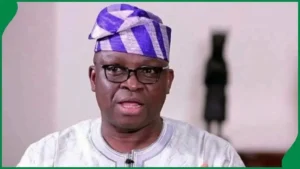
As Nigeria continues to navigate its complex socio-political landscape, prominent Peoples Democratic Party (PDP) chieftain Otunba Segun Sowunmi has issued a stern warning to the nation’s political class. He cautioned that democratic freedom must not be misconstrued as a license to incite the populace against the government or destabilize the country for selfish political gains. Speaking during an appearance on Channels Television’s flagship current affairs program, Politics Today, monitored in Abuja, Sowunmi emphasized the urgent need for political actors to play by the established rules of engagement, draw vital lessons from historical global upheavals such as the Arab Spring, and prioritize national stability over partisan ambitions.
The warning comes at a critical juncture in Nigeria’s democratic evolution. With the political space gradually expanding from a predominantly two-party system into a more dynamic three-party structure, concerns have been raised regarding the potential for inflammatory rhetoric to ignite social unrest. Sowunmi revealed that he has formally written to the National Security Adviser (NSA), Mallam Nuhu Ribadu, urging security apparatuses to clamp down on inflammatory speeches and reckless attitudes exhibited by politicians who threaten the peace and security of the Federal Republic of Nigeria.
The Evolution of Nigeria’s Party Politics and the Emerging Three-Party Dynamic
To fully understand the gravity of Sowunmi’s warnings, it is essential to examine the trajectory of Nigeria’s contemporary party politics. Since the return to civilian rule in 1999, the Nigerian political architecture has largely been dominated by a two-party hegemony. Initially, this was characterized by the dominance of the Peoples Democratic Party (PDP) and the All Nigeria Peoples Party (ANPP), followed by subsequent iterations featuring the PDP and the Action Congress of Nigeria (ACN), and later the fierce electoral battles between the PDP and the All Progressives Congress (APC).
This bipartisan equilibrium faced a major disruption during the 2023 general elections. The emergence of the Labour Party (LP), propelled by the massive youth-driven political mobilization spearheaded by former Anambra State Governor Peter Obi, fundamentally altered the electoral arithmetic. Rather than a straightforward contest between the ruling APC and the main opposition PDP, the political space effectively morphed into a vibrant three-way race.
Sowunmi noted that this structural evolution—featuring the entrenched architecture of the APC, the repositioned machinery of the PDP, and the formidable mobilization capacity associated with Peter Obi and the Labour movement—should inspire healthy competition based on policies, governance, and ideas. Instead, he lamented, some politicians have chosen to exploit these political realignments to propagate toxic rhetoric, inflame ethnic and religious tensions, and turn the country into a metaphorical battlefield under the guise of town hall meetings and public engagements.
The Spectre of the Arab Spring: A Warning from History
At the core of Sowunmi’s intervention is a stark historical parallel: the Arab Spring of 2010–2012. He reminded the political class of how a single act of desperation by a young street vendor in Tunisia, Mohamed Bouazizi, sparked a wave of popular uprisings that rapidly cascaded across the Middle East and North Africa. The resulting socio-political tremors led to the collapse of long-standing governments in Tunisia, Egypt, Libya, and Yemen, while plunging nations like Syria into protracted, devastating civil wars.
Sowunmi underscored that many of the countries dismantled during the Arab Spring were previously regarded by Western powers and international observers as stable, formidable states. The primary catalyst for their collapse was not merely economic hardship, but the rapid, unmanaged escalation of public anger fueled by unverified information, incendiary rhetoric, and the failure of political leadership to manage societal grievances responsibly.
Drawing lessons from these global events, Sowunmi expressed deep concern over the behavior of certain political actors and media commentators who seemingly push society toward a dangerous tipping point. In a country like Nigeria, which has battled a multifaceted security crisis—including Boko Haram insurgency in the Northeast, banditry and kidnapping in the Northwest and North-Central regions, and secessionist agitations in the Southeast—for over a decade and a half, the introduction of volatile political rhetoric could prove catastrophic.
Security Implications and the Appeal to the National Security Adviser
Given the fragility of the domestic security architecture, Sowunmi’s decision to formally petition the National Security Adviser, Nuhu Ribadu, highlights the growing apprehension among moderate political stakeholders regarding the tone of political discourse. The letter, submitted to the Office of the National Security Adviser (ONSA), calls for proactive measures to monitor and penalize purveyors of hate speech, incitement, and subversive rhetoric.
According to Sowunmi, democracy is fundamentally anchored on the rule of law, institutional integrity, and civic responsibility. It does not confer immunity on individuals to weaponize public discontent or incite civil disobedience. While emphasizing that his communication with the NSA is not intended to stifle democratic freedoms or infringe upon the rights of opposition figures to hold the government accountable, he stressed that a clear boundary must be drawn between robust democratic critique and reckless incitement that endangers national security.
Security experts and political analysts have often warned that the weaponization of poverty, ethnic polarization, and religious sentiments during election cycles poses a severe threat to internal stability. By formally engaging the nation’s topmost security coordinator, Sowunmi’s intervention seeks to establish a preventive protocol that holds political actors accountable for public utterances capable of triggering mass civil unrest.
Critique of Political Longevity and the Zoning Debate
Beyond national security concerns, Sowunmi used the platform to address internal party politics and the perennial challenge of political succession in Nigeria. He specifically directed his commentary toward veteran politicians who continually present themselves for election cycles despite repeated electoral setbacks and evolving national sentiments regarding zoning and generational shift.
Sowunmi offered candid advice regarding the political future of former Vice President Atiku Abubakar, who has contested the presidency multiple times under various political platforms. Pointing to the outcomes of past presidential elections—including Atiku’s defeats against the late President Umaru Musa Yar’Adua in 2007, former President Goodluck Jonathan in 2011, the late President Muhammadu Buhari in 2019, and President Bola Ahmed Tinubu in 2023—Sowunmi argued that it is time for veteran politicians to yield space to younger, sharper, and more dynamic leaders.
Furthermore, Sowunmi touched upon the delicate principle of zoning and power rotation within Nigerian politics. He maintained that the eight-year presidency of the late Muhammadu Buhari successfully completed the constitutional and political expectation of a Northern tenure spanning from 2015 to 2023. Consequently, he advocated strict adherence to power rotation principles that foster national unity, equity, and a sense of belonging across the diverse geopolitical zones of the federation.
Navigating Alliances and Intra-Party Controversies
Sowunmi also addressed recent political developments involving Atiku Abubakar’s maneuvers within alternative political platforms, specifically referencing the African Democratic Congress (ADC) and the controversies surrounding political figures like Nafiu Gombe. Sowunmi criticized what he described as a display of political arrogance and a sense of entitlement, warning that failure to respect foundational stakeholders and existing structures within opposition parties could jeopardize broader coalition efforts and lead to avoidable legal or electoral exclusions.
In Nigerian politics, coalition-building and cross-party alignments have historically played a decisive role in shaping electoral outcomes. However, such alliances often face friction when veteran figures attempt to dominate emerging platforms without adequately accommodating local political actors and grassroots structures. Sowunmi’s critique reflects broader internal anxieties within the opposition camp regarding strategy, unity, and the necessity of cultivating inclusive leadership models ahead of future electoral cycles.
Broader Impact and Implications for Nigeria’s Democracy
The intervention by Otunba Segun Sowunmi serves as both a cautionary tale and a roadmap for political reform in Nigeria. As the country looks beyond the 2023 elections and anticipates future political milestones, the integrity of its democratic institutions will depend heavily on the self-regulation and ethical conduct of its political class.
Several key implications emerge from this discourse:
-
The Necessity of Responsible Political Communication: Political actors must recognize that inflammatory language has real-world consequences. In a multi-ethnic and multi-religious society like Nigeria, divisive rhetoric can easily morph into localized violence, threatening lives and property.
-
Strengthening Regulatory and Security Oversight: The call for the Office of the National Security Adviser to monitor reckless political speeches highlights the thin line between freedom of expression and national security. Security agencies face the delicate task of protecting democratic freedoms while decisively checking actors who cross the line into subversion and incitement.
-
Generational Shift and Political Renewal: Sowunmi’s critique of perennial candidacy speaks to a broader national desire for political renewal. As the Nigerian electorate grows increasingly youthful and politically conscious, parties that fail to institutionalize internal democracy, embrace zoning, and elevate younger leaders risk alienating critical voting blocs.
-
The Maturation of Party Politics: The transition toward a more competitive three-party system requires a corresponding evolution in political culture. Parties must move away from zero-sum, do-or-die politics and embrace ideological competition, policy-driven campaigns, and respect for constitutional norms.
Conclusion
Otunba Segun Sowunmi’s recent admonitions provide a timely reality check for Nigeria’s political actors. As the nation grapples with multifaceted socio-economic challenges and lingering security concerns, the preservation of constitutional democracy remains paramount. By urging politicians to renounce inflammatory rhetoric, respect the rule of law, and learn sobering lessons from global history, his remarks underscore a collective responsibility: that the survival, stability, and prosperity of the Nigerian state must always supersede individual political ambitions.