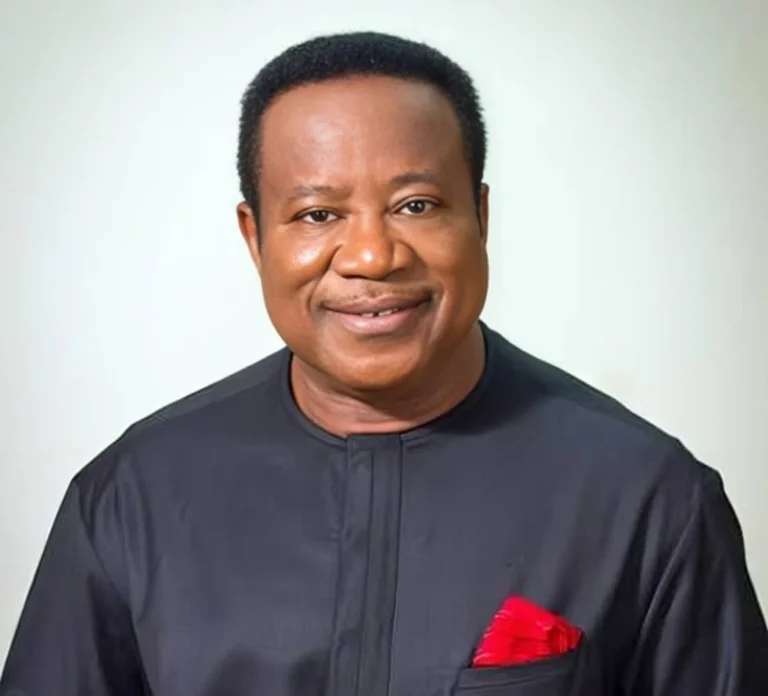
The current architecture of Nigeria’s democracy contains profound structural impediments that systematically marginalize specific demographics, rendering the ascension of an Igbo or Christian president nearly impossible under prevailing arrangements. This critique was delivered by Pastor Femi Emmanuel, the National Director of Politics and Governance for the Pentecostal Fellowship of Nigeria (PFN) and founder of Living Spring Chapel International, during a comprehensive interview on Channels Television’s public affairs program, Inside Sources.
Emmanuel, who previously served as the Deputy Speaker of the Oyo State House of Assembly, argued that the nation’s foundational laws and political conventions have entrenched a system wherein the northern geopolitical bloc retains disproportionate leverage over national leadership outcomes. According to the cleric, the electoral victories of former presidents Olusegun Obasanjo and Goodluck Jonathan were anomalies born of extraordinary
historical crises rather than products of an inherently equitable system designed to rotate power fairly among all regions and faiths.
The critique shines a spotlight on the enduring fault lines of Nigeria’s federal republic, reigniting national debates regarding constitutional restructuring, the dynamics of regional power-sharing, and the socio-political responsibilities of religious institutions in democratic governance.
Structural Fault Lines and the North-South Power Equation
At the core of Emmanuel’s analysis is the assertion that Nigeria’s political structure structurally disadvantages southeastern aspirants and Christian candidates. He explained that when political power rotates back to the southern half of the country following a northern administration’s tenure, regional fragmentation typically prevents cohesive cross-regional alliances, notably the "handshake across the Niger" linking the South-West and South-East.
Consequently, political dynamics often relegate the South-East to a peripheral status. Simultaneously, the underrepresentation of Christians within the foundational organs of mainstream political parties further diminishes the viability of Christian candidates when power shifts southward.
"The kind of constitution we have now, there is no way an Igbo man or a Christian will ever become president of this country," Emmanuel stated during the broadcast. Elaborating on the mechanics of this exclusion, he noted, "When it comes back to the South after eight years in the North, once the South-West takes its turn, you don’t see a handshake across the Niger. Then the Igbo person goes to the minority again. And because Christians are not in political parties, when it comes back to the South, a Christian cannot emerge because we are not in parties."
Historical Anomalies: Examining Past Exceptions
To substantiate his claims regarding structural exclusivity, Emmanuel reviewed the historical circumstances surrounding past presidencies, maintaining that rare political contingencies—rather than systemic inclusivity—explain how certain leaders attained office.
The emergence of Olusegun Obasanjo in 1999 occurred under the shadow of a profound national crisis: the annulment of the June 12, 1993, presidential election widely believed to have been won by the late business mogul and politician Chief MKO Abiola. The political establishment of the era engineered a power shift to the South-West specifically to appease the Yoruba population and stabilize a fractured federation.
Similarly, the ascension of Goodluck Jonathan in 2010 was a direct consequence of the sudden death of incumbent President Umaru Musa Yar’Adua, an event that elevated Jonathan from the vice-presidency. Emmanuel contended that under standard structural conditions, had Yar’Adua completed his full two-term mandate, the subsequent political trajectory would have followed a different regional and religious pattern.
Nevertheless, Emmanuel acknowledged the political acumen of the incumbent president, Bola Tinubu. He noted that Tinubu’s strategic foresight in building a robust regional political base in the South-West, maintaining sustained cross-regional alliances, and supporting former President Muhammadu Buhari through an eight-year tenure demonstrated exceptional tactical execution, ultimately culminating in his own successful presidential bid.
The Call for Constitutional Restructuring and Implementation of Past Reforms
Addressing the remedies for Nigeria’s governance challenges, Emmanuel advocated for a comprehensive, systemic overhaul of the federation. He urged the federal government and citizens to revisit and operationalize the extensive recommendations generated by the 2014 National Conference, which was convened under the administration of former President Goodluck Jonathan.
The 2014 conference brought together nearly 500 delegates from diverse ethnic, professional, and regional backgrounds to deliberate on critical issues affecting national unity, resource control, and structural devolution. Despite substantial financial investments by the federal treasury, the resulting report was shelved by the succeeding administration, a development Emmanuel described as a missed opportunity for national renewal.
Furthermore, the cleric referenced the internal committee established by the ruling All Progressives Congress (APC) under the leadership of former Kaduna State Governor Nasir El-Rufai. That committee was tasked with drafting a blueprint for true federalism and constitutional restructuring. Emmanuel questioned why the comprehensive recommendations formulated by the El-Rufai panel have languished without meaningful legislative translation or executive implementation.
"Go back to the 2014 constitutional conference document, tinker with it in line with the reality of today. Then we are making progress," Emmanuel advised. He cautioned, however, that incumbent political officeholders frequently resist structural reforms that threaten to dilute their localized power or disrupt entrenched patronage networks.
Grassroots Capture and the Metaphor of Political Colonization
Moving beyond macro-level constitutional debates, Emmanuel directed sharp criticism toward the micro-level mechanics of political participation in Nigeria. He characterized the current state of party politics as a form of internal "colonization," arguing that the nation has transitioned from British colonial rule and decades of military authoritarianism to an era where political elites have monopolized party apparatuses at the grassroots.
According to the PFN director, ordinary citizens and credible aspirants are locked out of the political space because entrenched interests—often referred to as political godfathers—control ward-level structures. These local party structures dictate the selection of delegates, party executives, and ultimately, candidates for elective office.
"If we vote a hundred times, we will be voting for the same people because they have colonised the nucleus that keeps producing them," Emmanuel warned. He maintained that simply obtaining Permanent Voter Cards (PVCs) and casting ballots during general elections is insufficient to effect systemic change if the electorate remains detached from the internal candidate-selection processes of political parties.
He issued a direct appeal to youths, professionals, and citizens of integrity to infiltrate ward-level party meetings, secure party membership cards, and actively contest positions within party structures. Without direct involvement at the foundational level, he argued, meaningful democratic transformation remains unattainable.
The Role of the Church: Challenging Doctrinal Apathy
In a particularly pointed segment of his commentary, Emmanuel turned his critique inward, addressing the leadership and doctrines of the Christian community in Nigeria. He asserted that religious institutions have inadvertently disadvantaged their members by propagating teachings that alienate believers from the sphere of governance.
Citing prevailing theological narratives within many Pentecostal and orthodox churches, Emmanuel accused religious leaders of fostering a culture of political escapism. By labeling politics as inherently "evil," "dirty," or worldly, spiritual leaders have effectively discouraged congregants from seeking elective office or engaging in partisan decision-making.
"The church community is an imprisoned community. We, their general overseers—I am not taking myself out of it—have imprisoned them with our doctrine and teaching: ‘Politics is evil. Politics is dirty. Leave politics for politicians.’ That is what has brought us to this place," he lamented.
Challenging contemporary pastoral approaches, Emmanuel urged general overseers and clergy to move beyond prayer meetings, fasting assemblies, and political prophecies. Referencing scriptural precedent from Psalm 115:16—which states that the heavens belong to the Lord, but the earth has been given to the children of men—the cleric emphasized that divine intervention does not absolve citizens of civic duty.
"God is not going to come and help us pick our president. God is not going to come and help us pick our governors. He has left that for us," Emmanuel stated. He called for a paradigm shift, urging believers to view political engagement not as a secular compromise, but as a moral imperative essential for national development and societal stewardship.
Implications for Nigeria’s Democratic Future
Emmanuel’s comprehensive assessment underscores the complex interplay between constitutional design, regional identity, religious orthodoxy, and civic action in shaping Nigeria’s political trajectory. As the country navigates ongoing socioeconomic pressures and prepares for future electoral cycles, the debate surrounding structural devolution and grassroots political mobilization remains a central flashpoint.
Political analysts note that while calls for constitutional restructuring and the implementation of the 2014 confab report enjoy broad theoretical support across various civil society organizations, executive and legislative consensus has historically proven elusive. Meanwhile, the challenge issued to faith-based organizations and young demographics to transition from passive spectatorship to active party participation highlights an evolving discourse on citizen agency.
Ultimately, Emmanuel’s message serves as both a critique of historical exclusion and a pragmatic roadmap for systemic reform. By emphasizing that democratic rehabilitation requires internal party penetration, inclusive constitutional architecture, and the dismantling of localized political monopolies, the cleric reiterates that the future of the Nigerian republic depends fundamentally on the deliberate actions of its citizenry.