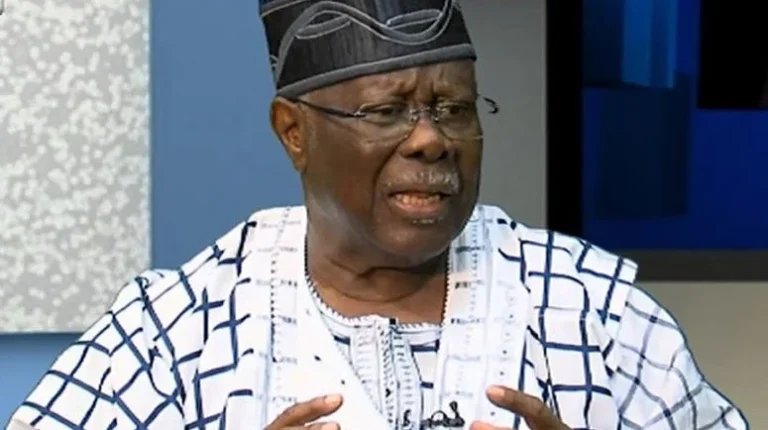
The National Chairman of the Peoples Democratic Party (PDP), Kabiru T. Turaki, SAN, has officially celebrated the birthday of Chief Olabode Ibiyinka George, a former Deputy National Chairman of the party, hailing him as a titan of political conviction and a man whose dedication to democratic ideals has remained steadfast through decades of service. In a commemorative message released via the party’s official communication channels on November 21, 2026, Turaki lauded the elder statesman for his dual legacy in both the Nigerian military and the nation’s democratic landscape.
The tribute serves as more than a standard anniversary acknowledgement; it highlights the enduring influence of Chief George, a retired Navy Commodore, within the internal politics of the PDP and the broader Nigerian sociopolitical spectrum. As the party navigates a complex period of internal repositioning and national engagement, the recognition of veteran figures like George underscores the PDP’s focus on institutional memory and the validation of its foundational members.
A Legacy Spanning Decades: From Naval Command to Political Governance
Born into a family of high achievement, Olabode George’s career trajectory is characterized by a transition from military administration to partisan politics. A former Military Governor of Ondo State, George played a pivotal role in the formative years of the Fourth Republic. His career in the public sector is marked by his tenure as the Chairman of the Nigerian Ports Authority (NPA), where he gained national prominence, and his subsequent rise through the ranks of the PDP.
For those tracking Nigerian political history, George represents the "old guard" of the PDP—a generation of leaders who were instrumental in establishing the party as the dominant political force in the early 2000s. His influence in Lagos State politics, in particular, has been a defining feature of the regional landscape, often positioning him as a vocal critic of opposition policies and a strategic architect for the PDP in the South-West geopolitical zone.
Chronology of Influence: Key Milestones
To understand the significance of the PDP chairman’s tribute, one must consider the historical markers of Chief George’s career:
- 1988–1990: Served as the Military Governor of Ondo State, establishing his reputation for administrative rigor and direct governance.
- 1999: Emerged as a key founding member of the Peoples Democratic Party, transitioning into civilian politics at the inception of Nigeria’s current democratic dispensation.
- 2001–2003: Appointed Chairman of the Nigerian Ports Authority (NPA), a period that saw significant reforms and controversies that would define his later public image.
- 2003–2008: Served as the National Vice Chairman (South-West) of the PDP, where he became a kingmaker in regional politics, overseeing party primaries and gubernatorial candidate selection processes.
- 2008–2010: Faced significant legal challenges regarding his tenure at the NPA, a period that tested his political resilience and necessitated a temporary retreat from the public eye.
- 2013–2016: Returned to the national stage as a Deputy National Chairman of the PDP, acting as a bridge between the party’s historical roots and the newer generation of leaders.
- 2026: Remains a potent voice in the party, regularly offering counsel to the National Working Committee (NWC) during critical policy deliberations.
The Essence of the Tribute: Courage and Conviction
In his statement, Kabiru T. Turaki, SAN, emphasized that the celebration of George’s birthday is an exercise in honoring the "courage of conviction." Turaki noted that the political landscape in Nigeria is often volatile, and standing for one’s principles—even when those principles are unpopular—is a rarity in contemporary discourse.
"Today, a great man both in military and civilian life is celebrated, not just for adding a year to his life but more for standing for the truth in very inconvenient times," Turaki remarked. The sentiment suggests that the current leadership of the PDP views George’s career as a template for resilience. By framing his service as "irrepressible," the Chairman is signaling that despite the legal and political battles George has faced, his capacity to influence the party’s direction remains undiminished.
Analysis of Political Implications
The public endorsement from the National Chairman of the Interim National Working Committee carries several implications for the party’s internal dynamics:
- Consolidation of Old and New: By aligning the party with a senior figure like George, the current leadership is working to bridge the generational divide. It signals to the older, more established members of the party that their contributions are still highly valued in an era where the party is attempting to rebrand itself to appeal to younger voters.
- Internal Stability: The PDP has faced a series of internal crises over the last decade, ranging from leadership tussles to mass defections. Celebrating figures like George serves as a rallying point for party unity. It reaffirms the party’s institutional identity and provides a sense of continuity.
- Regional Strategy: As the PDP seeks to regain electoral ground in the South-West, an endorsement of George—who remains a highly influential figure in Lagos—is a strategic move. It serves to remind stakeholders in the region that the party is deeply rooted in the history of the zone.
Broader Context: The Role of Elders in Modern Democracy
The role of "elder statesmen" in Nigerian politics is a subject of constant debate. Critics often argue that the dominance of older figures hinders the rise of younger leaders. However, supporters argue that in a country with a relatively young democratic history, the experience and institutional memory provided by figures like Chief George are indispensable.
In his message, Turaki acknowledged this by stating that the PDP had been "lavishly blessed" by George’s wise counsel. This suggests that the current NWC continues to rely on George for strategic advice, particularly regarding legislative maneuvers and the management of internal grievances.
Reactions and Public Sentiment
The birthday message has elicited a mixed response from political analysts and the public. While supporters of the PDP have used the occasion to flood social media with tributes to George’s legacy, critics have pointed to the controversial aspects of his tenure at the NPA as a reminder of the need for greater accountability in public office.
However, from the perspective of the PDP’s official hierarchy, the focus is squarely on loyalty and longevity. The signing of the message by the Chairman of the Interim National Working Committee, Kabiru T. Turaki, suggests that this is an official party position, not merely a personal gesture. It is an attempt to define the narrative of the party’s history as one of resilience rather than one of decline.
Looking Forward: The Path for the PDP
As the party looks toward the next electoral cycle, the continued engagement of veterans like Olabode George indicates that the PDP is prioritizing its established power base. The party’s ability to successfully blend this "old guard" experience with new policy initiatives will be the primary determinant of its electoral success in the coming years.
Turaki’s closing prayers for "protection, preservation and prosperity" are standard in Nigerian political culture, but in this context, they also function as a reinforcement of the status quo. The party is making a public statement that it stands by its own, regardless of the historical complexities that may surround any individual member.
Conclusion
The celebration of Chief Olabode George’s birthday by the National Chairman of the PDP is a significant moment that encapsulates the party’s current strategy: honoring the past to secure the future. By emphasizing the themes of courage, truth, and resilience, the party leadership is attempting to project an image of stability and unwavering loyalty.
Whether this approach will resonate with the wider electorate—particularly the youth demographic, which has shown a growing preference for systemic change—remains to be seen. Nevertheless, for the PDP, Chief George remains an "irrepressible" force, a symbol of the party’s enduring, if at times controversial, place in Nigeria’s complex political mosaic. As the party moves forward, the influence of such figures will continue to be a subject of intense analysis by political observers and stakeholders alike.