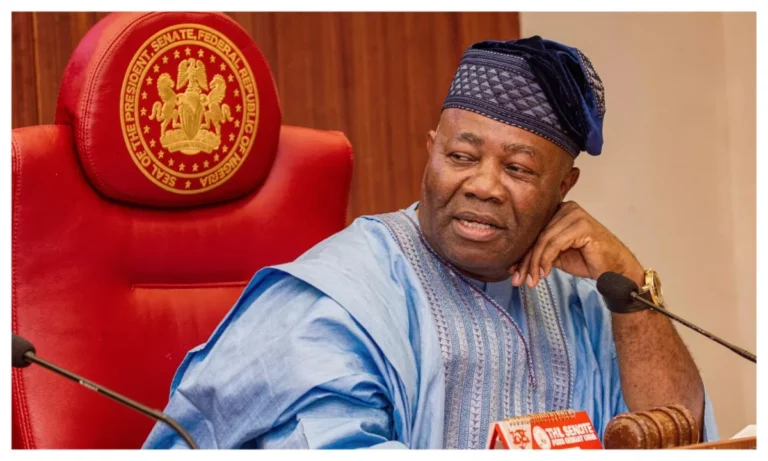
Senate President Godswill Akpabio has publicly questioned the political loyalty and strategic judgment of former Labour Party presidential candidate, Peter Obi, following the 2023 general election. Akpabio’s remarks, made during the commissioning of a new National Research and Statistics (NRS) building on Tuesday, criticized politicians who, despite benefiting from substantial electoral support through a specific party, subsequently abandon that platform to seek new affiliations. This commentary has ignited a fresh debate on party discipline, political opportunism, and the stability of Nigeria’s nascent democratic institutions.
Akpabio’s Critique and the Implicit Target
Speaking at the event, Akpabio, a prominent figure in the ruling All Progressives Congress (APC) and a former Governor of Akwa Ibom State, articulated a strong stance against what he described as a detrimental trend in Nigerian politics. He underscored the importance of nurturing and maintaining party structures, arguing that the abandonment of a party after achieving significant electoral mileage undermines its foundation and contributes to political instability.
"Somebody will go and get up to six million votes in the last presidential election through a political party and yet abandon that party and the six million votes to start shopping for a new party that he will go and start building up," Akpabio stated emphatically. To preempt misinterpretation, he added, "I’m not talking about Soludo. I’m talking about somebody around his area." This geographical specificity, referencing a figure from the South-East region of Nigeria, left little doubt among observers that his critique was directed squarely at Peter Obi, who hails from Anambra State and famously secured over six million votes under the Labour Party banner in the fiercely contested 2023 presidential race.
Akpabio’s allusion to "Soludo" (Professor Charles Soludo, the current Governor of Anambra State) served as a rhetorical device to narrow the focus, as Soludo, a former Governor of the Central Bank of Nigeria, has also been a subject of political discussions, albeit in a different context. However, the mention of "somebody around his area" solidified the public’s interpretation, pointing directly to Obi, whose electoral performance in 2023 marked an unprecedented surge for the Labour Party.
The Rise of Peter Obi and the Labour Party in 2023
Peter Obi’s journey to becoming a formidable presidential candidate in 2023 was a dynamic and often unpredictable one. A two-term former Governor of Anambra State under the All Progressives Grand Alliance (APGA), Obi later joined the Peoples Democratic Party (PDP), serving as its vice-presidential candidate in the 2019 general election alongside Atiku Abubakar. His reputation as a fiscally conservative and prudent administrator garnered him a significant following, particularly among younger Nigerians and those disillusioned with the traditional political establishment.
In May 2022, just days before the PDP presidential primary, Obi dramatically defected from the party, citing irreconcilable differences and a perceived deviation from the party’s core values. He subsequently joined the Labour Party, a relatively obscure political entity with minimal national presence. His entry into the Labour Party transformed its fortunes almost overnight, igniting what became known as the "Obidient movement" – a grassroots, youth-driven phenomenon that leveraged social media to mobilize support across the country.
During the 2023 presidential election held on February 25, 2023, Obi’s candidacy defied expectations. He secured 6,101,533 votes, representing 25.40% of the total votes cast. While he ultimately placed third behind Bola Ahmed Tinubu of the APC (8,794,726 votes) and Atiku Abubakar of the PDP (6,984,520 votes), his performance was historic for the Labour Party. He won in states traditionally considered strongholds of the two dominant parties, including Lagos State and the Federal Capital Territory (FCT), signaling a significant shift in Nigeria’s political landscape and demonstrating a powerful mandate from a considerable segment of the electorate. The "Obidient" movement, characterized by its fervent online and offline advocacy, represented a significant challenge to the established political order.
Post-Election Developments and Reports of Obi’s Political Realignments
Following the declaration of the 2023 presidential election results, Peter Obi and the Labour Party, along with the PDP, challenged the outcome at the Presidential Election Petition Tribunal (PEPT) and subsequently at the Supreme Court. Both tribunals upheld President Tinubu’s victory, concluding the legal battles over the election.
In the aftermath of the legal challenges, reports began to surface regarding Peter Obi’s potential realignment away from the Labour Party. While Obi has maintained a public stance of focusing on national issues and advocating for good governance, whispers within political circles and media reports have indicated his interest in exploring other political platforms. The African Democratic Congress (ADC) has been frequently mentioned as a potential new home for Obi, a development that, if confirmed, would represent another significant shift in his political career.
The motivations behind such a potential move are subjects of intense speculation. Some analysts suggest it could be a strategic maneuver to build a broader coalition ahead of the 2027 general election, leveraging a party that might offer a more stable internal structure or a less tumultuous path to securing a presidential ticket. Others point to internal wrangling and leadership disputes within the Labour Party itself, which have plagued the party since the election. The prolonged leadership crisis, including legal battles over who constitutes the authentic national leadership, may have created an environment conducive to Obi seeking a more harmonious platform.
Inferred Reactions and Political Dynamics
While no direct statements from Peter Obi or his representatives regarding Akpabio’s comments have been made public at the time of this report, one can logically infer potential responses and reactions from various political camps:
- From Peter Obi’s Camp: A likely response would emphasize his commitment to the welfare of Nigerians, asserting his right to associate with any political group that aligns with his vision for national development. His supporters might argue that political agility and the ability to forge new alliances are essential for progressive change, rather than being bound by the perceived limitations of a single party, especially one facing internal strife. They might also highlight his consistent focus on issues rather than party labels.
- From the Labour Party: The party would likely express disappointment and reiterate the importance of party loyalty, particularly from a figure who benefited immensely from their platform. They might emphasize the sacrifices made by party members and the "Obidient" movement to elevate Obi’s profile. Any defection would undoubtedly be viewed as a significant blow to the party’s cohesion and future prospects, especially as it seeks to consolidate its gains and establish itself as a viable national opposition force.
- From the African Democratic Congress (ADC): Should Obi genuinely be considering joining the ADC, the party would likely welcome such a high-profile figure, viewing it as a massive boost to their national relevance and electoral competitiveness. They would position themselves as a credible alternative for progressive forces seeking to unite under a common banner.
- From the Ruling All Progressives Congress (APC): Akpabio’s statement is consistent with the APC’s broader strategy of highlighting perceived inconsistencies or weaknesses within the opposition ranks. By questioning Obi’s loyalty, the APC aims to sow discord, weaken opposition unity, and potentially alienate Obi from his core base of supporters who identify strongly with the Labour Party’s "Obidient" identity. This narrative reinforces the ruling party’s position and potentially dampens the morale of opposition movements.
Broader Implications for Nigerian Democracy and Party Politics
Akpabio’s critique, while directed at Peter Obi, touches upon a deeper, systemic issue in Nigerian politics: the prevalence of party switching, often perceived as driven by personal ambition rather than ideological conviction. This phenomenon has long plagued Nigeria’s multi-party democracy, contributing to weak party structures and a political landscape where personalities often overshadow party manifestos.
Weakening Party Structures: When prominent figures frequently switch parties, it undermines the institutional integrity and stability of political parties. Parties struggle to develop strong ideological foundations, consistent policies, and predictable internal processes when their leading lights are transient. This leads to a system where parties serve more as electoral vehicles than as ideologically coherent entities.
Erosion of Voter Trust: The constant movement of politicians across party lines can erode public trust in the political system. Voters, especially those who invested emotional and material capital in a candidate and his original party, may feel betrayed or disillusioned when their chosen representative abandons the platform that brought them to prominence. This can lead to voter apathy and cynicism about the democratic process.
Impact on Opposition Unity: Peter Obi’s potential departure from the Labour Party could further fragment an already fractured opposition. A united and formidable opposition is crucial for a healthy democracy, providing checks and balances against the ruling party and offering viable alternative policies. If opposition figures constantly regroup in different smaller parties, it diminishes their collective power to challenge the incumbent effectively.
The "Obidient" Movement’s Future: A significant aspect of Obi’s 2023 campaign was the organic "Obidient" movement, which transcended traditional party loyalty. Many "Obidients" saw the Labour Party as synonymous with Obi’s vision. If Obi were to move to another party, it would test the loyalty of this movement. Would they follow Obi regardless of the platform, or would their loyalty remain with the Labour Party, which they helped build? This dynamic could redefine the nature of political followership in Nigeria, potentially shifting it even further towards personality cults rather than party ideologies.
Akpabio’s Strategic Positioning: As Senate President, Akpabio occupies a powerful position within the ruling party. His comments can be interpreted as a strategic move to destabilize the opposition and consolidate the APC’s political dominance. By casting doubt on Obi’s political character, Akpabio effectively frames the former candidate’s potential actions in a negative light, aiming to discredit him and weaken any future political endeavors. This is a classic tactic in competitive political environments, where the ruling party seeks to maintain its advantage by exposing perceived flaws in its opponents.
Conclusion
Senate President Godswill Akpabio’s pointed remarks about Peter Obi’s alleged party abandonment have reopened a critical discussion about the principles of political loyalty, party stability, and the future trajectory of Nigeria’s democratic experiment. While Obi’s camp and the Labour Party navigate these complexities, the episode serves as a potent reminder of the fluid and often transactional nature of Nigerian politics. The implications of such movements extend beyond individual political careers, touching upon the very foundations of party structures, the integrity of the electoral process, and the ongoing quest for a more robust and accountable democratic system in Nigeria. As the nation looks towards future elections, the actions of key political figures like Peter Obi and the reactions from figures like Godswill Akpabio will continue to shape the narrative and influence the political landscape.