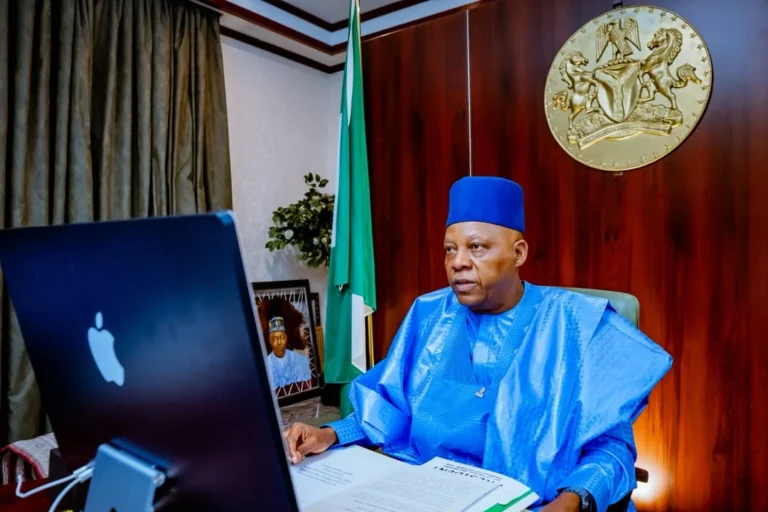
Vice President Kashim Shettima has issued a stern warning against proposals to restore the petrol subsidy regime in Nigeria, arguing that such a move would jeopardize the nation’s fiscal stability and dismantle the structural reforms initiated by the Bola Tinubu administration. Speaking at the 32nd Nigerian Economic Summit in Abuja on Monday, Shettima emphasized that the country must prioritize long-term economic sustainability over politically expedient promises, specifically challenging a prominent presidential aspirant who has campaigned on a platform of reintroducing fuel subsidies.
The summit, which drew key stakeholders from the private sector, international policy institutions, and government, was held under the theme: “Growth that Works: Delivering Jobs, Productivity and Shared Prosperity.” During his keynote address, the Vice President framed the ongoing economic transition not merely as a matter of fiscal policy, but as an existential necessity for a nation that had previously been tethered to a unsustainable subsidy model.
The Fiscal Context of Reform
The removal of the petrol subsidy in May 2023 marked a watershed moment in the Tinubu administration’s tenure. Upon his inauguration, President Tinubu declared that the subsidy was no longer sustainable, given the severe depletion of foreign exchange reserves and the escalating cost of debt servicing. At the time of the policy shift, Nigeria’s foreign reserves stood at approximately $33.9 billion, a figure that officials argued left little room for the massive fiscal drain necessitated by the subsidy.
Shettima characterized the former arrangement as a “subsidy scam” and an “industry” that thrived at the expense of the average Nigerian. According to the Vice President, the previous pricing mechanism incentivized rent-seeking behavior and facilitated the massive smuggling of petroleum products to neighboring countries, effectively forcing Nigeria to subsidize the consumption of other African nations, including as far afield as the Central African Republic.
“Mr. President understood that postponing difficult decisions would multiply the eventual cost,” Shettima stated, positioning the administration’s actions as a proactive response to an economy teetering on the verge of collapse. He maintained that the decision, while politically costly, was essential to redirecting public resources toward infrastructure, education, and healthcare—sectors that had been starved of funding due to the heavy reliance on oil revenue for subsidy payments.
Economic Indicators and Growth Projections
The administration used the platform of the 32nd Nigerian Economic Summit to present data reflecting a tentative recovery. According to figures shared by the Vice President, Nigeria’s real Gross Domestic Product (GDP) grew by 3.89 percent in the first quarter of 2026, marking an improvement over the 3.18 percent growth recorded in the corresponding period of 2025.
Further emphasizing the administration’s narrative of improving investor confidence, Shettima highlighted that capital importation surged to $10.37 billion during the same quarter—an 83.83 percent increase year-on-year. This data, the government contends, is a direct result of the liberalization of the foreign exchange market and the removal of administrative bottlenecks that had previously stifled investment.
In the energy sector, which remains the backbone of Nigeria’s export earnings, the government reported that crude oil and condensate production reached 1.735 million barrels per day (mbpd) as of June 2026. This uptick in production is viewed as a critical component of the government’s broader strategy to stabilize the naira and rebuild foreign reserves. However, the Vice President acknowledged that production gains must be matched by an increase in domestic refining capacity to fully insulate the economy from global price volatility.

The Political Economy of Subsidies
The Vice President’s critique of the unnamed presidential aspirant reflects a growing tension in the Nigerian political discourse as the nation looks toward future election cycles. The promise of “cheaper fuel” has historically been a powerful tool for mobilization in Nigeria, yet the economic reality of the past three years has forced a recalibration of public expectations.
Analysts observe that the debate over subsidy restoration is not merely about fuel prices, but about the fundamental role of the state in market regulation. Those who favor a return to the subsidy point to the immediate inflationary pressures and the rising cost of living that have accompanied the floating of the naira and the removal of price controls. Conversely, fiscal conservatives and multilateral institutions, such as the World Bank and the International Monetary Fund, have consistently urged Nigeria to maintain its current course, arguing that the “subsidy era” resulted in gross inefficiencies and a lack of investment in critical social sectors.
Shettima’s stance underscores a shift in government communication: moving away from justifying reforms as “painful but necessary” to presenting them as the only viable pathway to a modern, industrialized economy. “Administrations can go and go,” the Vice President remarked, stressing that the sustainability of the Nigerian state must be anchored on stable policy frameworks that transcend the tenure of any single political leader.
Challenges and Structural Hurdles
Despite the government’s optimistic outlook, the path forward remains fraught with challenges. While GDP growth and capital importation numbers show positive trends, the impact of these reforms on the common citizen—often described as the “real economy”—remains a point of significant contention. Inflationary pressure, driven by the currency devaluation and the energy transition, has significantly reduced the purchasing power of the middle and lower classes.
The administration’s strategy now pivots toward mitigating these side effects through targeted interventions. Shettima highlighted ongoing reforms in the agricultural sector, the solid minerals industry, and the power sector as essential pillars for job creation. By focusing on non-oil exports, the government hopes to diversify the revenue base and reduce the country’s vulnerability to global oil price shocks.
However, the success of these reforms depends heavily on the government’s ability to sustain consistent policy implementation. Critics argue that the gap between macro-level statistics and micro-level realities must be closed to prevent social unrest and ensure that the “shared prosperity” mentioned in the summit’s theme becomes a tangible experience for the population.
Looking Ahead: The Sustainability Mandate
As Nigeria continues its transition, the discourse at the 32nd Economic Summit suggests that the government is prepared for a long-term battle against the culture of subsidies. The challenge for the current administration is to convince an electorate that has endured significant hardship that these sacrifices will lead to a more prosperous future.
The Vice President’s comments serve as a clarion call for policy consistency. By explicitly distancing the current administration from the practice of using subsidies as a political tool, Shettima is setting the stage for a future political contest where the definition of “economic competence” will be the central theme. Whether the Nigerian electorate will prioritize long-term fiscal discipline over the immediate relief of a returned subsidy remains the defining question of the next political cycle.
Ultimately, the administration’s message is clear: the era of "quick-fix" economics is over. Whether through the lens of crude oil production targets, capital inflow, or tax reforms, the current government is betting its legacy on the premise that Nigeria can no longer afford to live beyond its means. The upcoming months will be critical in determining whether these policies can be effectively translated into sustainable growth that effectively lifts millions out of poverty, fulfilling the promise of a modern and productive Nigerian state.