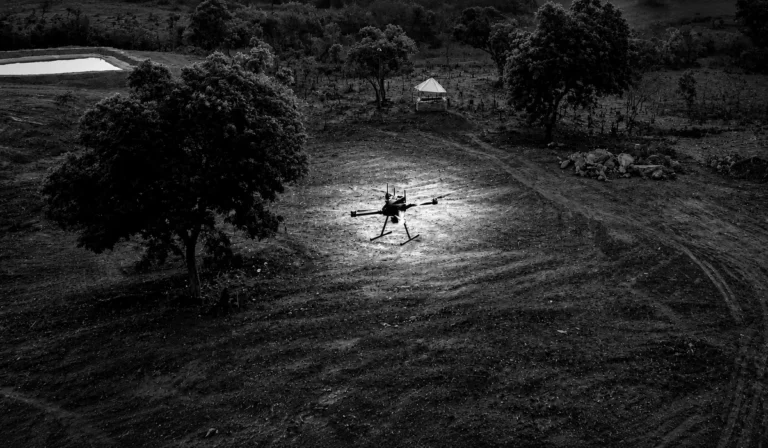
The commercial division of Nigerian defense-technology startup Terra Industries has secured USD 2 million in contracts to provide advanced aerial and ground perimeter security for lithium mining operations in Nigeria, marking a swift and lucrative validation of the company’s recent strategic pivot. Barely a week after formally launching its dedicated commercial unit, the firm announced it will deploy an integrated security infrastructure comprising 20 autonomous sentry towers and four proprietary Iroko drones across two separate mining locations. These systems will be governed by ArtemisOS, Terra’s proprietary command-and-control software, delivering round-the-clock surveillance, real-time threat detection, and automated tactical response capabilities.
Company executives indicate that these initial agreements are merely the vanguard of a broader operational rollout, with additional mining sites slated to come online as the operating companies scale their domestic footprint. This rapid commercialization underscores the escalating urgency private resource extractors face in safeguarding critical mineral assets across the African continent. However, the multi-million-dollar deal also thrusts Terra Industries into the center of a complex geopolitical debate regarding technological sovereignty, foreign-backed venture capital, and the security of Africa’s critical green energy supply chains.
Chronology of Terra Industries and the Commercial Pivot
The trajectory of Terra Industries reflects the rapid maturation of the African defense-tech sector, moving from localized research and government-focused procurement to aggressive international commercial expansion.
The foundational architecture for Terra was established with an emphasis on domestic security solutions, manufacturing critical aerospace and hardware components in-house. By designing and building its own airframes, specialized propellers, high-capacity battery packs, and software suites, the startup positioned itself as a low-cost, high-efficiency alternative to traditional Western defense contractors. This vertically integrated manufacturing model allowed the company to undercut international competitors by up to 55 percent on hardware costs, an attractive value proposition for both cash-constrained African governments and profit-driven private enterprises.
For the initial years of its operation, Terra split its operational bandwidth between state security contracts and ad-hoc commercial services, gradually building a portfolio that now protects approximately USD 11 billion worth of infrastructure assets, primarily concentrated within the energy and mining sectors.
The inflection point for the startup occurred in August of this year with the strategic appointment of Todd Stiefler as Director of Commercial Operations. Stiefler, an alumnus of Silicon Valley data-mining giant Palantir Technologies, was brought on board to institutionalize and accelerate Terra’s expansion into the private sector. His mandate was clear: package the company’s battlefield-tested autonomous security solutions for commercial deployment across Africa, the Middle East, South America, and South Asia. Within weeks of this structural reorganization, the division secured the USD 2 million lithium mining contracts, signaling that the market demand for automated industrial security far outpaces current supply.
The Strategic Importance of Nigerian Lithium and the Security Crisis
To fully understand the significance of Terra Industries’ latest contracts, one must examine the geopolitical and economic weight of lithium within Nigeria’s broader macroeconomic strategy. Often referred to as "white gold," lithium is an indispensable component in the manufacturing of lithium-ion batteries, which power everything from electric vehicles (EVs) to grid-scale renewable energy storage systems. As the global economy accelerates its transition away from fossil fuels, demand for the mineral has skyrocketed, transforming mineral-rich developing nations into critical nodes of the global clean energy supply chain.
Nigeria possesses substantial, largely untapped reserves of hard-rock lithium, primarily concentrated in states such as Nasarawa, Kwara, Ekiti, and Kogi. Recognizing the potential to move up the global value chain, the Nigerian federal government has implemented strict policies prohibiting the raw export of unprocessed solid minerals, mandating instead that mining operators establish local processing and refining facilities within the country.
However, this regulatory push has inadvertently triggered a chaotic scramble for the resource. The combination of high global market valuations, porous borders, and inadequate state security infrastructure has turned many mining districts into hotspots for illicit extraction. Artisanal miners and heavily organized criminal syndicates—frequently operating in illicit collusion with foreign syndicates—routinely bypass federal licensing frameworks.
The human and economic toll of this lawlessness is substantial. In May, Nigerian authorities launched a major crackdown, arraigning 15 Chinese nationals and nine Nigerian accomplices over large-scale illegal mining operations in Nasarawa State. The Nigerian Security and Civil Defence Corps (NSCDC) and federal mining task forces have increasingly characterized the protection of critical mineral sites as a matter of supreme national security.
With state security forces perpetually overstretched and struggling to police vast, remote mining concessions, private operators have been forced to take matters into their own hands. Terra Industries has effectively stepped into this vacuum, marketing its autonomous drone fleets and sentry towers as a technologically superior, cost-effective substitute for traditional, corruption-prone human security guards.
Industry Data and Technological Edge
Terra Industries’ competitive advantage lies in its aggressive cost structure and proprietary technology stack. Traditional industrial security in remote African mining enclaves has historically relied on private security companies (PSCs) deploying armed personnel, armored vehicles, and static guard posts. This model is not only financially burdensome—often running into millions of dollars annually for personnel retention, rotation, and logistics—but also operationally limited by human error, fatigue, and vulnerability to bribery or ambushes.
By contrast, Terra’s deployment model relies on hardware-software integration:
- Autonomous Airframes: The four Iroko drones deployed at the Nigerian mining sites operate via pre-programmed patrol routes or dynamic tasking issued by ArtemisOS, removing the need for constant human pilot oversight.
- Sentry Towers: The 20 fixed towers act as localized radar and optical surveillance nodes, providing persistent over-the-horizon awareness and deterring unauthorized incursions before they reach critical infrastructure.
- Cost Arbitrage: By manufacturing airframes and battery packs domestically or within optimized regional supply chains, Terra reportedly reduces hardware overhead by 55% compared to imported Israeli, European, or American defense hardware.
- Asset Protection Footprint: Prior to the lithium deals, Terra’s systems were already deployed across various high-value energy and mining installations, securing cumulative assets valued at approximately USD 11 billion.
Despite these impressive metrics, the identity of the two mining companies and the precise geographic coordinates of the protected sites have been withheld by Terra Industries for proprietary and security reasons. Company representatives have confirmed, however, that operational footprints will expand incrementally as the client companies commission additional mining pits and processing plants.
The Sovereignty Debate: Balancing Protection and Foreign Influence
While the commercial success of the lithium mine security contracts is undeniable, the partnership has reignited intense debate regarding technological sovereignty, data governance, and foreign influence in the Global South.
Terra Industries has consistently framed its overarching corporate mission in nationalistic and regional terms: to empower nations in the Global South with the indigenous technological capabilities required to secure their own economic futures and safeguard critical resources. Company leadership frequently emphasizes local manufacturing, regional job creation, and the reduction of dependency on traditional Western defense conglomerates.
However, a critical examination of Terra’s financial backing and executive leadership reveals deep entanglements with Silicon Valley and Western intelligence-linked networks. The startup is principally backed by 8VC, a prominent venture capital firm founded by Joe Lonsdale—who is also a co-founder of Palantir Technologies. Furthermore, the commercial division responsible for executing these lucrative mining contracts is spearheaded by Todd Stiefler, a direct transplant from Palantir, a firm renowned globally for its deep integration with Western defense, intelligence, and national security apparatuses.
This dual identity—operating as an African champion of technological self-reliance while being financially and structurally tethered to Silicon Valley venture capital—presents a complex paradox.
The lithium mines now being secured by Terra sit at the very heart of Nigeria’s economic diversification and resource sovereignty ambitions. Consequently, the data flowing through Terra’s ArtemisOS command-and-control layer, as well as the high-resolution feeds captured by its Iroko drones, possess immense strategic value. This surveillance infrastructure generates granular intelligence regarding:
- Real-time movement patterns and logistical workflows of the mining operations
- Exact infrastructural vulnerabilities and power grid layouts
- Detailed topographical and geological mapping data
- Comprehensive security response times and blind spots
Critics and geopolitical analysts argue that whoever controls the data pipelines of critical mineral extraction sites effectively holds a secondary lever of control over the resource itself. While Terra maintains that data sovereignty remains strictly with its clients and host governments, the structural influence of foreign-backed investors and Western-trained executives leaves the company vulnerable to scrutiny.
Broader Implications and Future Outlook
The deployment of Terra Industries’ autonomous defense systems at Nigerian lithium sites serves as a bellwether for the future of resource extraction security across developing economies. As climate change policies drive an unyielding demand for critical minerals, traditional models of industrial protection are proving obsolete. Autonomous surveillance, AI-driven threat triage, and drone-based perimeter defense are rapidly transitioning from experimental military applications to essential commercial commodities.
For Nigeria, the contracts represent an immediate tactical victory in the ongoing war against illegal mining and resource theft. If Terra’s sentry towers and Iroko drones successfully deter criminal cartels and secure processing plants without major security breaches, the federal government may look to institutionalize similar public-private technological frameworks across other vital sectors, including petroleum pipelines and agricultural belts.
For Terra Industries, however, the stakes extend far beyond a USD 2 million balance sheet. The company has convincingly proven that it can sell its products and deploy advanced tactical technology into high-stakes commercial environments. Yet, the broader political test remains entirely unquantified. Whether Terra can successfully deliver genuine technological sovereignty to the Global South on its own terms—while navigating the competing interests of local regulatory bodies, regional sovereignty advocates, and its Silicon Valley financial backers—will define the company’s long-term legacy in Africa’s high-tech industrial landscape.