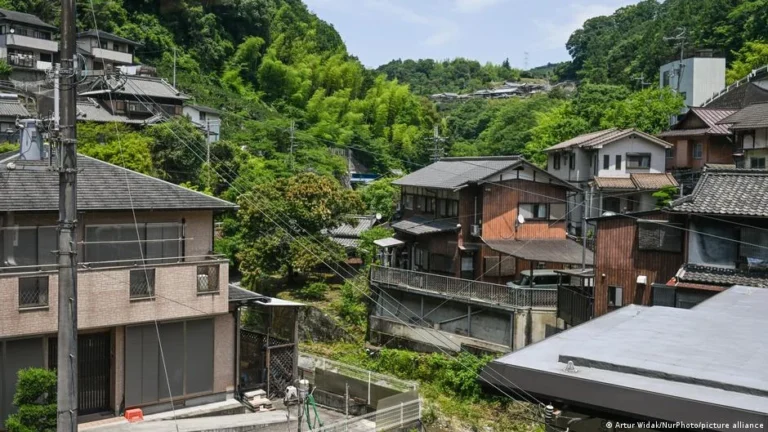
In the quiet, residential suburbs of Yokohama, a two-story house stands as a stark testament to a deeply ingrained cultural aversion. Its metal shutters are permanently drawn, obscuring the downstairs windows, while upstairs, the once-delicate paper sliding doors hang in tatters. The garden, a chaotic tangle of weeds and overgrown shrubs, suggests years of neglect. This property, like thousands across Japan, is not merely old or run-down; it is a "jiko bukken" – a stigmatized property – a label that renders it virtually untouchable in the eyes of many Japanese. Despite its potential for renovation into a perfectly habitable home, it has stood empty for at least five years, a silent monument to an unfortunate past.
The Unseen Burden: Defining "Jiko Bukken"
A "jiko bukken" is a property where an "incident" has occurred, a broad term encompassing a range of distressing events that are believed to imbue the location with a sense of impurity or misfortune. The most common incidents include suicides, fires that resulted in fatalities, or what the Japanese refer to as "kodokushi" – lonely deaths, where an elderly person passes away unnoticed, sometimes for an extended period. Murders, though less frequent, also irrevocably brand a property as stigmatized. The immediate visual cues, such as the decrepit state of the Yokohama house, often reflect years of abandonment following such an incident. Owners find themselves in a precarious position, burdened by a property that generates no income but accrues taxes and maintenance costs, all while facing a profound societal reluctance to engage with its history.
This cultural phenomenon is not merely a quirk but a significant factor contributing to Japan’s escalating vacant home crisis. Kazutoshi Kodama, president of Kachimode Co., a specialist property firm established in December 2022, views "jiko bukken" not just as a financial drain on owners but as a burgeoning business opportunity. His company, Kachimode, offers services to "assist owners of properties with a history of incidents with the management of their rental properties," a mission that increasingly involves confronting the intangible. Part of this unique service includes a comprehensive "ghost investigation," a demand for which, Kodama notes, is rapidly soaring.
A Cultural Tapestry of Impurity and Misfortune
The deep-seated aversion to "jiko bukken" is rooted in Japan’s rich spiritual traditions, particularly Shintoism and Buddhism. In Shinto, Japan’s indigenous religion, death is associated with kegare, a state of ritual impurity. Contact with death is believed to transmit this impurity, which can bring misfortune or even spiritual defilement. While not inherently evil, kegare must be purified through rituals known as harae. This belief system influences daily life, including residential preferences. Many Japanese believe that residing in a place where a tragic death occurred could invite bad luck, negative energy, or even lingering spirits.
"Japanese people sometimes regard death as impure," Kodama explained to DW. "Death equates to impurity and misfortune. Consequently, they believe that coming into close contact with death will bring them misfortune. And that means quite a lot of Japanese are reluctant to go near such properties, let alone rent or buy one." This sentiment extends beyond the immediate family of the deceased, affecting potential tenants and buyers who may fear inheriting the spiritual weight of the past occupants. The concept of "lonely death" is particularly poignant, as it implies a lack of care or connection, which can be seen as an additional layer of sorrow or ill omen associated with a property.
Buddhist traditions also contribute to these anxieties, with beliefs in ancestral spirits and the possibility of restless souls. If a death was violent, sudden, or filled with despair (like suicide), there is a fear that the spirit of the deceased may not have found peace, potentially remaining attached to the place of their passing. These cultural sensitivities create a unique challenge in Japan’s real estate market, transforming what might be a minor renovation project elsewhere into an intractable problem.
Japan’s Vacant Home Crisis: A Stigmatized Contribution
The issue of "jiko bukken" is inextricably linked to Japan’s broader crisis of vacant homes, known as "akiya." According to a government survey conducted in late 2024, there were an astounding 9 million vacant homes across Japan, accounting for 13.8% of all accommodation in the country. This figure represents a record high and underscores a pressing national challenge. While various factors contribute to this phenomenon – including Japan’s rapidly aging population, declining birthrate, urbanization leading to rural exodus, and complex inheritance laws – the cultural stigma surrounding "jiko bukken" plays a significant, if often overlooked, role.
Many akiya are located in rural areas, where population decline is most severe. However, even in city centers, surprisingly high numbers of empty properties exist. Families often disagree on how to dispose of inherited properties, or they may simply not deem a dilapidated home worth the effort of selling, especially if it carries a stigma. The economic implications are substantial. Vacant homes contribute to urban blight, depress property values in surrounding areas, and represent untapped economic potential. Owners of "jiko bukken" face the dual burden of maintaining a property that generates no income while often paying property taxes, creating a financial drain that can persist for years, if not decades.
The Digital Blacklist: Oshimaland and Disclosure Laws
The challenge of renting or selling a "jiko bukken" is further compounded by strict legal requirements and the pervasive availability of information. In Japan, real estate agents are legally obligated to disclose a property’s history to any interested parties. This legal mandate ensures transparency but also acts as a powerful deterrent. In 2021, Japan’s Ministry of Land, Infrastructure, Transport and Tourism (MLIT) issued updated guidelines to clarify the disclosure requirements. These guidelines generally stipulate that disclosure is required for deaths resulting from murder, suicide, accidental fire, or "lonely deaths" that occurred within the property or common areas. However, they also introduce nuance: for "lonely deaths" or accidents, disclosure may not be required if a subsequent tenant has lived there for a significant period (e.g., three years) without issue, or if the property has undergone extensive renovation. For murder or suicide, however, disclosure is almost always mandated, irrespective of time or subsequent occupancy.
Beyond legal obligations, a highly visible online resource, Oshimaland (oshimaland.co.jp), has emerged as a crowdsourced database of stigmatized properties. This website maps the location of virtually every known "jiko bukken" in the country, often detailing the reason for its blacklisting. While most listings indicate accidental fires, lonely deaths, or suicides, some offer a more ominous note: "Obtain details from real estate agent," hinting at more disturbing incidents. This digital blacklist ensures that even if an agent were to attempt to obscure a property’s past, a quick online search by a prospective buyer or renter would reveal the truth, reinforcing the stigma.
The financial repercussions for owners are severe. In a bustling metropolis like Tokyo, where rental demand is high, the owner of a stigmatized property might expect to cut the rent by at least 30%. In less competitive areas, the reduction can be as much as half. Kodama noted that some properties, despite aggressive advertising, remain vacant for as long as 500 days, with extreme cases exceeding 1,000 days. "In short, they simply become vacant properties and the concept of a price reduction just does not apply," he stated, illustrating the complete market failure for some of these homes.
Innovative Solutions: Bridging the Supernatural and the Real Estate Market
In response to this unique market challenge, innovative solutions have begun to emerge, blending scientific investigation with traditional spiritual practices to address the anxieties surrounding "jiko bukken."
-
Kachimode’s "Ghost Investigations": A Scientific Approach to the Spiritual
Kazutoshi Kodama’s Kachimode Co. stands at the forefront of this niche market. His company’s "ghost investigation" service aims to "cleanse" a property not just through physical refurbishment (replacing carpets, fittings, wallpaper) but also through a rigorous, almost scientific, assessment of its spiritual atmosphere.
"My company carries out what we call ‘ghost investigation,’" Kodama explained. "We stay in rooms where incidents have occurred from 10 p.m. until 6 a.m. the following morning, conducting video recording, audio recording, electromagnetic wave surveys, measurements of room temperature, humidity and atmospheric pressure, thermography and noise surveys." The objective is twofold: to verify that the rooms have been thoroughly refurbished and are physically clean, and crucially, "to prove that poltergeist phenomena, the presence of ghosts and other mysterious occurrences do not occur."
Kachimode’s service is unique in Japan, often involving collaboration with a university professor specializing in monitoring the supernatural. An overnight investigation costs 88,000 yen (approximately €474 or $542), after which a comprehensive report is provided to the owner. This report then serves as documentation for real estate agents, bolstering their assertion that no lingering "bad spirits" remain. Kodama admits that his equipment has occasionally picked up anomalies, such as video cameras stopping recording or microphones malfunctioning. However, he emphasizes, "in the vast majority of cases, what was perceived as an ‘impurity’ could not be replicated and was dismissed as a one-off occurrence." Yet, he acknowledges, "there are also properties where various mysterious phenomena occur consistently over a long period of more than a year." For these particularly challenging cases, Kachimode offers tailored strategies, underscoring the complexity and variability of perceived spiritual activity. -
AkiyaMart’s Shinto Rituals: Traditional Purification for Modern Problems
Another entrepreneur tackling the stigmatized property market is Joey Stockerman, co-founder of AkiyaMart, a platform dedicated to promoting the sale of vacant homes across Japan, particularly in rural areas. Stockerman recognizes the pervasive nature of superstition in Japan. "Japanese people are often very superstitious," he told DW. "Renting places where someone has died can be really hard, and they do not want properties that are close to graveyards either as there are strong feelings here about death."
To address these deep-seated concerns, AkiyaMart has recently introduced a package service: a Shinto priest from a nearby temple will visit the property to perform a traditional purification ceremony. These rituals, known as o-harai or jichinsai (ground-breaking ceremony, adapted for existing structures), are designed to cleanse the space of impurity, appease any restless spirits, and invite good fortune. While Stockerman describes the service as "a bit quirky," he notes that "there has been interest," suggesting a growing openness to combining traditional spiritual remedies with modern real estate transactions. This approach directly taps into the cultural belief that proper rituals can neutralize negative energies and restore a sense of peace to a property.
Economic Reality Bites: The Price of Stigma
The financial impact of "jiko bukken" is not just theoretical; it manifests in tangible losses for property owners and challenging investment scenarios. Stockerman recounted the experience of a business acquaintance who saw an investment opportunity in a stigmatized property in a Tokyo suburb. The investor acquired the home for less than $5,000, roughly 5% of its estimated true market value, hoping to capitalize on the deep discount. However, the investment did not yield the anticipated quick returns. The real estate agent, bound by legal and ethical obligations, refused to gloss over the property’s history, leading to it remaining empty for two years before a tenant was finally secured. This case highlights that even with significant price reductions, the stigma can outweigh financial incentives for a considerable period.
Such stories are common. Properties that languish for hundreds of days, even with drastic price cuts, exemplify the market’s irrationality when confronted with deep-seated cultural beliefs. The concept of "price reduction just does not apply" to properties that are simply unrentable or unsellable due to their history. This creates a challenging environment for owners, who must decide between holding onto a depreciating asset, selling at a significant loss, or investing in the unconventional "cleansing" services now offered.
Beyond Superstition: Addressing a National Challenge
The rise of specialized services like Kachimode and AkiyaMart points to a burgeoning industry dedicated to addressing a uniquely Japanese challenge. Kodama, with over 15 years in real estate, firmly believes in the growth potential of this sector. "Properties where we do find mysterious phenomena are the ones that are typically shunned," he acknowledged. "They are difficult to let or sell. But there are still ways to manage even these properties, and we work with owners to do that. I think this sector has potential because there are people in need."
The implications of the "jiko bukken" phenomenon extend beyond individual property owners and into the broader societal fabric. It exacerbates Japan’s national akiya crisis, contributing to a landscape dotted with decaying homes that could otherwise provide much-needed housing, especially for younger generations or those seeking affordable alternatives. While the economic imperative to utilize these properties is clear, it must contend with deeply ingrained cultural beliefs that are resistant to purely rational solutions.
As Japan continues to grapple with demographic shifts and an abundance of vacant homes, the role of companies offering "ghost investigations" and spiritual purifications may become increasingly vital. These services, while seemingly unconventional, represent a pragmatic attempt to reconcile modern economic pressures with ancient cultural sensibilities. By acknowledging and addressing the spiritual anxieties associated with death and misfortune, these businesses offer a path towards reintegrating stigmatized properties into the market, one cleansed home at a time, providing a glimmer of hope for owners and contributing to the slow, complex process of revitalizing Japan’s dormant real estate.