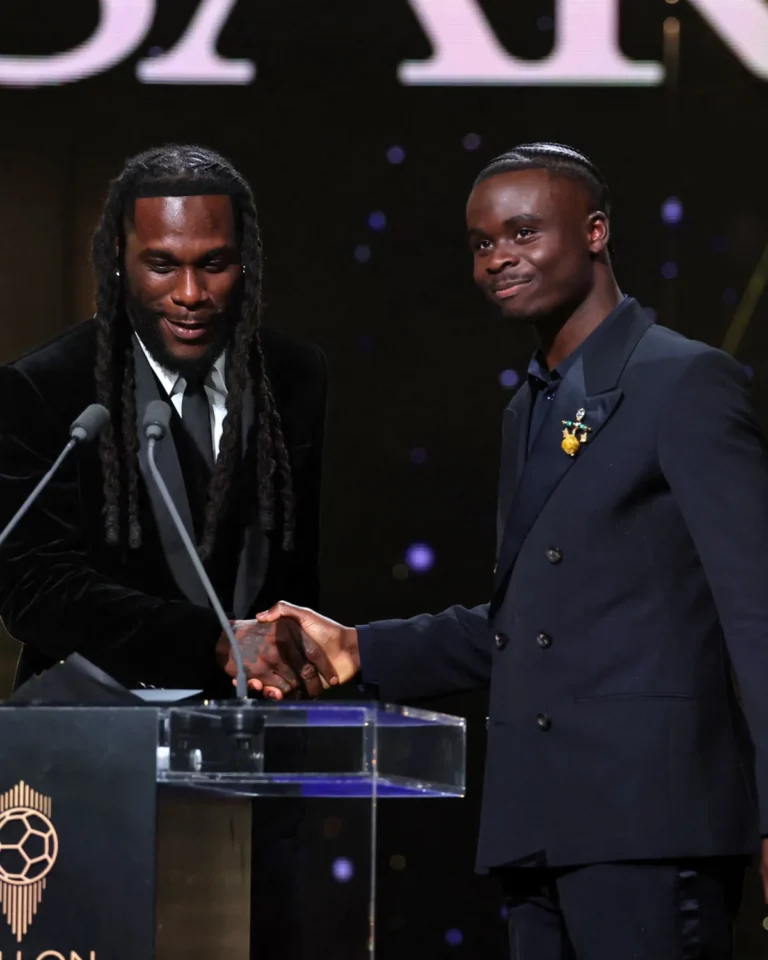
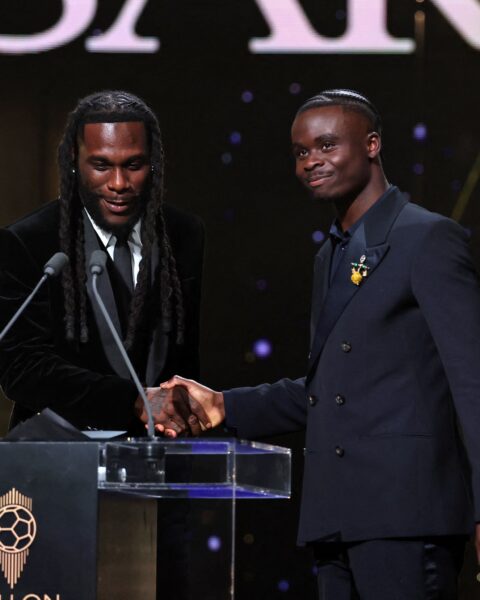
The intersection of elite global sports and world-class entertainment witnessed a defining cultural milestone on Monday, October 26, 2026, when Nigerian music titan Burna Boy took the stage at the prestigious Ballon dOr ceremony. Hosted in London at the iconic Palladium Theatre—shifting from its traditional Paris home for a landmark international edition—the event served as a celebration of athletic achievement while simultaneously highlighting the profound social impact of global icons. Among the evening’s most resonant moments was the presentation of the prestigious Socrates Award to Arsenal and England winger Bukayo Saka. In a powerful alignment of heritage and excellence, Burna Boy, dressed in a sharply tailored black suit adorned with subtle metallic embellishments and his signature dark sunglasses, handed the accolade to Saka, who cut an equally dashing figure in a classic black tuxedo and bow tie. The convergence of two of Nigeria’s most prominent cultural ambassadors on a legendary European sporting platform underscored a broader narrative: the growing influence of African diaspora talent across international industries, from music to elite football.
The Mechanics of the Socrates Award and Bukayo Sakas Humanitarian Footprint
Established in partnership between France Football and Peace and Sport, the Socrates Award is named after the legendary late Brazilian footballer Socrates, renowned for his activism and intellectual engagement. The accolade is specifically designed to recognize footballers who are actively engaged in social projects, philanthropy, and humanitarian initiatives outside the traditional boundaries of competitive sport. Bukayo Saka’s receipt of the 2026 Socrates Award reflects a growing trend among modern athletes who leverage their massive platforms, financial resources, and personal narratives to effect tangible change in vulnerable communities.
While Saka is internationally celebrated for his blistering pace, clinical finishing, and pivotal contributions to both Arsenal Football Club and the England national team, his impact off the pitch has been equally commendable. Over recent years, the Hale End academy graduate has quietly spearheaded numerous philanthropic ventures, focusing heavily on youth empowerment, education, and healthcare access both in the United Kingdom and his ancestral homeland of Nigeria. Saka has consistently funded initiatives providing sporting infrastructure, educational supplies, and healthcare support to underprivileged children, embodying the exact ethos of social responsibility that the Socrates Award was created to honor. His ability to navigate the intense pressure of elite Premier League and international football while maintaining a deep commitment to social welfare made him an undisputed choice for the international jury panel in 2026.
Burna Boys Vision for African Football and Grassroots Infrastructure
Adding profound contextual weight to the presentation, Burna Boy utilized his moment at the podium to shed light on his own philanthropic and entrepreneurial endeavors aimed at transforming the sporting landscape in West Africa. The Grammy-winning Afrofusion pioneer—born Damini Ebunoluwa Ogulu—addressed the global audience not merely as a guest presenter, but as a stakeholder in the future of athletic development. During his brief yet impactful address, Burna Boy revealed the existence of a grassroots football academy he established in Nigeria several years prior, created specifically to nurture raw talent, provide structural support, and bridge the massive infrastructure gap that historically hinders African youth from realizing their full potential in professional sports.
"Something I started a few years ago, just to support the football culture back home," Burna Boy remarked to the assembled audience of football legends, executives, and international media. "Hopefully, inshallah, one day I’ll come back here to see one of my people getting an award in Ballon d’Or."
This declaration serves as a poignant reminder of the systemic challenges facing sports development across the African continent. Despite producing some of the world’s most formidable footballing talents, West Africa—and Nigeria in particular—has often struggled with inadequate training facilities, corrupt or inefficient administrative structures, and a lack of clear pathways from grassroots participation to elite European academies. By establishing independent academies and investing directly in community sports culture, high-profile figures from the entertainment industry like Burna Boy are increasingly stepping into roles traditionally neglected by municipal and national governing bodies. His explicit aspiration—seeing a locally nurtured talent ascend to the absolute summit of world football to claim a Ballon d’Or or equivalent honor—articulates a collective dream shared by millions of football enthusiasts across the African continent.
Chronology of the 2026 Ballon dOr Ceremony in London
The relocation of the Ballon dOr ceremony to London on Monday, October 26, 2026, marked a significant departure from its traditional French capital residency, reflecting the growing commercial and cultural globalization of the sport. Planning for the event began nearly a year prior, with organizers seeking to capture a broader international audience by rotating the host city among global cultural hubs.
By midday on October 26, international media outlets, football administrators, and celebrity guests began arriving at the Palladium Theatre. Security protocols were exceptionally tight, given the high concentration of elite athletes, billionaires, and global entertainment icons in attendance. The red-carpet arrivals commenced at approximately 5:00 PM Greenwich Mean Time (GMT), showcasing high-fashion statements from football’s biggest names alongside figures from fashion, film, and music.
The main awards gala kicked off promptly at 7:30 PM GMT, opening with an introductory address by the event’s executive producers highlighting the evolving role of football in contemporary society. Throughout the evening, various accolades were distributed, including the Kopa Trophy for the best under-21 player, the Yashin Trophy for the best goalkeeper, and the men’s and women’s Ballon d’Or prizes.
The presentation of the Socrates Award occurred midway through the ceremony, strategically positioned to emphasize the human element of the sport amidst an evening largely dominated by statistical achievements, goal tallies, and trophy counts. Burna Boy’s introduction by the event hosts was met with rapturous applause, signaling the profound crossover appeal of Afrobeats music within mainstream European cultural spaces. Following his speech and the handing of the trophy to Saka, the two Nigerian icons briefly addressed the press pool backstage before returning to their seats to enjoy the remainder of the historic evening.
Broader Industry Implications and the Soft Power of African Culture
The convergence of Burna Boy and Bukayo Saka at the 2026 Ballon d’Or is far more than a fleeting viral moment for social media algorithms; it represents a profound structural shift in the global exercise of soft power. For decades, cultural hegemony was strictly unidirectional, flowing from Western industrial centers outward to the Global South. However, the exponential rise of Afrobeats as a dominant global musical genre—spearheaded by artists like Burna Boy, Wizkid, and Davido—coupled with the relentless production of world-class football talent of African descent across European leagues, has completely inverted this historical dynamic.
Economically and culturally, Nigeria punches significantly above its weight on the global stage. The nation’s youth demographic—representing over 60 percent of its population under the age of 25—serves as an inexhaustible reservoir of creative and athletic capital. When global platforms like the Ballon d’Or actively invite and elevate Nigerian figures to prominent presentation roles and major awardees, it validates the immense commercial and cultural value generated by the African diaspora.
Furthermore, the intersection of music and sports philanthropy points toward a sustainable model of private-sector-led social development. As traditional state funding for youth infrastructure in developing nations frequently stumbles due to bureaucratic inefficiency and shifting political priorities, independent initiatives spearheaded by cultural icons offer a viable alternative. Burna Boy’s football academy and Bukayo Saka’s targeted humanitarian interventions demonstrate that successful individuals originating from or connected to regions with developmental deficits are increasingly willing to reinvest their capital and influence directly into community upliftment.
From an analytical standpoint, this event signals to corporate sponsors, sports federations, and international governing bodies that cultural authenticity is no longer a peripheral marketing tool, but the very core of modern audience engagement. Football clubs and award organizers alike recognize that aligning with artists like Burna Boy expands their demographic reach into vital emerging markets across Africa and its vast international diaspora. Simultaneously, acknowledging athletes not just for their athletic output on the pitch, but for their moral character and societal contributions off it, elevates the entire discourse surrounding professional sports.
As the echoes of the 2026 Ballon d’Or ceremony fade and the footballing world turns its attention back to domestic leagues and continental qualifiers, the image of Burna Boy and Bukayo Saka standing shoulder-to-shoulder on a London stage remains etched into the annals of contemporary culture. It stands as a testament to what is possible when raw talent, relentless discipline, and a deep-rooted commitment to community converge on the highest possible tier of global recognition. Whether Burna Boy’s vision of a homegrown academy product lifting the ultimate individual football prize will materialize in the coming years remains to be seen, but the foundation for that future has undeniably been laid by the generational pioneers shaping our modern era.