ABU DHABI, United Arab Emirates — In the gleaming exhibition halls of the Abu Dhabi Future Health Summit, a stark paradox defined the three-day gathering: revolutionary promises of eternal youth clashed directly with the sobering admissions of the clinicians tasked with delivering them. While artificial intelligence startups showcased painkilling molecules designed to outperform morphine in animal models, and government officials courted wearable-tech magnates to integrate biometric data into public apps, the medical director of the world’s first licensed longevity center offered a blunt reality check.
"I’m being honest with you. I would say to you there’s no evidence," Dr. Rory Melville, medical director of the Institute for Healthier Living Abu Dhabi (IHLAD), told Health Policy Watch. "For me to work out whether there’s evidence, I’m going to have to wait for that person to get to the end of their life, which could be, you know, 20, 30, 50, 70 years."
This foundational tension underscores Abu Dhabi’s ambitious, highly capitalized campaign to position itself as the global epicenter of longevity medicine. Yet, as the emirate builds a regulatory framework to tame what industry experts have long criticized as the "Wild West" of anti-aging clinics, it confronts profound scientific, ethical, and demographic hurdles. From soaring regional diabetes rates to fierce corporate legal battles over smart rings, the Middle Eastern financial hub is attempting an unprecedented feat: turning speculative biotech into rigorous, population-scale healthcare.

A Regulatory Blueprint for an Untamed Industry
Longevity medicine has long suffered from a severe reputation problem. Globally, private clinics market expensive blood panels, stem-cell infusions, and proprietary "biological age" tests almost exclusively to affluent clientele, earning sharp rebukes from academic leaders. Eric Verdin, head of the Buck Institute for Research on Aging, has frequently condemned the sector as "medicine for the rich, by the rich." Similarly, Prof. Andrea Maier of the National University of Singapore and co-founder of the Healthy Longevity Medicine Society has characterized the commercial anti-aging landscape as an unregulated frontier.
Abu Dhabi’s response has been an aggressive push toward standardization. In November 2024, the emirate’s Department of Health (DoH) officially licensed IHLAD as the world’s first specialized Healthy Longevity Medicine Centre. By April 2025, the DoH implemented its Healthy Longevity Medicine Clinic Standard.
This regulatory framework is notably more conservative than prevailing commercial advertising. Under the standard, epigenetic and protein-based biological age "clocks" are categorized as optional tools requiring substantial further validation. Furthermore, drugs repurposed for longevity must demonstrate positive randomized controlled trial (RCT) data in human populations before widespread clinical deployment.
However, critics note that this rulebook was crafted within a remarkably insular ecosystem. Dr. Melville acknowledged that IHLAD actively assisted the DoH in drafting the standards, drawing expert consultation from the Healthy Longevity Medicine Society—an organization where IHLAD Chief Executive Dr. Nicole Sirotin serves on the council. When pressed on independent peer review, Melville conceded that because global standards for longevity medicine do not yet exist, these frameworks represent the closest available approximation of governance for a nascent industry.

Wearable Tech, Public Apps, and the "Ring Wars"
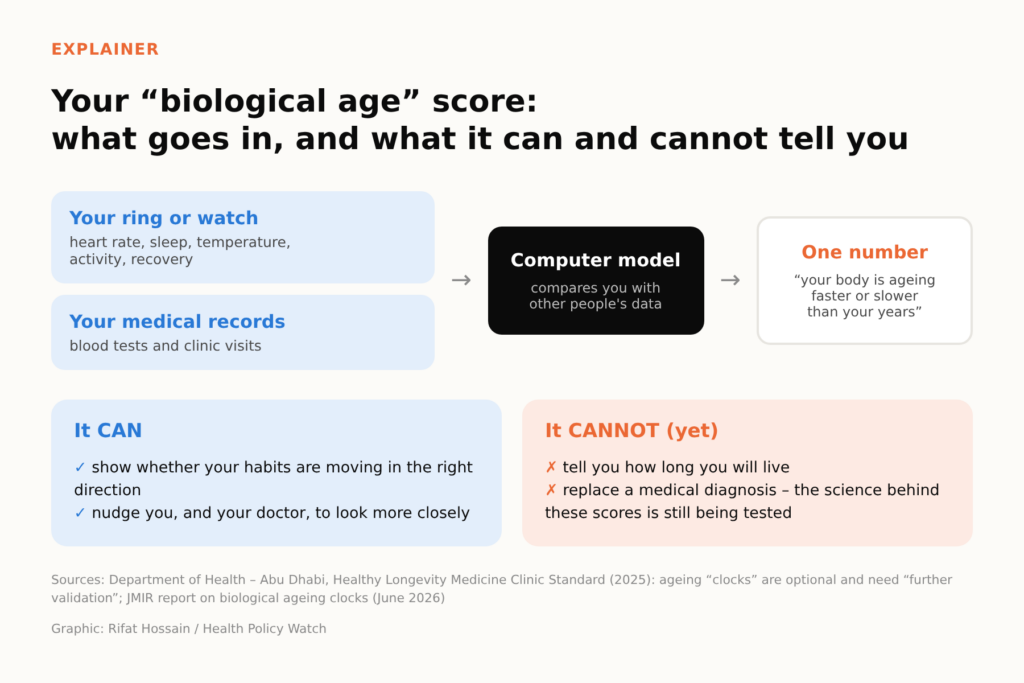
The most visible facet of Abu Dhabi’s preventive health strategy targets the everyday consumer through digital integration. In October 2026, just days before the summit, the Abu Dhabi Public Health Centre finalized a landmark two-year agreement with Indian smart-ring manufacturer Ultrahuman. The partnership aims to build a comprehensive "biological health age" model fusing routine medical diagnostics with continuous wearable telemetry.
This initiative complements the DoH’s existing infrastructure, which features a "health age" scoring system embedded within the government-backed "Sahatna" app and the TAMM services platform. By connecting consumer-grade wearables to the Malaffi health information exchange, Abu Dhabi is attempting to scale preventive medicine across its entire resident population.
"Doctors can say and tell anything that the model could tell because it’s the same human body and biological information," Mohit Kumar, Ultrahuman’s founder and chief executive, explained on the sidelines of the summit. "The only difference is that we could tell this continuously."
Despite the enthusiasm, mainstream medical skepticism persists. In August, a comprehensive review published in JAMA Internal Medicine concluded that there is a lack of robust scientific evidence demonstrating that continuous glucose monitors—another flagship product offered by Ultrahuman—meaningfully improve health outcomes or prevent disease in healthy cohorts. Furthermore, independent clinical researchers emphasize that wearable biometric trackers do not measure biological aging in a literal, diagnostic sense.

Compounding these scientific debates are fierce commercial hostilities. Even as Abu Dhabi courts multiple wearable enterprises, those companies remain locked in aggressive international litigation. Finland-based Oura secured a significant legal victory in a U.S. trade case that temporarily barred imports of earlier Ultrahuman rings. Following U.S. customs clearance of a redesigned device, Oura filed fresh patent infringement claims against Ultrahuman’s newer products precisely during the week of the Abu Dhabi summit.
Concurrently, Oura partnered with the DoH and Corniche Hospital to launch "Project Cradle," a two-year clinical study evaluating whether smart rings worn during pregnancy can predict the early onset of premature labor. Meanwhile, rival American wearable maker WHOOP deepened its regional research footprint after Abu Dhabi’s state-backed investment fund, Mubadala, injected $75 million into the company in May 2025.
AI Drug Discovery: From Computer Screens to Clinical Trials
Beyond consumer biometrics, Abu Dhabi is heavily subsidizing artificial intelligence to transform pharmaceutical development. Insilico Medicine, which operates a premier AI drug-discovery hub in Masdar City, made waves at the summit by highlighting its pipeline of computationally designed therapeutic candidates.
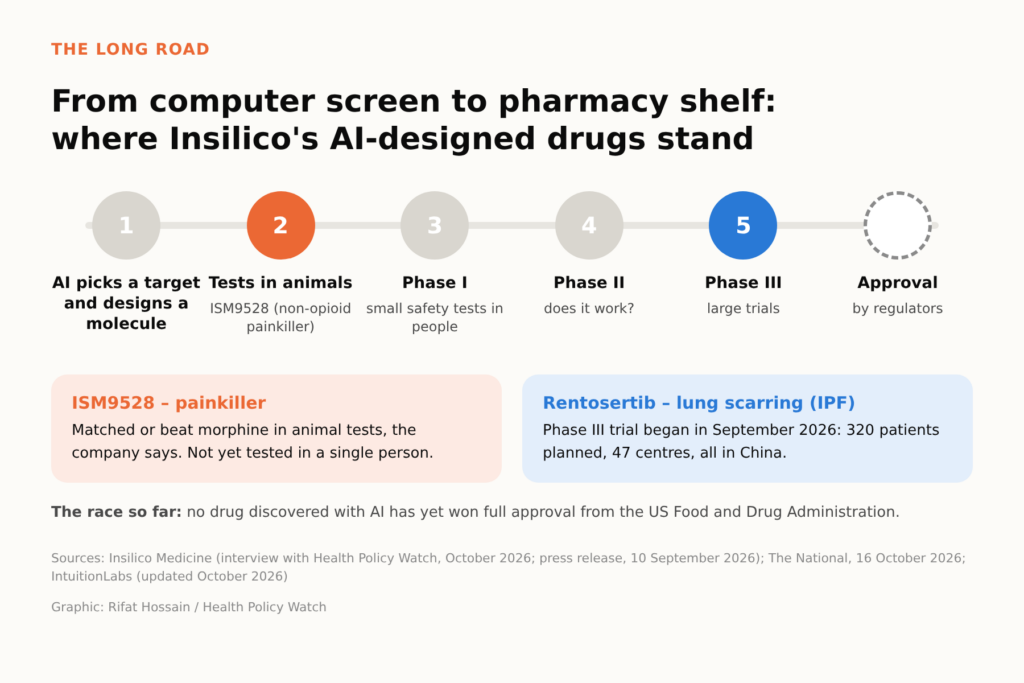
Alex Aliper, co-founder and president of Insilico Medicine, detailed the development of ISM9528, a non-opioid painkiller engineered entirely via artificial intelligence algorithms. "In terms of injectable formulation, we showed that it was on par and even sometimes outperformed morphine in terms of its efficiency of ameliorating and stopping pain," Aliper stated. "So it can replace morphine. That’s what we saw in animals."
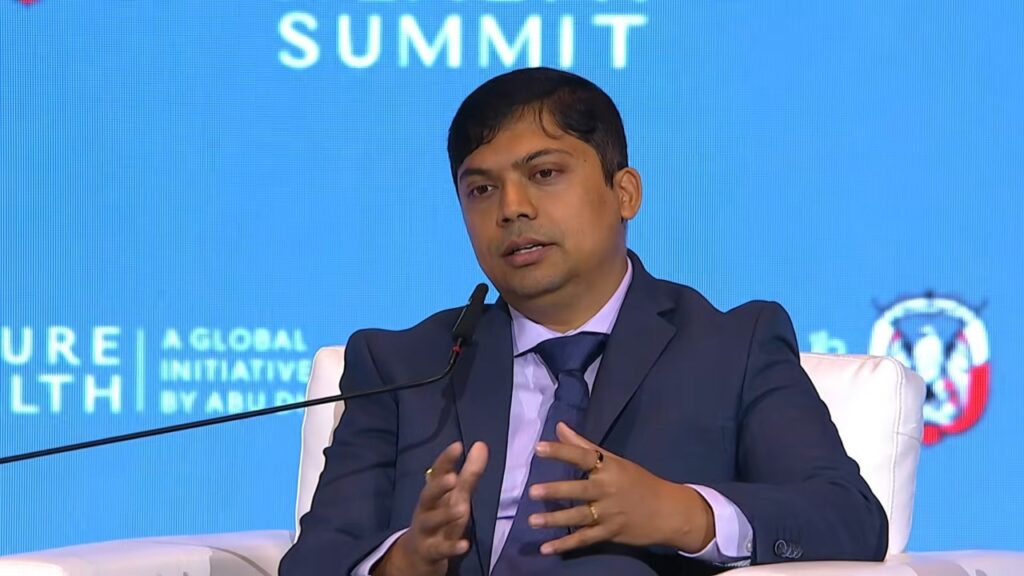
If successfully translated to human trials, a safe, non-addictive alternative to opioids would fundamentally disrupt pain management and mitigate the devastating global overdose epidemic. However, industry analysts remain cautious; ISM9528 has yet to be administered to human subjects, and a vast majority of preclinical candidates fail during clinical translation.
Insilico’s broader portfolio touches directly on the biology of aging. Its lead candidate, rentosertib, is designed to treat idiopathic pulmonary fibrosis—a debilitating, scarring lung disease characterized by distinct aging hallmarks. In September, scientists published data in Nature Biotechnology indicating that patients from early-stage trials exhibited biologically "younger" profiles on specific proteomic aging clocks following treatment. These findings are currently being tested in a rigorous 52-week Phase III clinical trial involving 320 patients across 47 international centers.
The Regional Health Crisis: Confronting Diabetes and Lifestyle Shifts
Underpinning Abu Dhabi’s massive financial investments in longevity and biotechnology is an urgent, long-standing public health challenge: an escalating burden of cardiometabolic disease.
According to Dr. Melville, the United Arab Emirates faces an adult diabetes incidence rate of approximately 21%, more than double the global average of 11%. Data from the International Diabetes Federation further underscores the crisis, estimating age-standardized prevalence near 20.7%, with nearly 64% of affected individuals remaining undiagnosed prior to clinical presentation.
"Up until 50 years ago they were living a Bedouin life, so they actually had a much more active life," Melville noted, reflecting on rapid socioeconomic modernization and the subsequent adoption of high-calorie Western dietary patterns. Genetic predispositions among Emirati populations, alongside high-risk cardiometabolic profiles among the nation’s substantial South Asian workforce, exacerbate these vulnerabilities.
Despite pervasive health screening infrastructure, local health metrics reveal persistent systemic challenges. "Looking at the statistics, the population [are] not getting any healthier," Melville admitted. "And there’s something not quite right with the system."
Socioeconomic Equity and the Future of Longevity
As Abu Dhabi charts its path forward, critical questions regarding healthcare equity remain unanswered. Foreign nationals and low-paid migrant laborers constitute the vast majority of the UAE’s population. While premium longevity clinics remain financially inaccessible to the average worker, government-backed initiatives and consumer apps strive for broader accessibility. Nevertheless, structural disparities in device ownership, data privacy frameworks, and equitable access to advanced therapeutics continue to pose significant ethical challenges.
Demographic and epidemiological consensus emphasizes that the realistic goal of longevity science is not necessarily an indefinite expansion of maximum lifespan, but rather the compression of morbidity—shortening the duration of chronic illness and frailty at the end of life.
As global health systems watch Abu Dhabi’s high-stakes experiment unfold, the ultimate verdict rests on whether the emirate’s blend of rigorous clinical trials, transparent data validation, and AI-driven pharmacology can successfully translate into measurable population-wide health gains. For now, the architects of Abu Dhabi’s longevity strategy maintain a pragmatic outlook.
"I think there’s a lot of promise," Melville concluded, "but we just need to wait and see whether that comes to fruition."