
The European Union has taken its most aggressive regulatory stance yet against Big Tech, unveiling a landmark legislative framework designed to insulate children and adolescents from the recognized mental health hazards of digital platforms. Announced in Brussels by European Commission President Ursula von der Leyen, the proposed “EU Kids Act” seeks to institute a comprehensive social media ban for all children under the age of 13 across the bloc’s 27 member states. Beyond outright exclusion for the youngest demographics, the sweeping digital health initiative mandates rigorous parental oversight, structural platform redesigns, and strict usage caps for young teenagers aged 13 to under 15.
The proposal arrives at a critical juncture for public health policy, as international medical communities increasingly categorize excessive, engagement-driven screen time as a major contributor to rising rates of adolescent anxiety, depression, and sleep deprivation. By shifting the regulatory burden of proof directly onto technology corporations, the European Commission aims to establish the world’s first binding supranational standard for minor digital safety, effectively challenging the prevailing business models of global social media conglomerates.
Main Facts of the EU Kids Act Framework
The core of the EU Kids Act centers on redefining how minors interact with digital environments. Rather than focusing solely on user behavior, the legislation targets the architecture of platforms themselves. The draft strategy specifically encompasses "Social Media+" platforms, video-sharing services, and conversational artificial intelligence companions that exploit developing cognitive systems.
Under the proposed rules, children under 13 will be legally barred from holding independent social media profiles. Meanwhile, adolescents aged 13 to under 15 will be restricted to guardian-supervised "mini-accounts." These specialized profiles come equipped with mandatory safeguards, including a strict one-hour daily screen-time limit, default private settings, and highly restricted contact lists to prevent unsolicited interactions with strangers or predatory actors.

To ensure compliance, the legislation forces platform operators to abandon engagement-maximizing features by default. Practices such as infinite scrolling, randomized reward loops reminiscent of slot machines, and aggressive push-notification triggers designed to capture adolescent dopamine cycles will be outlawed. Furthermore, technology companies will be legally obligated to conduct rigorous safety-by-design audits and scientifically demonstrate that their algorithms do not cause psychological harm before deploying new features to young users.
Background Context and the Escalating Youth Mental Health Crisis
The formulation of the EU Kids Act is rooted in mounting empirical evidence linking heavy digital consumption to severe psychological distress among youth. Recent data published via the Eurobarometer survey highlights that European teenagers spend an average of 4.5 hours online daily during school days. Public health experts warn that this level of hyper-connectivity severely disrupts natural circadian rhythms, diminishes academic performance, and exposes vulnerable minds to cyberbullying, unrealistic body image standards, and harmful algorithmic content.
The psychological toll has prompted international alarm. Pediatric associations, mental health advocates, and academic researchers have spent years lobbying governments to intervene, arguing that self-regulation by technology companies has failed. The EU proposal directly mirrors recommendations from a specialized European Commission expert panel, which advised Brussels to establish a uniform digital age of majority and upend the traditional legal dynamic that places the responsibility of safety onto parents and children.
The urgency of the European initiative is further magnified by concurrent global legal battles. In the United States, public scrutiny reached a historic milestone following massive multi-billion-dollar litigation brought by state attorneys general against Meta, accusing the tech giant of designing addictive features that deliberately target and harm minors. Meanwhile, individual European nations have previously attempted legislative curbs, though with varying degrees of success. Most notably, France enacted a national social media ban for teenagers under 15, only to have its Constitutional Council strike down the measure over constitutional infringements related to freedom of expression and proportionality. By structuring the EU Kids Act around supervised accounts and technical design standards rather than an absolute blanket ban for older teens, the European Commission has deliberately engineered the framework to withstand similar judicial challenges.
Chronology of Regulatory Milestones

The path toward the EU Kids Act reflects a multi-year escalation in European digital governance:
- Early 2023 to Late 2024: Growing empirical studies from public health organizations correlate spikes in youth depression with the widespread adoption of short-form video algorithms and algorithmic feeds.
- Mid-2024: The European Commission establishes a specialized expert panel to review evidence on digital harms and formulate policy recommendations for minor safety.
- Late 2024: National attempts, such as France’s legislative push to ban social media for under-15s, face domestic legal roadblocks, demonstrating the need for a harmonized, legally robust supranational approach.
- Throughout 2025: Draft proposals are developed in secret, drawing on inputs from child psychologists, data protection authorities, and digital rights groups.
- September 2026: A leaked Commission draft is published by media outlet Euractiv, revealing the precise contours of the legislation.
- September 16, 2026: European Commission President Ursula von der Leyen formally announces the EU Kids Act during her State of the Union address in the European Parliament, setting the stage for formal legislative debate.
Privacy Safeguards and Implementation Challenges
Balancing child safety with fundamental data privacy rights has been one of the most complex hurdles for the European Commission. The draft legislation attempts to solve this dilemma by mandating the use of an open-source EU age verification tool based on zero-knowledge cryptographic proofs. This system allows users to cryptographically verify that they meet specific age thresholds without disclosing their identity, legal names, or exact birthdates to platform operators.
Despite these advanced technical safeguards, legal scholars and civil liberties experts have voiced significant concerns. Christiane Wendehorst, a prominent legal expert from the University of Vienna, has pointed out that critical circumvention loopholes remain viable. Teenagers could theoretically bypass one-off verification checks by registering accounts under the credentials of older siblings, parents, or compliant peers.
Furthermore, enforcement mechanisms place a heavy bureaucratic burden on both regulators and corporations. Under the proposed administrative framework, platforms classified as Very Large Online Platforms (VLOPs) under EU law must submit comprehensive safety and impact plans to public authorities 30 days prior to releasing any new service or feature. These oversight activities will be financed directly through an EU-wide supervisory fee levied on the platform operators themselves.
Official Responses and Industry Implications
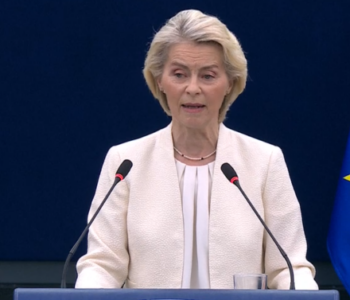
The announcement of the EU Kids Act has drawn swift reactions from political leaders, digital rights advocates, and industry representatives. Championing the initiative as a decisive reclamation of public welfare, President von der Leyen emphasized Europe’s sovereign right to regulate its internal market.
"It is not about our minors accessing social media. It is about when and how we allow social media to access minors," von der Leyen stated during her address. "Europe has the power to act; it is we who decide our rules, not Big Tech."
Conversely, technology sector trade associations have expressed deep apprehension, arguing that strict age-gating and mandatory surveillance of user accounts could undermine end-to-end encryption standards and compromise the privacy of adult users as well. Industry lobbyists contend that rigid time caps and feature bans stifle digital innovation and hinder young people from developing necessary modern media literacy skills.
Broader Impact and Future Legislative Steps
With the formal introduction of the proposal, the legislative fate of the EU Kids Act now shifts to the European Parliament and the Council of the European Union. As co-legislators, European parliamentarians and government ministers will engage in rigorous negotiations to finalize the binding rules. Member states will exercise decisive leverage within the Council, where a qualified majority is required to enact the text into European law.
If successfully ratified, the EU Kids Act will create a powerful global precedent. By establishing unified digital health standards and forcing multinational corporations to alter their core engagement models, the European Union is positioning itself as the definitive global standard-setter for digital ethics, effectively compelling tech companies to prioritize child mental health over ad-driven engagement metrics worldwide.




