On Friday, German Chancellor Friedrich Merz announced his country’s readiness to contribute mine clearance and maritime reconnaissance capabilities to an international effort aimed at securing the vital Strait of Hormuz. This declaration followed extensive consultations with fellow European leaders regarding the formation of a potential multinational mission to safeguard the strategic waterway in the aftermath of a hypothetical or escalating regional conflict. Merz emphasized Germany’s proficiency in mine-clearance operations, stating, "We could provide mine-clearance vessels – we are good at that," while also underscoring the necessity of establishing a "sound legal basis" for any such intervention. The urgency of these discussions was immediately underscored by a swift reversal from Tehran. The same day, Iran’s top diplomat, Abbas Araghchi, initially declared the critical waterway "completely open" for the duration of an Israel-Lebanon ceasefire. This was echoed by US President Donald Trump, who likewise affirmed its readiness for "full passage." However, in a dramatic shift less than 24 hours later, Iran reversed its decision, effectively shutting the strait once more, plunging global maritime trade into renewed uncertainty.
Immediate Developments and International Response
The rapid succession of events on Friday and Saturday highlighted the volatile and unpredictable nature of the Strait of Hormuz’s security landscape. Chancellor Merz’s offer of German naval assets, particularly mine-clearance vessels and reconnaissance capabilities, signifies a proactive step from Berlin and the broader European Union to ensure freedom of navigation through a passage critical for global energy supplies. The explicit mention of a "sound legal basis" for intervention reflects Germany’s adherence to international law and its cautious approach to military deployments in sensitive regions, particularly those fraught with geopolitical tensions. This prerequisite indicates a desire for a mandate that would legitimize any multinational force, likely through the United Nations or a broad international coalition, to avoid unilateral actions that could further destabilize the region.
The contrasting statements from Iran, initially opening the strait then abruptly closing it, sent ripples of confusion and concern through international shipping and diplomatic circles. While Araghchi’s initial announcement could be interpreted as a gesture of de-escalation or a temporary concession linked to the ceasefire, its swift retraction underscored Iran’s asserted sovereign control over the strait and its willingness to leverage this control as a strategic tool. US President Trump’s parallel statement about the strait being "ready for full passage" might have been an attempt to counter Iranian claims of control or to project an image of international resolve in maintaining open sea lanes. However, the subsequent Iranian closure illustrated the limits of such declarations in the face of Tehran’s asserted territorial authority and strategic interests.
Amidst these diplomatic and political maneuvers, the underlying physical threat to maritime traffic remained ambiguous. Iranian authorities had previously hinted at the possible presence of underwater mines in the strait, a claim that experts view with a degree of skepticism. Johannes Peters, an expert on undersea warfare at Kiel University’s Institute for Security Policy, articulated this uncertainty: "We aren’t even certain that there are mines [in the Strait of Hormuz]." Yet, Peters quickly added, "But the underlying threat is enough [to deter passage]. For now, nobody in the war zone can actually go and check." This expert assessment highlights the psychological and economic impact of an unconfirmed threat, which can be as disruptive as an actual physical impediment, forcing commercial vessels to consider alternative, often longer and more expensive, routes or to halt operations altogether.
The Geopolitical Lifeline: Understanding the Strait of Hormuz
The Strait of Hormuz is not merely a waterway; it is a geopolitical artery pulsating with the lifeblood of the global economy. This narrow passage, connecting the Persian Gulf to the Arabian Sea and beyond, is the world’s most important oil transit chokepoint. Approximately one-fifth of the world’s total petroleum liquids consumption, or about 21 million barrels per day, passed through the Strait in 2018, according to the U.S. Energy Information Administration. This includes nearly all the liquefied natural gas (LNG) produced by Qatar, the world’s largest LNG exporter. Any significant disruption to traffic through Hormuz would send shockwaves through international energy markets, leading to soaring oil prices, supply chain vulnerabilities, and potential global economic instability.
The strait’s strategic importance is further amplified by its geographical characteristics. At its narrowest point, it is only 21 nautical miles (39 kilometers) wide, with the shipping lane itself a mere 2 nautical miles (3.7 kilometers) in each direction. This confined space, flanked by Iran to the north and Oman and the UAE to the south, makes it particularly vulnerable to blockades or attacks. Historically, the region has been a hotbed of tension, marked by the Iran-Iraq War (1980-1988), during which both sides targeted tankers in what became known as the "Tanker War." More recently, incidents involving attacks on oil tankers and commercial vessels have periodically escalated tensions, often linked to broader geopolitical confrontations between Iran and Western powers, particularly the United States.
Under the United Nations Convention on the Law of the Sea (UNCLOS), the Strait of Hormuz is designated as an international strait, granting all ships the right of "transit passage," which cannot be impeded. However, Iran, while a signatory to UNCLOS, has not ratified it and occasionally challenges this interpretation, asserting a greater degree of control over the waterway, especially during periods of heightened tensions. This legal ambiguity, coupled with Iran’s military capabilities, including naval forces, missile batteries along its coast, and the potential deployment of naval mines, forms the backdrop against which Germany’s offer and the broader international discussions are taking place.
Berlin’s Proactive Stance: A European Initiative

Germany’s offer to deploy mine-clearance vessels and maritime reconnaissance capabilities represents a significant foreign policy move for a nation that has historically been cautious about military interventions beyond its immediate defense needs. Chancellor Merz’s explicit mention of German proficiency in mine clearance highlights a specific area of military expertise that could be invaluable in securing the Strait. The German Navy possesses advanced mine countermeasure (MCM) vessels, including mine hunters and mine sweepers, equipped with sophisticated sonar systems and unmanned underwater vehicles (UUVs). This specialized capability positions Germany as a potentially crucial player in any multinational effort.
The emphasis on a "sound legal basis" for intervention signals Germany’s commitment to multilateralism and international legitimacy. Such a basis would typically involve a UN Security Council resolution or a clear mandate from an internationally recognized coalition, ensuring that any military deployment is perceived as an effort to uphold international law and freedom of navigation, rather than an act of aggression. This aligns with Germany’s post-World War II foreign policy doctrine, which prioritizes diplomacy and collective security frameworks.
The consultations with fellow European leaders preceding Merz’s announcement suggest a concerted effort within the European Union to formulate a common response to the escalating maritime security challenges in the Gulf. European nations, heavily reliant on energy supplies transiting through the Strait of Hormuz, have a vested interest in its stability. A coordinated European mission, potentially under the umbrella of the EU’s Common Security and Defence Policy (CSDP) or in conjunction with NATO allies, could aim to provide escort services for commercial shipping, conduct surveillance, and, as Germany has offered, undertake mine clearance operations. Such a mission would underscore Europe’s commitment to projecting security and safeguarding its economic interests in a volatile region, while also potentially acting as a stabilizing force between the US and Iran.
The Unseen Threat: Naval Mines and Their Deterrent Power
The threat of naval mines, whether real or perceived, is a potent instrument of deterrence and disruption. As Johannes Peters highlighted, even the uncertainty of their presence can be enough to deter passage. Mines are relatively inexpensive to acquire and deploy, yet they pose an immense, long-lasting threat to maritime traffic. Their clandestine nature makes them particularly insidious, as they can be laid secretly and remain undetected for extended periods, turning vast expanses of water into hazardous zones.
Naval mines have evolved significantly since their rudimentary beginnings. Throughout World War I and World War II, moored mines featuring contact-sensitive switch horns were the standard. These devices, designed to explode upon physical contact with a ship, caused widespread damage and severely restricted naval movements. "Modern mines have fairly little to do with those," Peters explained, indicating the advancements in mine warfare technology.
Contemporary naval mines are far more sophisticated. Their firing mechanisms no longer require direct physical contact but instead can be triggered by various "influence" factors associated with passing vessels. These include magnetic effects (from a ship’s steel hull), underwater sound waves (from propellers and machinery), or changes in water pressure caused by a ship’s displacement. Advanced mines can even be programmed to discriminate between different types of vessels. As Peters elaborated, "submarines can help determine the acoustic profile of a hostile ship." This allows mines to be set to detonate only when a specific "hostile" acoustic signature is detected, enabling "friendly" ships to pass through mined areas unharmed. This capability adds another layer of complexity to mine clearance, as a mine designed for a specific target might not react to a mine-hunting vessel, making detection and neutralization even more challenging. There are three main kinds based on their placement: Moored mines are anchored to the seabed and float at a predetermined depth, often just below the surface, to target the hull of passing ships. Bottom mines rest on the seabed and are typically used in shallower waters to target ships passing overhead. Drifting mines are unanchored and float freely with ocean currents, posing an indiscriminate threat to all maritime traffic.
The Arduous Task of Mine Clearance: Traditional vs. Modern Approaches
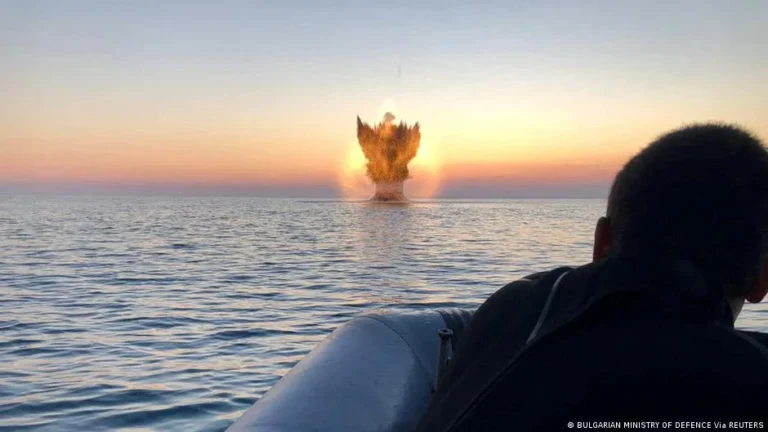
The process of clearing naval mines is inherently complex, dangerous, and time-consuming, comprising two primary activities: mine hunting and mine sweeping. Mine hunting involves actively searching for suspicious objects on the seafloor or in the water column using sonar or other detection equipment. Once a potential mine is located, experts must then visually identify it, often using remotely operated vehicles (ROVs) or divers, to determine if it poses a threat. If it is confirmed to be an explosive device, specialists have several options: they can attempt to recover and disarm the mine, or, more commonly, trigger a controlled underwater explosion to neutralize it. Peters likened this meticulous process to an "underwater ordnance clearing service," underscoring the precision and expertise required.
Mine sweeping, by contrast, is a less precise method that involves towing specialized equipment designed to trigger mines by mimicking the acoustic, magnetic, or pressure signatures of actual ships. While effective in clearing larger areas, it is less discriminate and can be less safe, as it deliberately provokes detonations. Both methods historically placed human lives at direct risk, requiring specialized personnel to operate in hazardous environments. The sheer scale of the task can be daunting; clearing a heavily mined area can take years, even decades, as evidenced by ongoing efforts to clear World War I and World War II mines from various sea lanes around the globe.
Drones Revolutionize Mine Countermeasures: Lessons from the Black Sea and German Navy

Recent technological advancements, particularly in autonomous systems, are revolutionizing mine clearance operations, significantly reducing the risk to human life. The ongoing conflict in Ukraine has provided stark examples of these new methodologies. Mykola, a Ukrainian soldier part of a task force clearing Russian-laid naval mines in the Black Sea, shared his experience: "When possible, we use drones to search for objects, then identify and destroy them." This shift towards uncrewed systems allows for the reconnaissance and neutralization of mines without exposing human personnel to immediate danger.
The German Navy has likewise embraced drone technology for mine hunting. Frigate Captain Andreas, of the 3rd Minesweeping Squadron, explained the transformative impact: "We predominantly use autonomous systems to search the seafloor." He further elaborated on the safety benefits: "In the past, boats equipped with sonar systems would have to pass straight over areas where mines were suspected to detect them. Autonomous systems mean those 40 lives no longer have to be put at direct risk." Beyond safety, drones also greatly enhance efficiency and reduce the need for large human crews. These unmanned systems can independently send high-resolution footage and sonar data from the seafloor back to a control station for assessment. While the final decision on whether an object is a harmless piece of junk or a deadly mine, and how to deal with it, still rests with human experts, the initial dangerous reconnaissance is now performed remotely.
Despite these advancements, the legacy of naval mines is incredibly persistent. Artyom, another Ukrainian mine sweeper in the Black Sea, offered a sobering perspective on the long-term nature of the threat: "We’re still finding mines from World War II, and even some from World War I. That shows how many years of work we’ve still got ahead of us." This underscores that even with the most advanced technology, fully ridding a maritime stretch of mines after a conflict can be a multi-generational endeavor.
Hormuz Specifics: Challenges for Drone Deployment
While drones offer significant advantages, their deployment in a highly sensitive and potentially hostile environment like the Strait of Hormuz presents unique challenges. Frigate Captain Andreas highlighted a key limitation of current drone technology: battery capacity. "The battery capacity of the drones used by Germany’s navy still restricts how long they can be deployed on open waters," he noted. This means that for now, drones must be released relatively close to their target search area. "You always have to be close-by," Andreas explained, adding a crucial security concern for the Strait: "That would be difficult in a sensitive area like the Strait of Hormuz. Iran[ian weapons have] a long range, and we need to protect the people working for us." The proximity required for current drone operations could expose support vessels and personnel to unacceptable risks from coastal missile batteries or other fast-attack craft.
Recognizing these limitations, several companies are actively developing next-generation autonomous underwater vehicles (AUVs) with significantly extended operational ranges and endurance. One such company is Euroatlas from Bremen, Germany, which is developing the Greyshark drone. Markus Beer, Chief Sales Officer for AUVs at Euroatlas, detailed the Greyshark’s impressive capabilities. He stated that the current prototype can sustain 10 knots (18.5 kilometers per hour, 11.5 miles per hour) for 6 hours, or 4 knots for three times as long. More importantly, Euroatlas has announced that a fully autonomous, battery-powered version is slated for production in September 2026, with a subsequent model equipped with a fuel cell system, allowing for week-long deployments, expected by the end of the year.
Beer elaborated on how Greyshark drones could address the specific challenges in the Strait of Hormuz. "Ships on the Strait of Hormuz are at risk of sustaining fire from land," he acknowledged, directly referencing the danger to traditional mine-hunting vessels. "But underwater [drone] reconnaissance could still be possible, without risk and without escalating the situation." The advantage of Greyshark drones, he explained, is their wider operational range, allowing them to be released at a safe distance from hostile shores. "The small drones currently being used to hunt mines can only last a few hours," Beer said. "Greyshark drones can travel much further," while also being capable of capturing high-resolution images and independently identifying objects encountered on the seafloor. Last September, Euroatlas successfully demonstrated the Greyshark’s capabilities at REPMUS, a world-leading event for testing uncrewed maritime systems held off Portugal’s coast, showcasing its potential for future deployment in critical waterways.
Broader Implications for Global Maritime Security
The German offer, the Iranian reversals, and the ongoing expert debate underscore the complex interplay of technology, geopolitics, and international law in maintaining global maritime security. The Strait of Hormuz serves as a microcosm of the broader challenges facing international navigation in an era of resurgent state competition and asymmetric threats. The reliance on advanced autonomous systems like the Greyshark represents a significant paradigm shift in naval warfare and countermeasures, moving towards "dull, dirty, and dangerous" tasks being performed by machines rather than humans.
However, technology alone is not a panacea. The persistent threat of naval mines, even those from past conflicts, highlights the long-term commitment required to secure vital sea lanes. The economic implications of even a perceived threat can be severe, demonstrating the strategic power of disruption. For Germany and its European partners, involvement in the Strait of Hormuz would signal a deepening commitment to international security and a willingness to protect global trade routes vital to their own prosperity. It also necessitates robust international cooperation to establish legitimate mandates, share intelligence, and coordinate efforts effectively. The future of maritime security in critical chokepoints like the Strait of Hormuz will depend not only on continuous technological innovation but also on sustained diplomatic engagement and a collective resolve to uphold the principles of freedom of navigation against all threats, both visible and unseen. The ongoing developments underscore the imperative for nations to adapt their naval capabilities and strategic thinking to address the evolving nature of maritime challenges.