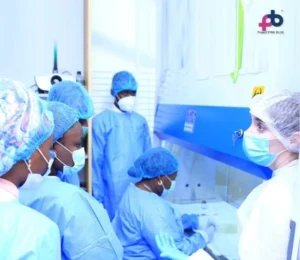
In a landmark achievement for medical science in sub-Saharan Africa, a team of medical specialists has successfully executed what is being hailed as Nigeria’s and West Africa’s first-ever tele-robotic surgery. The complex procedure—a telesurgery-assisted, robot-assisted right radical nephrectomy—involved the removal of a cancerous kidney tumor from a patient located hundreds of kilometers away.
The operation took place in real-time, bridging a physical gap between The Redeemer’s Health Village (RHV) and Nisa Premier Hospital in Abuja. While the patient lay on the operating table at Nisa Premier Hospital in the nation’s capital, the lead surgeon operated from a sophisticated Toumai robotic console installed at RHV. This medical breakthrough not only underscores the rapidly advancing integration of robotics and telecommunications in African healthcare but also signals a transformative shift in how specialized medical care can be delivered across vast geographic distances without requiring patients or doctors to travel.
The Anatomy of a Breakthrough Procedure
The three-hour operation, which concluded successfully with minor, planned pauses to verify equipment calibration and system integrity, targeted a malignant kidney tumor. The procedure utilized a cutting-edge tele-robotic platform that allows a surgeon to translate hand movements into precise, micro-scaled mechanical actions executed by robotic arms inside the patient.
Prof. Obi Ekwenna-Davis, a US-based professor of Urology and Transplantation and co-founder of RoboMed Global who spearheaded the surgical team, reported that the patient tolerated the procedure exceptionally well. Post-operative assessments confirmed that the patient was in stable condition and projected to be discharged within 24 hours of the operation—a stark contrast to the extended recovery timelines typically associated with open radical surgeries.
"Distance should never decide who receives safe surgery; this is what safe and trusted surgery looks like," Professor Ekwenna-Davis remarked immediately following the procedure. He emphasized that the operation successfully demonstrated how telesurgery can bypass geographic constraints to deliver high-level surgical interventions to patients in diverse regions of Nigeria and, by extension, the broader global community.
A Collaborative Triumph Across Institutional Lines
The historic surgery was the culmination of a strategic tripartite collaboration involving The Redeemer’s Health Village, RoboMed Global, and Nisa Premier Hospital. Journalists and medical observers watched the procedure unfold live on monitors at RHV, witnessing firsthand the seamless coordination between the surgical console and the remote operating theatre.
Adedamola Dada, the Chief Executive Officer of RHV, noted that the event was a watershed moment not just for Nigeria, but for the entire West African sub-region. Established as a faith-based, 300-bed multispecialty hospital by the Redeemed Christian Church of God (RCCG), RHV was envisioned as a sanctuary of medical innovation providing world-class healthcare at sustainable costs.
"What has happened today is a demonstration that Nigerians can access modern healthcare without traveling abroad," Mr. Dada stated. He reiterated that the institution’s primary driver is societal impact rather than profit, aligning with the foundational vision of the church’s General Overseer to alleviate the medical burdens of citizens.
Dr. Ibrahim Wada, Chief Executive Officer and founder of Nisa Premier Hospital—which has served as a designated center for robotic surgery in West Africa since late 2025—hailed the synergy between Nigerian medical institutions. "Today, our patient received specialist surgical expertise from across the country without leaving Abuja. This is what becomes possible when Nigerian institutions decide to build together," Dr. Wada observed.
Board Chairman of RHV, Kunle Onakoya, similarly described the event as a historic milestone, urging stakeholders to appreciate the gravity of the achievement in charting a new course for national healthcare delivery.
Context, Timeline, and the Fight Against Medical Tourism
For decades, Nigeria has grappled with heavy economic and human capital losses attributed to medical tourism. Thousands of citizens travel annually to India, the United States, Europe, and South Africa seeking advanced treatments for oncological, cardiological, and complex surgical conditions. This outflow places a severe financial strain on patients and families while draining the domestic economy of vital foreign exchange.
The introduction of tele-robotic surgery serves as a direct counter-strategy to this trend. By establishing domestic infrastructure capable of handling high-complexity cases remotely, Nigerian hospitals are positioning themselves as regional hubs for specialized care.
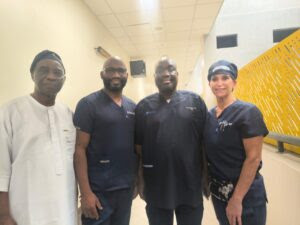
The timeline leading to this milestone reflects a steady, deliberate integration of technology into the nation’s healthcare sector. Nisa Premier Hospital laid foundational groundwork by introducing robotic surgery capabilities in November 2025. Following this, collaborations with international and diaspora medical experts—such as those at RoboMed Global—catalyzed the development of tele-robotic protocols, culminating in Saturday’s synchronized cross-city procedure.
Overcoming Infrastructure and Operational Challenges
While the success of the Abuja-to-RHV operation opens new frontiers, healthcare leaders are candid about the infrastructure hurdles that must be navigated to ensure scalability. Tele-robotic surgery relies heavily on ultra-low latency, high-bandwidth data transmission, reliable electrical power grids, and stable weather conditions to maintain real-time feedback loops between the console operator and the surgical instruments.
Mr. Dada acknowledged that connectivity issues, environmental factors, and the availability of specialized biomedical engineering personnel pose ongoing operational challenges. To mitigate these risks, the partnering institutions deployed robust, redundant network architectures designed to handle data fluctuations seamlessly during the procedure.
Furthermore, sustaining this technological leap requires a deliberate pipeline of human capital development. Recognizing that advanced hardware alone cannot guarantee universal access, the leadership of RHV and RoboMed Global have announced plans to establish a dedicated robotic academy.
The proposed academy aims to train and certify at least 150 surgeons, along with nurses, biomedical engineers, and product specialists, over the next two years. Organizers believe that building local capacity is the most effective safeguard for the long-term viability of advanced surgical technologies in the country.
Policy Implications and Calls for Government Partnership
Addressing the policy dimensions of the breakthrough, medical leaders have issued a direct call to action for federal and state governments, as well as private sector investors, to back the expansion of robotic and telesurgery frameworks.
Professor Ekwenna-Davis confirmed that the initiative has received encouraging initial backing from the Federal Ministry of Health and other institutional bodies, but stressed that broader non-governmental and corporate partnerships remain essential.
Echoing this sentiment, CEO Adedamola Dada urged the government to institute targeted scholarship programs and financial sponsorships for medical professionals eager to master robotic and tele-robotic disciplines.
"My message to government is to support and sponsor Nigerians, the surgeons, the nurses, the biomedical engineers who would want to come and do this training here," Mr. Dada urged. "They can award scholarships to them so that within two to three years, Nigeria will have a lot of professionals who are capable of performing robotic surgery."
Broader Impact on National Healthcare Delivery
The successful execution of Nigeria’s first tele-robotic surgery carries profound implications for healthcare equity. In a country where specialist medical personnel are heavily concentrated in urban centers like Lagos, Abuja, Port Harcourt, and Ibadan, patients residing in rural or underserved states often face insurmountable barriers to accessing life-saving interventions.
Telesurgery shatters these traditional geographic bottlenecks. By decoupling the physical location of the surgeon from that of the patient, top-tier specialists can theoretically operate across state boundaries, regional clinics, and rural medical outposts without relocating. This democratization of expertise holds the promise of dramatically improving survival rates for time-sensitive conditions, including various forms of cancer, cardiovascular emergencies, and complex trauma cases.
As the global medical community shifts toward minimally invasive, digital-first interventions, Nigeria’s successful foray into tele-robotic surgery demonstrates that African institutions are not merely observing technological revolutions from the sidelines—they are actively participating in, and occasionally pioneering, the future of global medicine. With continued investment in digital infrastructure, rigorous professional training, and collaborative institutional frameworks, the country is steadily turning the vision of borderless healthcare into a clinical reality.