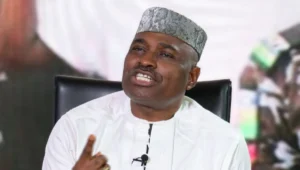
The political landscape in Nigeria’s commercial nerve center has witnessed a significant early alignment as the National Youth Council of Nigeria (NYCN), Lagos State Chapter, formally reaffirmed its unflinching support for President Bola Ahmed Tinubu and the Lagos State Deputy Governor, Dr. Kadri Obafemi Hamzat, ahead of the 2027 general elections. The high-profile endorsement, which positions the youth bloc firmly behind the ruling All Progressives Congress (APC) administration at both federal and state levels, was officially communicated to the public through a statement released on Monday by the NYCN Lagos State Chairman, Ibrahim Adigun.
According to the leadership of the state youth council, the decision to endorse the incumbent leaders was reached during the maiden edition of the Voluntary Youth Organisations (VYO) 1.0 summit. The landmark gathering, which coincided with the commemoration of National Youth Day, was hosted at the historic Campus Mini Stadium located on Lagos Island. The event brought together a diverse mosaic of youth leadership, prominent government officials, policy-makers, and prominent political actors, creating a vibrant platform for discourse surrounding youth empowerment, governance structures, and sustainable societal development.
The event, marked by colorful displays and robust intellectual engagement, operated under the potent theme: “Converging Lagos Youth Voices: Voluntary Youth Organisations as Pillars of Structure, Accountability and Sustainable Youth Development.” Beyond the political endorsements, the summit served as a critical appraisal forum for evaluating the foundational structures supporting youth groups in the state. Observers note that this early mobilization by the youth council underscores the fierce battle for the demographic dividend in Lagos State—a critical electoral battleground given its dense population of politically conscious young voters.
A Convergence of Stakeholders and Dignitaries
The Campus Mini Stadium played host to a formidable delegation of political heavyweights, traditional figures, and civil society leaders. Dr. Kadri Obafemi Hamzat, the Lagos State Deputy Governor and APC governorship hopeful, was notably represented at the occasion by his running mate, Princess Damilola Sonayon-James. The presence of Princess Sonayon-James underscored the administration’s deliberate effort to project inclusivity and bridge generational gaps in political representation.
The event also drew the presence of high-ranking legislative and executive actors, including the Deputy Speaker of the Lagos State House of Assembly, Honourable Mojisola Miranda, whose legislative insights added institutional weight to the discussions. The political machinery of the ruling party was further reinforced by the attendance of Senator Musiliu Obanikoro, Director-General of the PBAT-KOH Campaign Organisation, alongside his deputy, Honourable Rasaq Ajala. Also present to lend institutional support was the Lagos State Commissioner for Youth and Social Development, alongside an array of technocrats, youth leaders, and representatives from various ministries, departments, and agencies.
The vibrant gathering featured major voluntary youth institutions that have historically formed the backbone of discipline, civic training, and community service in Nigeria. Prominent among these groups were the Man O’ War, the Girl Guides, the Lagos State Scout Council, and the Boys’ Brigade. The convergence of these disciplined uniformed bodies alongside contemporary youth advocates created a symbolic display of structured youth mobilization rarely seen outside official state parades.
Institutionalizing Youth Governance: The NYCN Lagos State Bye-Law
A defining moment of the VYO 1.0 summit was the formal unveiling of the NYCN Lagos State Bye-Law. Unveiled jointly by Princess Damilola Sonayon-James and other high-ranking dignitaries, the newly introduced legal and operational framework is designed to sanitize, organize, and regulate the activities of voluntary youth organizations across the state.
For decades, stakeholders have pointed to the fragmentation and lack of a unified operational code as major impediments hampering the effectiveness of youth groups in Lagos. The new bye-law provides an institutional framework aimed at curbing proliferation, ensuring administrative transparency, and establishing clear lines of accountability among registered entities. By giving statutory backing to the internal governance of youth groups, the Lagos State chapter of the NYCN has set a precedent for structured youth organization that could potentially serve as a model for other chapters nationwide.
In his address, NYCN Chairman Ibrahim Adigun elaborated on the challenges plaguing voluntary youth organizations, describing them as invaluable nurseries for leadership development and social advancement whose impacts have been stifled by systemic neglect and inadequate state-backed infrastructure. Adigun did not mince words in calling for a structural overhaul of how government engages with youth development frameworks.
Policy Demands and Strategic Proposals for Youth Development
Capitalizing on the presence of key government functionaries, the NYCN leadership presented a comprehensive charter of demands aimed at transforming the socio-economic reality of young people in Lagos State. The proposals went beyond mere political rhetoric, offering actionable policy blueprints designed to institutionalize youth welfare and capacity building.
Among the cornerstone recommendations put forward by the council was the urgent establishment of a dedicated Lagos State VYO Development and Support Fund. This financial vehicle, according to the council, would provide sustainable grants and operational backing to registered youth bodies, enabling them to execute community-based projects without perpetually battling financial strangulation.
Furthermore, the council advocated for the creation of a comprehensive VYO Registry and Accreditation Framework, which would work in tandem with the newly unveiled bye-law to ensure quality control and professional standards among youth-serving organizations. Other vital proposals tabled at the summit included:
- The initiation of a Lagos Youth Community Prevention Partnership to combat social vices and enhance grassroots security.
- Structured capacity development programs tailored specifically for the leadership and rank-and-file members of voluntary organizations.
- Guaranteed access to state-owned youth centers, recreational facilities, and public infrastructure for community-oriented programs.
- Aggressive youth economic empowerment schemes and targeted employment partnerships between the state government and the private sector.
- The institutionalization of an annual Lagos State Voluntary Youth Organisations Assembly to institutionalize dialogue between the government and youth leadership.
Evaluating the Political Endorsement: The Rationale Behind the 2027 Backing
While the summit addressed critical administrative and socio-economic hurdles, the political undertone of the gathering remained its most widely discussed outcome. Explaining the rationale behind the unanimous endorsement of President Bola Ahmed Tinubu and Dr. Kadri Obafemi Hamzat, Adigun stated that the decision was anchored on a pragmatic assessment of ongoing policy interventions executed by the APC-led administrations at both the federal and sub-national levels.
The youth council particularly highlighted the Renewed Hope Agenda of President Tinubu, pointing to specific legislative and administrative milestones designed to ease the burden on Nigerian youths. Foremost among these interventions is the Nigerian Education Loan Fund (NELFUND), which has opened up access to tertiary education for indigent students through interest-free loans. The council also referenced the staging of the National Youth Conference and various deliberate affirmative actions aimed at bringing young professionals into governance structures as tangible evidence of progressive youth inclusion.
At the state level, the NYCN praised Dr. Obafemi Hamzat’s extensive track record as an accomplished administrator, technocrat, and academic. The council argued that Hamzat’s deep understanding of governance dynamics, coupled with his proven competence in infrastructure delivery and urban management, makes him uniquely positioned to safeguard and advance the developmental trajectory of Lagos State.
"Our endorsement of President Bola Ahmed Tinubu and Dr. Kadri Obafemi Hamzat is borne out of our conviction that the APC-led administrations at the federal and state levels have demonstrated commendable commitment to youth development and inclusion," Adigun emphasized during his media briefing. "From the Nigerian Education Loan Fund to the National Youth Conference and the deliberate inclusion of young people in governance, there are tangible efforts that deserve recognition."
Implications for the 2027 Electoral Landscape
The early endorsement by the umbrella body of youth organizations in Lagos State carries profound strategic implications for the political equation ahead of 2027. Lagos, renowned as Nigeria’s most cosmopolitan and politically volatile state, possesses an expansive youth demographic that frequently acts as both a formidable voting bloc and a vanguard for political mobilization.
By securing the formal backing of the NYCN alongside major disciplined uniformed youth bodies like the Boys’ Brigade and Man O’ War, the APC administration has effectively co-opted key grassroots structures capable of penetrating local communities, university campuses, and inner-city neighborhoods. Analysts note that these structured youth groups possess the organizational discipline required for effective door-to-door campaigning and voter education—assets that could prove decisive in counteracting opposition narratives.
However, political analysts also observe that such high-profile endorsements come with heightened expectations. The youth council’s robust policy demands—ranging from dedicated funding to massive employment partnerships—mean that the political leadership will be held accountable for translating these endorsements into concrete socio-economic dividends. As the build-up to 2027 gathers momentum, the ability of the Tinubu and Hamzat administrations to address youth unemployment, economic inflation, and infrastructural deficits will ultimately determine whether this foundational youth support translates into undisputed electoral victory at the ballot box.