Portugal maintained their perfect start to the UEFA Nations League campaign with a hard-fought 2-1 victory over Norway, in a match defined by tactical discipline, individual errors, and the continued evolution of a team navigating life without its veteran talisman, Cristiano Ronaldo. Despite the presence of the 41-year-old on the team sheet, manager Roberto Martínez opted for a youthful attacking front, leaving the global icon on the bench for the entirety of the 90 minutes.
The result at the stadium serves as a significant marker in the Nations League group stage, confirming Portugal’s status as a dominant force in European football while underscoring the defensive vulnerabilities that continue to plague the Norwegian national side. For Portugal, the win marks their second consecutive victory, placing them in a commanding position at the top of their group.
The Tactical Battle: A Match of Errors and Efficiency
The encounter began with a high-intensity press from both sides, but it was Portugal that drew first blood. João Félix, continuing his impressive run of form, found the back of the net in the first half. The goal was his second in as many games, highlighting his growing importance to Martínez’s system. Félix’s ability to find pockets of space between the midfield and the defensive line proved to be the primary headache for the Norwegian backline, which struggled to contain Portugal’s fluid movement.
However, the second half began with a shift in momentum. Erling Haaland, who has become the cornerstone of Norwegian football, leveled the scoreline early in the half. The goal was a landmark achievement for the Manchester City striker, marking his 65th international goal and his 22nd in the UEFA Nations League. This strike further cemented his record as the most prolific goalscorer in the history of the competition.
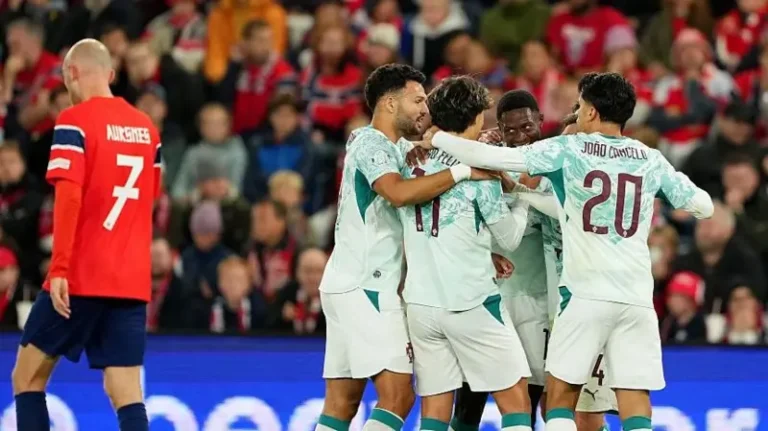
The turning point of the match occurred shortly after Norway’s equalizer. Norway goalkeeper Ørjan Nyland, who had otherwise performed creditably under pressure, committed a fatal error that gifted Portugal the winning goal. In an attempt to distribute the ball from the back, Nyland inadvertently played a pass directly into the path of Gonçalo Ramos. The Benfica forward displayed remarkable composure, executing a delicate chip over the stranded goalkeeper to restore Portugal’s lead.
Chronology of the Match Events
The tactical narrative of the game can be broken down into distinct phases:
- First Half: Portugal established early control through disciplined possession. João Félix broke the deadlock midway through the half, capping a period of sustained pressure.
- Early Second Half: Norway emerged from the dressing room with increased urgency. Erling Haaland’s clinical finish leveled the score, momentarily shifting the momentum toward the visitors.
- The Decisive Moment: A lapse in concentration from Ørjan Nyland provided Gonçalo Ramos with the opportunity to score the winner. The goal forced Norway into a more desperate, high-risk tactical approach.
- Late Game Chaos: Portugal continued to press for a third. Rafael Leão came agonizingly close to extending the lead, hitting the crossbar with a deflected strike. A second goal from Ramos was eventually disallowed by the Video Assistant Referee (VAR) for offside, following yet another error in the buildup involving Nyland.
The Ronaldo Question: A Legacy in Transition
The fact that Cristiano Ronaldo remained an unused substitute throughout the 90 minutes has ignited intense speculation regarding his role in the current Portugal squad. At 41, the five-time Ballon d’Or winner is currently pursuing a historic milestone: reaching 1,000 career goals. He currently sits 21 goals short of this unprecedented target.
While Ronaldo’s presence is often viewed as an asset to team morale and a source of experience, his lack of game time in a competitive Nations League fixture suggests a shifting dynamic. Roberto Martínez has previously emphasized the importance of merit-based selection, and with the impressive form of younger players like Ramos and Félix, the coaching staff appears to be preparing for a post-Ronaldo era.
The absence of captain Bruno Fernandes, who was sidelined due to an injury, further complicated the team selection. In his absence, the leadership void was filled by collective effort, with the squad demonstrating a level of tactical cohesion that did not rely on any single individual—a hallmark of a team that has matured under Martínez’s stewardship.
Broader Implications for the Nations League
The victory places Portugal in a strong position to advance to the knockout stages of the competition. Their 100% record is a testament to the depth of the squad, which has successfully integrated new talent without sacrificing defensive stability. For Portugal, the Nations League is not merely a tournament; it is a vital testing ground for the upcoming World Cup qualifiers and the eventual transition toward a new generation of talent.
Conversely, Norway finds itself at a crossroads. Despite having one of the world’s most potent strikers in Erling Haaland, the team continues to suffer from individual errors at the back. Nyland’s performance serves as a microcosm of Norway’s recent struggles: the team is capable of matching the best in the world offensively, but defensive fragility often undermines their collective effort.
Statistical Context and Performance Analysis
Data from the match highlights a stark contrast in efficiency. Portugal managed to sustain pressure despite lower overall possession in the final 20 minutes, choosing to exploit the space left by Norway’s desperate search for an equalizer.
- Haaland’s Dominance: With 22 goals in the Nations League, Haaland remains the competition’s statistical anomaly. His ability to score against high-level European opposition is consistent, yet the lack of a balanced defensive structure around him remains a hurdle for Norway’s coaching staff.
- Portugal’s Defensive Resilience: Even without Fernandes, Portugal’s midfield transition was efficient. They successfully neutralized the transition play that usually defines Norway’s counter-attacking style.
- The VAR Factor: The disallowed goal for Ramos was a point of contention but ultimately demonstrated the effectiveness of modern officiating in ensuring the integrity of the scoreline.
Official Reactions and Future Outlook
While no formal post-match press conference statements have been released by the Portuguese Football Federation (FPF) regarding the decision to bench Ronaldo, the general sentiment within the camp remains focused on the "collective objective." Roberto Martínez has consistently maintained that the squad is built on the current form of players at their respective clubs, rather than past accolades.
For Norway, the focus will now shift to defensive drills and the psychological recovery of their goalkeeper. Coach Ståle Solbakken is expected to face scrutiny regarding the team’s reliance on Haaland and the lack of a robust defensive safety net.
As the Nations League progresses, Portugal will look to continue their unbeaten run, with the focus shifting toward their upcoming fixtures. The competition has proven to be a crucible for European nations, and for a side as ambitious as Portugal, the current momentum is essential for building the confidence required to challenge for major international honors.
The match served as a stark reminder that in the modern era of football, even the greatest icons are subject to the tactical requirements of the manager. Whether Ronaldo will return to the starting XI for the next international break remains a subject of intense debate, but for now, the Portuguese machine continues to function effectively, winning matches and securing points with or without its most famous son. As the squad looks toward the future, the integration of players like Gonçalo Ramos and the tactical flexibility shown by Martínez suggest that Portugal’s footballing future remains bright, irrespective of the inevitable end of the Ronaldo era.