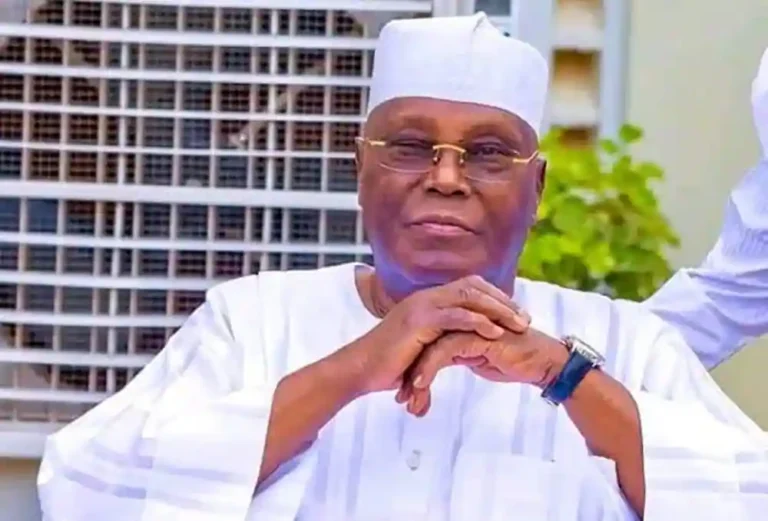
The political landscape in Nigeria is once again bracing for intense debate regarding power distribution, regional equity, and governance accountability. Former Senator Shehu Sani, who represented Kaduna Central in the 8th National Assembly, has issued a stark warning that a potential victory by former Vice President Atiku Abubakar in the 2027 presidential election would permanently dismantle the unwritten convention of power rotation between the northern and southern regions of the country.
Speaking during an appearance on Channels Television’s flagship political current affairs program, Politics Today, the outspoken former lawmaker maintained that while every eligible Nigerian possesses the constitutional right to seek elective office, the overarching imperatives of national unity, fairness, and geopolitical balancing must take precedence in structuring the upcoming electoral contest. Sani’s comments have reignited national discourse on the delicate fault lines of Nigerian politics, specifically concerning how political parties choose their standard-bearers and the long-term implications of regional hegemony.
The Context of Power Rotation in Nigeria’s Fourth Republic
Since the return to democratic governance in 1999, Nigeria’s political elite has largely adhered to an informal gentleman’s agreement known as the zoning or power rotation principle. Designed to mitigate deep-seated ethnic and regional anxieties, this convention seeks to alternate the presidency between the predominantly Muslim North and the largely Christian South, ensuring that no single geopolitical block feels perpetually marginalized from the pinnacle of national leadership.
The trajectory of this principle was notably demonstrated during the 2015 general elections, when former President Muhammadu Buhari, a northerner, defeated the incumbent southern president, Goodluck Jonathan. Buhari went on to serve two consecutive terms, completing an eight-year tenure for the North from 2015 to 2023. In alignment with the unwritten rotational understanding, the pendulum swung back to the South in 2023, culminating in the victory of current President Bola Ahmed Tinubu.
However, the question of what happens after President Tinubu’s administration concludes its mandate remains a contentious subject within political circles. While southern stakeholders largely expect to complete a cumulative eight-year run—stretching from 2023 to 2031—several northern politicians, including Atiku Abubakar, who finished second in the 2023 presidential race under the platform of the Peoples Democratic Party (PDP) and has since been associated with opposition realignments under the African Democratic Congress (ADC), continue to eye the highest office.
Sani’s Prescription for the 2027 Electoral Battle
During his television interview, Sani elaborated on his stance, emphasizing that the 2027 presidential contest ought to be exclusively contested by political heavyweights from the southern region. He argued that allowing the South to complete its uninterrupted eight-year cycle is essential for maintaining political stability and preventing a breakdown of trust between the country’s diverse regions.
"I never said Atiku should not run. Constitutionally, he has the right to run for any election. But what I said was that the southern part of Nigeria should be allowed to have its eight-year tenure in office, just like the way the North has from 2015 to 2023," Sani explained.
The former senator went further to outline a hypothetical lineup of southern politicians across various political platforms, suggesting how parties should structurally position themselves to respect the regional balance. He posited that political parties should field candidates solely from the South, allowing voters in that region to determine leadership before the mantle returns unconditionally to the North by 2031.
"All the parties. Like the ADC now, they’re supposed to field Amaechi. That is what’s supposed to be. The NDC should field Peter Obi, and the APM, field Makinde. Let the South struggle it out and see who wins, and for four years. And when the tenure is done by 2031, the North shall have its unchallengeable opportunity to produce leadership of the country," he stated.
This perspective builds upon a statement Sani earlier published on his official social media handle on X (formerly Twitter). In the post, he explicitly named prominent southern political actors—including President Bola Tinubu, Labour Party leader Peter Obi, Oyo State Governor Seyi Makinde, activist Omoyele Sowore, presidential aspirant Adewole Adebayo, and former Cross River State Governor Donald Duke—as the rightful contenders for the 2027 ballot. He cautioned that bypassing the rotation principle in 2027 would inevitably lead to its total abandonment by northern politicians in subsequent election cycles, effectively setting off a free-for-all race that could heighten sectional bitterness.
Implications for Political Parties and Democratic Consolidation
Political analysts note that Sani’s arguments underscore a fundamental tension within Nigerian democracy: the friction between individual constitutional liberties and collective political arrangements designed to preserve peace in a pluralistic society.
While the 1999 Constitution of the Federal Republic of Nigeria (as amended) does not explicitly mandate power rotation—guaranteeing every citizen above the age requirement the unhindered right to contest any election—political parties have often integrated zoning into their internal constitutions to maintain internal cohesion. When major political platforms disregard these internal zoning formulas, it frequently triggers mass defections, party fragmentation, and regional alienation.
If opposition figures from the North, such as Atiku Abubakar, successfully secure major party tickets and win the presidency in 2027, the traditional eight-year northern/southern alternation cycle would be effectively reset or disrupted. Proponents of zoning argue that such a development could entrench political dominance by regions with larger voter populations, frustrating smaller or rotationally disadvantaged blocs and undermining the fragile national consensus.
Shifting Gears: Defense of General Christopher Musa and Critique of El-Rufai
Transitioning from national electoral politics to regional security concerns, Shehu Sani also addressed a raging controversy involving the Minister of Defence, General Christopher Musa (rtd), and former Kaduna State Governor, Nasir El-Rufai.
The feud began when General Musa publicly accused the former governor of implementing policies and actions that allegedly exacerbated divisions and worsened the security crisis in Southern Kaduna during his tenure. The Defence Minister’s remarks provoked sharp criticisms from various northern interest groups and loyalists of the former governor, who viewed the military chief’s comments as an unwarranted political attack on a civilian administrator.
Weighing in on the controversy, Sani strongly defended the Defence Minister, launching a scathing critique of those criticizing the military official. He alleged that the vast majority of commentators rushing to defend El-Rufai lacked firsthand, on-the-ground knowledge of the security realities in the affected rural communities.
"I went through the comments of people about what General Musa said, and if you look at it, 80 per cent of those who are commenting have never been to Southern Kaduna. They don’t know where Sanga is, where Kauru is, where Kachia is, where Kagarko is, where Banchiki is, where Kafanchan is. So, they only read what they read on the pages of newspapers," Sani asserted.
A Decade of Unabated Violence in Kaduna Communities
Sani, who hails from Kaduna State and has a long history of human rights activism and legislative oversight within the region, painted a grim picture of the security vacuum that allegedly characterized the El-Rufai administration. He claimed that violent non-state actors—broadly categorized as terrorists and bandits—have operated with relative impunity in Southern Kaduna and other parts of the state for over ten years without receiving adequate tactical or humanitarian interventions from the state government.
"It is a fact that terrorists and bandits have been killing people in Southern Kaduna for over a decade without any intervention from the state government. Not only in Southern Kaduna. In Central Kaduna, where I come from, the state government did nothing," Sani stated.
The former lawmaker further accused the former governor’s administration of failing to provide logistical, financial, or material support to federal security agencies stationed in the state, such as the Nigeria Police Force, the Nigerian Army, and the Nigeria Security and Civil Defence Corps (NSCDC). According to Sani, state-level backing is critical for curbing rural banditry and communal clashes, arguing that the absence of institutional support severely hampered security operations during the period in question.
Characterizing El-Rufai as a figure prone to inconsistent messaging, Sani labeled him a "man of double-speak," alleging that the former governor frequently issued contradictory public statements regarding his administration’s strategic approach to confronting armed criminal networks.
Wider Reactions and the Path Forward
The convergence of Shehu Sani’s commentary on rotational politics and historical security management in Kaduna highlights the multi-layered challenges confronting Nigeria as it looks toward the next election cycle and struggles to stabilize its internal security architecture.
As political parties begin early behind-the-scenes realignments ahead of 2027, the debate over zoning is expected to intensify. While northern political heavywaters continue to weigh their options based on party dynamics and electoral calculations, southern leaders face mounting pressure to consolidate their political structures and present a unified front. Concurrently, ongoing debates regarding the accountability of past state chief executives on security matters demonstrate that the ghosts of past governance failures continue to haunt Nigeria’s contemporary political discourse.
Ultimately, stakeholders across the political spectrum maintain that managing regional sensitivities, upholding democratic norms, and prioritizing institutional accountability will remain crucial in safeguarding Nigeria’s stability in the years leading up to 2027 and beyond.