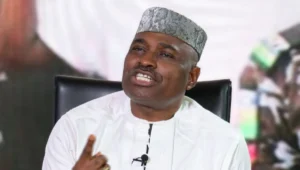
The political landscape of Edo State and the wider Nigerian federation has entered a new phase of intense strategic realignment as political actors position themselves for the upcoming general elections. Central to this unfolding narrative is the Nigerian Democratic Congress (NDC) candidate for the Oredo Federal Constituency in the forthcoming January 16, 2027, House of Representatives election, Efosa Omo-Osagie. Widely known among his supporters and political associates by the moniker "Mighty Man," Omo-Osagie recently captured public attention by unveiling an ambitious and comprehensive 15-point legislative agenda. The blueprint, which addresses critical socio-economic and security challenges facing the country, was formally presented during a series of high-level consultation meetings held across Edo State and the nation’s capital, Abuja. These strategic sessions brought together critical stakeholders, including NDC party leaders, support group coordinators, political strategists, women and youth leaders, and prominent religious groups, setting the stage for what promises to be a fiercely contested parliamentary race.
At the core of Omo-Osagie’s legislative proposals is a controversial yet widely resonant initiative concerning the safety and welfare of participants in the National Youth Service Corps (NYSC). The candidate has pledged to sponsor a landmark bill explicitly prohibiting the deployment of NYSC members to states, local government areas, and local communities currently grappling with active threats of terrorism, insurgency, and banditry. Furthermore, the proposed legislation seeks to introduce stringent penal measures, including legal and financial sanctions, against government and scheme officials who flout these directives by deploying vulnerable young graduates to insecure zones despite existing official security advisories.
Background Context of the NYSC Safety Debate
The National Youth Service Corps, established by Decree No. 24 of May 1973 under the administration of General Yakubu Gowon, was conceived primarily to foster national reconciliation, integration, and unity in the wake of the Nigerian Civil War. For over five decades, the scheme has mandated that university and polytechnic graduates under the age of 30 participate in a one-year national service program, which traditionally begins with a rigorous orientation camp, followed by primary assignment in a state other than the corps member’s state of origin.
However, in recent years, the program has faced profound structural and security challenges. As asymmetric warfare, Boko Haram insurgency in the Northeast, banditry and mass kidnappings in the Northwest and North-Central zones, and localized criminal violence in parts of the South have escalated, the safety of corps members has become a matter of intense national anxiety. Numerous instances have been documented where young professionals on national service found themselves caught in crossfires, subjected to highway abductions for ransom, or posted to remote, highly vulnerable rural communities devoid of basic security infrastructure.
While the management of the NYSC has repeatedly stated its commitment to partnering with security agencies to protect corps members, security analysts and civil society organizations have continuously called for a structural review of posting policies. Omo-Osagie’s proposed legislation directly addresses these persistent anxieties, offering a legislative framework that prioritizes human security over routine bureaucratic compliance. Addressing stakeholders during his consultation tour, Omo-Osagie emphasized the moral urgency of the matter, stating, "Among other things, I am seriously considering a bill to prohibit posting of NYSC corps members to states or parts of the federation under terrorists and bandits occupation or threats."
A Comprehensive Manifesto: Six Thematic Pillars
Beyond the NYSC protection bill, Omo-Osagie’s comprehensive manifesto is systematically organized around six core thematic areas: infrastructure development, reduction of the cost of governance, economic empowerment, anti-corruption measures, healthcare delivery, and educational reform. Each pillar is designed to tackle systemic institutional inefficiencies and deliver tangible dividends to the electorate of the Oredo Federal Constituency and the broader Nigerian populace.
The infrastructure component of the agenda introduces a targeted, community-centric legislative proposal aimed at safeguarding public commercial spaces. Omo-Osagie has proposed a bill mandating the mandatory installation of modern firefighting equipment, deep water boreholes, solar-powered electricity panels, and dedicated police desk offices in all public markets across the federation. Public markets in major Nigerian commercial hubs have historically suffered from devastating fire incidents, often exacerbated by poor access roads, lack of water sources, and delayed emergency responses, resulting in multi-billion-naira losses for traders. By integrating security desks and fire mitigation infrastructure into market governance, the proposed bill seeks to protect traders’ investments and secure economic micro-ecosystems.
Addressing the Cost of Governance
In alignment with growing public frustration over the bloated expenditures associated with political office in Nigeria, Omo-Osagie has adopted a hardline stance on public sector cost reduction. During his engagements in Benin City and Abuja, he sharply criticized the utilization of public funds to maintain offices, staff, and programs associated with the spouses, children, and immediate family members of elected public office holders. He argued that such expenditures place an unwarranted burden on the public treasury at a time when millions of citizens are grappling with severe economic hardship.
To institutionalize fiscal discipline, the NDC candidate has promised to sponsor dedicated legislation prohibiting post-tenure benefits, pensions, and severance packages for elected public office holders, with a specific exception maintained exclusively for former presidents and vice-presidents. This policy proposal speaks directly to popular sentiments regarding political entitlement and the widening gap between the governed and the governing class in Nigeria. "Nigeria cannot continue like this. Sometimes we’ve got to say enough is enough, and I think this is the time," Omo-Osagie declared while outlining his fiscal philosophy to party leaders.
Chronology of Legal Victory and Campaign Momentum
The unveiling of Omo-Osagie’s legislative agenda follows closely on the heels of a significant legal resolution that cemented his candidacy within the Nigerian Democratic Congress. The political trajectory leading up to his current status was marked by an intense internal party dispute over the rightful ticket for the Oredo Federal Constituency seat.
The turning point occurred precisely one week prior to his stakeholder consultations, when a Federal High Court sitting in Benin City delivered a decisive judgment on October 27, 2026. The court ruled in favor of Omo-Osagie, formally sacking the previously recognized NDC candidate, Uyi Omosigho, and declaring Omo-Osagie as the authentic and lawful candidate of the party for the January 16, 2027, parliamentary election. The legal battle, which involved multiple aspirants vying for political leverage within the party structure, had temporarily created uncertainty regarding the party’s preparedness for the polls. With the judicial hurdle cleared, Omo-Osagie has swiftly consolidated his political base, translating legal vindication into proactive policy formulation.
The stakeholder consultations, which commenced in Benin City—the heartbeat of Edo State—and subsequently extended to the political machinery in Abuja, represent the foundational phase of his electoral mobilization. According to the campaign organization, these rigorous brainstorming and alignment sessions are designed to ensure that the candidate’s manifesto reflects the grassroots realities and practical aspirations of the electorate. These engagements are expected to culminate imminently in the official constitution and inauguration of Omo-Osagie’s comprehensive campaign council, the details of which are slated for public announcement in the coming days.
Broader Implications and Political Analysis
As the political clock ticks down toward the January 16, 2027 House of Representatives elections, the entry of candidates with explicit, thematic legislative agendas introduces a substantive dimension to political discourse in Edo State. Oredo Federal Constituency, comprising Oredo Local Government Area, is historically one of the most politically sophisticated and strategically vital constituencies in Edo State. It serves as a major urban and commercial melting pot, making its electoral outcome a bellwether for broader political trends in the region.
Political analysts observing the Edo political terrain note that Omo-Osagie’s strategy of anchoring his campaign on structural governance reforms—particularly touching on emotive issues like youth corps safety and the reduction of executive entitlements—is a calculated effort to appeal to a demographically youthful and economically stressed electorate. By addressing systemic national concerns alongside constituency-specific needs, the candidate is attempting to transcend traditional, patronage-based politics in favor of issues-based electoral mobilization.
However, political commentators also point to the formidable challenges awaiting any federal lawmaker attempting to push such sweeping legislative reforms through the National Assembly. Proposals seeking to curtail post-tenure benefits for lawmakers and executive officials, or those mandating structural changes to federal deployment protocols like the NYSC, routinely face entrenched institutional resistance from political elites across party lines.
Nevertheless, by placing these critical debates at the forefront of his pre-election discourse, Efosa Omo-Osagie has successfully framed his parliamentary ambition around a narrative of systemic reform and institutional accountability. As the campaign council is constituted and the electoral race enters its critical operational phase, the resonance of his 15-point agenda among the voters of Oredo will serve as a definitive test of the appetite for legislative disruption in contemporary Nigerian politics.