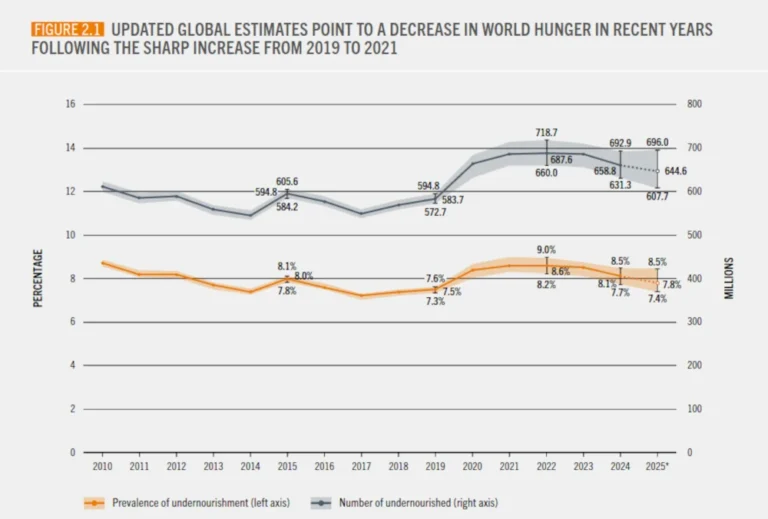
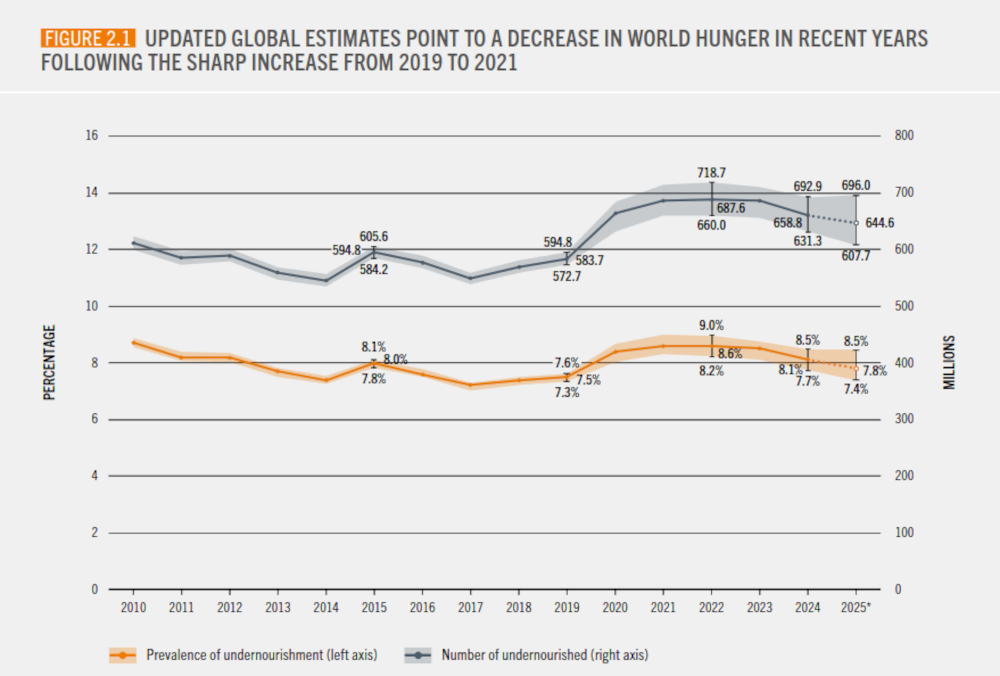
The global landscape of food security has witnessed a marginal improvement in the past year, as the number of people facing chronic hunger declined for the third consecutive year following the record highs of the COVID-19 pandemic. According to the latest State of Food Security and Nutrition in the World (SOFI) report, a flagship publication produced jointly by five United Nations agencies, global hunger fell to approximately 7.8% in 2025, down from 8.1% in 2024. This represents a reduction of roughly 43 million people compared to the 2022 peak, bringing the total number of undernourished individuals worldwide to an estimated 645 million. However, beneath these headline improvements lies a complex and troubling reality: the cost of a healthy, nutrient-dense diet has soared beyond the reach of one-third of the global population, threatening to derail the United Nations’ Sustainable Development Goal (SDG) 2 of "Zero Hunger" by 2030.
The report, co-authored by the Food and Agriculture Organization (FAO), the International Fund for Agricultural Development (IFAD), the United Nations Children’s Fund (UNICEF), the World Food Programme (WFP), and the World Health Organization (WHO), paints a picture of a world at a crossroads. While absolute hunger numbers are trending downward, the quality of nutrition remains a luxury for many. Current projections suggest that by the end of the decade, as many as 520 million people will still suffer from chronic undernourishment, a figure that highlights a significant failure to meet international commitments made a decade ago.
The Financial Barrier to Nutrition
A primary takeaway from the 2025 SOFI report is the escalating cost of a healthy diet. In terms of purchasing power parity (PPP), the average global cost of maintaining a diet rich in fruits, vegetables, and animal-sourced proteins has surged to $4.28 per person per day. This is a sharp increase from the $3.44 recorded in 2021. This inflationary trend is particularly devastating for low-income households, where food often accounts for more than half of total expenditure.
"Healthy diets should not be a luxury," stated Dr. Tedros Adhanom Ghebreyesus, Director-General of the World Health Organization, during the report’s launch. "They are the foundation of health, and they should be within everyone’s reach. When nutritious food is priced out of the market, we see a rise in both wasting and stunting in children, alongside an increase in non-communicable diseases in adults. The cost of inaction is far higher than the investment required to fix our food systems."

The report defines a "healthy diet" as one that meets the nutrient requirements for a long and healthy life, focusing on dietary diversity and the inclusion of micronutrient-rich foods. For roughly 2.3 billion people, this standard is currently unattainable. This economic exclusion creates a "nutrition gap" where the poorest are forced to rely on calorie-dense but nutrient-poor starchy staples, such as maize, rice, and wheat, which are often subsidized by national governments.
Regional Disparities and the African Crisis
The global reduction in hunger is not distributed evenly. While Asia and Latin America have reported steady gains in food security—driven by economic growth and expanded social safety nets—Africa continues to struggle. In absolute terms, Africa now hosts the highest number of undernourished people in the world, totaling 309 million. While the percentage of the population facing hunger has remained relatively stable on the continent, rapid population growth means that more people are entering a state of food insecurity every year.
The statistics for Africa are particularly stark: 66.6% of the continent’s population is entirely priced out of a healthy diet. This crisis is most acute in rural areas and among women and children. Animal-sourced foods, which provide essential proteins and micronutrients like iron, B12, and calcium, are the most expensive dietary components in African nations. The high cost of meat, dairy, and eggs is attributed to low livestock productivity, the high price of imported animal feed, and a lack of accessible veterinary services.
Furthermore, the report highlights a critical infrastructure deficit. In many sub-Saharan African nations, the lack of a reliable "cold chain"—refrigerated transport and storage—results in massive post-harvest losses. For highly perishable items like dairy, fish, and fresh produce, losses can reach between 30% and 40% before the food ever reaches a retail market. These losses are factored into the final price, further inflating the cost for the end consumer.
The Chronology of Global Food Shocks
To understand the current state of global food security, it is necessary to look at the timeline of events that have shaped the last half-decade.
- 2020-2022 (The Pandemic Peak): Global supply chains collapsed, and lockdowns devastated the informal economies of developing nations. Undernourishment spiked as food prices rose and incomes vanished.
- 2022-2023 (The Conflict Catalyst): The invasion of Ukraine by Russia disrupted the "breadbasket of the world," leading to a global shortage of wheat and fertilizers. This sent energy prices soaring and caused a massive spike in global food inflation.
- 2024 (The Fragile Recovery): Supply chains began to stabilize, and some commodity prices retreated. Hunger began a slow downward trend, though food price inflation remained "sticky" at the retail level.
- 2025 (The Current Outlook): Hunger continues to fall in percentage terms, but geopolitical tensions and climate extremes prevent a full recovery. The cost of a healthy diet reaches a record high of $4.28.
Geopolitics and the Energy-Food Nexus
The 2025 report introduces a significant focus on how broader geopolitical shocks are fracturing food systems. A key concern highlighted by UN experts is the ongoing tension in the Middle East, specifically the friction between the United States and Iran. This geopolitical standoff has led to periodic disruptions in the Strait of Hormuz, a vital maritime chokepoint through which a significant portion of the world’s petroleum and liquefied natural gas passes.
The impact on food security is indirect but profound. Modern agriculture is energy-intensive. Fuel is required for tractors, irrigation systems, and, most importantly, the transport of food. Additionally, natural gas is a primary feedstock for nitrogen-based fertilizers. When energy prices rise due to geopolitical blockades or sanctions, the cost of farming rises immediately. African nations are particularly vulnerable to these shocks. Decades ago, many of these countries were encouraged by international financial institutions to pivot from indigenous food production to cash crops for export. This shift has left them as net importers of basic grains and fuel, leaving their domestic food prices at the mercy of global oil markets.
Conflict and Climate: The Double Threat
Armed conflict remains the primary driver of acute food insecurity. In Sudan, South Sudan, Nigeria, and the Democratic Republic of the Congo, fighting has displaced millions of smallholder farmers and pastoralists. The situation in Sudan is especially dire; the report warns of a credible risk of famine across 14 separate regions. In these areas, fighting not only destroys crops but also blocks humanitarian access and destroys the markets where people would otherwise buy food.
Simultaneously, extreme weather events—ranging from prolonged droughts in the Horn of Africa to catastrophic flooding in Southeast Asia—are reducing yields and destroying infrastructure. The report argues that without significant investment in "climate-resilient" agriculture, such as drought-resistant seeds and modern water management systems, the progress made in reducing hunger will be easily reversed by the next major weather event.
Recommendations for Closing the Finance Gap
The SOFI report concludes with a call for a fundamental shift in how governments and international donors approach agricultural finance. Historically, subsidies have been directed toward starchy staples to prevent mass starvation. While successful in providing calories, this policy has inadvertently contributed to a "hidden hunger" of micronutrient deficiencies.
FAO Director-General Qu Dongyu emphasized the need for a policy pivot. "Ending hunger and making healthy diets affordable requires political commitment, sustained investment, and enabling policies," Qu said. "We must repurpose agricultural subsidies to support the production of nutrient-dense foods and invest in the rural road networks and storage facilities that connect farmers to markets."
The report suggests that if public funding were redirected toward supply chain resilience—specifically cold storage and rural logistics—local food markets would be better insulated from global price spikes. This would not only make healthy food more affordable but also provide more stable incomes for small-scale producers.
Analysis: The Long-term Implications
The findings of the 2025 SOFI report suggest that while the world is no longer in the "emergency" state of the pandemic years, it has entered a period of "chronic instability." The fact that hunger is decreasing while the cost of nutrition is increasing indicates a growing divide between those who can afford health and those who can only afford survival.
From a public health perspective, the inability of one-third of the population to afford a healthy diet suggests a looming crisis of stunting, wasting, and obesity-related diseases. This will eventually place an immense burden on the healthcare systems of developing nations, potentially stifling economic growth for generations. The 2030 goal of Zero Hunger now appears less like a target and more like a reminder of the vast distance the global community has yet to travel. To reach that goal, the world must look beyond mere calorie counts and address the systemic economic and geopolitical barriers that keep nutrition out of reach for billions.