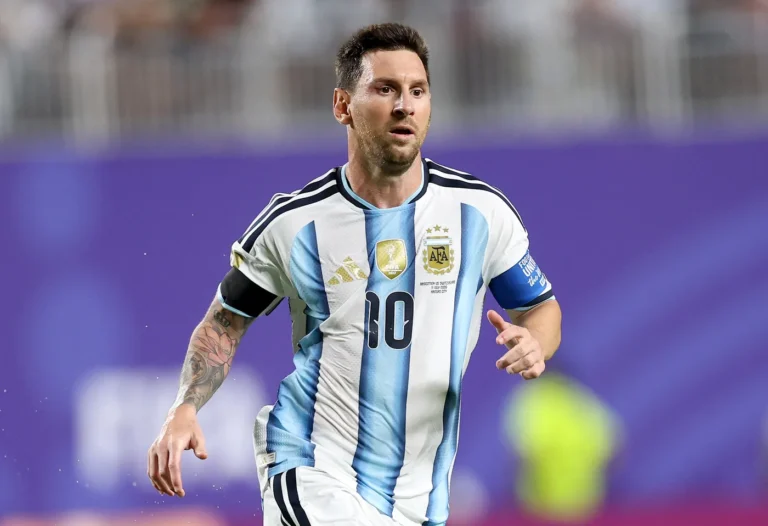
The trajectory of Lionel Messi’s career is synonymous with unparalleled sporting excellence, defined by eight Ballon d’Or trophies, a FIFA World Cup victory, and a storied tenure at FC Barcelona, Paris Saint-Germain, and Inter Miami. Yet, beneath the veneer of global athletic supremacy, the Argentine icon has recently shed light on a lingering personal frustration that transcends the football pitch: his lack of fluency in the English language. In a candid appearance on the podcast Miro de Atrás, Messi articulated that his failure to master English during his youth remains one of the few genuine regrets of his life, a reflection that serves as a sobering reminder of the multifaceted pressures and missed opportunities faced by even the most accomplished individuals.
A Reflection on Missed Opportunities
During the interview, Messi discussed the formative years of his career, a period characterized by intense focus on physical development and tactical mastery within the youth academy systems of Rosario and later, Barcelona’s La Masia. He admitted that while he had the necessary time and resources to pursue linguistic education during his adolescence, he failed to prioritize it. The admission was direct and unadorned: “I didn’t do it, and I regret it a lot.”
This sentiment underscores a common narrative among elite athletes who are thrust into the global spotlight at a young age. For Messi, the transition from a local prodigy to a global icon happened rapidly. By the age of 17, he had already debuted for the FC Barcelona first team, and by his early twenties, he was arguably the most recognizable athlete on the planet. The demands of professional football, particularly at the elite level, often necessitate a singular focus that leaves little room for extracurricular pursuits, such as mastering a second or third language.
Chronology of a Global Career
To understand the implications of Messi’s linguistic limitation, one must examine the chronology of his career. Born in 1987 in Rosario, Argentina, Messi’s professional journey began in earnest when he moved to Spain in 2000 to join FC Barcelona. His life was immediately immersed in the Catalan and Spanish languages. Throughout his two-decade tenure at Barcelona, his communication was primarily conducted in Spanish, with the occasional necessity of Catalan.
When Messi transferred to Paris Saint-Germain in 2021, he was faced with a new cultural and linguistic environment. Although he was able to navigate the dressing room through a large contingent of Spanish-speaking teammates and coaching staff, the necessity for a broader linguistic repertoire became more apparent. His subsequent move to Major League Soccer (MLS) with Inter Miami in 2023 further amplified the importance of English. In the United States, English is the primary language for media, commercial partnerships, and day-to-day fan engagement. While his stature allows him to transcend language barriers, the practical limitations of not being fluent in the lingua franca of the sport have become more evident in his role as a global ambassador for MLS.
Supporting Data and Linguistic Trends in Global Football
The professionalization of football has led to an increasing emphasis on linguistic versatility. According to data from the International Centre for Sports Studies (CIES), the mobility of professional footballers has increased by over 30% in the last decade. As squads become increasingly multinational, the ability to communicate across borders is no longer a luxury but a professional necessity.
In the English Premier League, for instance, players are often encouraged—and sometimes required—to undertake intensive language training upon signing. While Messi has achieved everything possible in the sport without the need for English, his case represents an era of football where superstar autonomy allowed for a different set of priorities. However, the commercial reality of the modern game dictates that athletes are not just players, but global brands. The ability to articulate one’s thoughts, participate in international press conferences, and engage directly with a global audience via English is a significant driver of brand equity. For an athlete of Messi’s magnitude, the lack of English fluency potentially limits the depth of his off-field impact, particularly in markets like the United States, the United Kingdom, and the broader Asian and Middle Eastern football landscapes.
Expert Analysis and The Weight of Celebrity
Sociologists and sports psychologists often note that high-performance athletes exist in a "bubble" where their primary mode of communication is physical. However, as these athletes retire or transition into roles such as coaching, management, or media punditry, linguistic skills become paramount.
Dr. Helena Varga, a specialist in sports communication, notes: "When an athlete of Messi’s stature speaks about regret, it humanizes the myth. It highlights that success in one domain—in this case, football—does not automatically equate to holistic preparedness for the globalized world. The regret is likely not about the football itself, but about the missed potential for deeper cultural integration and communication with a wider sphere of influence."
The implications for the next generation of athletes are clear. Modern football academies, such as those operated by the City Football Group or the Red Bull network, now integrate mandatory language lessons into their youth development programs. This shift acknowledges that an athlete’s career is a lifelong endeavor, and that linguistic agility is a vital component of personal and professional longevity.
Official Reactions and Industry Perspective
While no official statement has been issued by his management team or Inter Miami regarding this specific reflection, industry observers suggest that Messi’s honesty is a strategic asset. By admitting to a vulnerability, he resonates with a demographic that often feels intimidated by the perceived perfection of elite athletes.
Public relations experts have noted that such admissions of "human" flaws—like not knowing a language—often strengthen the personal brand of an athlete. It removes the barrier of "otherness" and allows the public to relate to him as a person who, like many others, prioritized his primary craft at the expense of other educational goals. Furthermore, the sporting community has largely reacted with empathy. Teammates, past and present, have frequently noted that Messi’s leadership style is defined by his actions on the pitch rather than his rhetoric in the dressing room. His silence or reliance on translators has never been interpreted as a lack of intelligence, but rather a reflection of his humble, reserved personality.
The Broader Impact on Sports Education
The discourse surrounding Messi’s comments has prompted a renewed conversation about the balance between athletic development and general education. The "Education vs. Sport" debate is a perennial topic in youth development. Organizations like FIFA and various national federations have long advocated for "dual career" programs, which ensure that young athletes have a viable pathway outside of sport should they suffer an injury or fail to reach professional levels.
Messi’s regret serves as a powerful case study for these programs. It demonstrates that even for the person who reaches the pinnacle of their profession, there is an awareness that a complete education is a hedge against the uncertainty of a sports career. For young athletes currently navigating the pressures of academies, the message is one of moderation: the physical training that leads to a professional contract is necessary, but the intellectual training that follows the athlete into retirement is equally vital.
Conclusion: Success, Regret, and the Human Experience
Lionel Messi’s reflection on his inability to speak English provides a fascinating look into the mind of a legend. It is a reminder that even at the height of his powers, with the world at his feet, the human experience is marked by the same types of regrets that affect ordinary people: the realization that time is finite and that certain doors, once closed, are difficult to reopen.
As he continues his career in Major League Soccer, Messi’s legacy remains secure. His achievements on the pitch will undoubtedly be studied for generations, but his willingness to be vulnerable about his personal development adds a layer of depth to his public persona. The regret over his missed linguistic opportunities is not a mark of failure, but a testament to his continued growth as an individual. It serves as a poignant reminder that in the journey toward greatness, the most important lessons are often the ones learned in hindsight, long after the final whistle has blown. Ultimately, Messi’s story remains one of relentless pursuit, even if that pursuit is now accompanied by the quiet wisdom of what he might have done differently along the way.