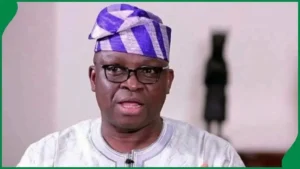
Alwan Hassan, a prominent chieftain of the ruling All Progressives Congress (APC) and a member of the party’s Presidential Campaign Council, has sparked widespread public debate by asserting that citizens of the country are not as economically distressed as opposition politicians frequently portray. Speaking during an appearance on a prominent current affairs program on Channels Television on Tuesday, Hassan addressed the mounting public discourse surrounding the nation’s severe cost-of-living crisis and the political framing of the upcoming 2027 general elections.
The APC chieftain’s remarks came in direct response to assertions made by various opposition factions, who have framed the political battleground for 2027 as an inevitable referendum between President Bola Ahmed Tinubu’s administration and a populace grappling with pervasive hunger and poverty. When pressed by the interviewers on how the ruling party intends to counter this damaging narrative ahead of the polls, Hassan categorically dismissed the characterizations, labeling them as mere political rhetoric designed to score cheap points rather than reflect an accurate assessment of everyday realities on the ground.
"That is an opposition rhetoric. People are not that hungry," Hassan asserted during the live broadcast, setting off a wave of immediate criticism and disbelief from households currently navigating the unprecedented economic pressures defining modern Nigeria. When challenged directly on whether ordinary Nigerians bearing the brunt of surging inflation would accept such a characterization, the APC stalwart doubled down on his stance, emphasizing his personal immersion in the domestic environment. "I’m telling you, I live in Nigeria," he maintained, defending his perspective against mounting skepticism.
Economic Realities and the Agricultural Sector Debate
To substantiate his controversial claims, Hassan pointed toward perceived downward trends in food prices across select regional markets. He argued that the recent fluctuations indicate that ongoing fiscal and monetary policies implemented by the Federal Government are successfully driving down the cost of consumable goods. According to the party chieftain, the impact of these interventions has become so pronounced that domestic farmers are beginning to voice frustration over plummeting market prices for agricultural produce.
"People are not that hungry the way the opposition are portraying it. And I’ll say it anywhere. People are not that hungry," Hassan reiterated. "In fact, farmers are complaining because foodstuffs are down in the market. Why? Because this government is importing and reducing the prices."
This defense, however, immediately invited critical scrutiny regarding the long-term sustainability and strategic wisdom of relying on foreign food imports to solve domestic supply shortages. When the interviewer questioned whether resorting to importation reflects positively on the administration’s much-touted agricultural development policies, Hassan conceded a fundamental structural vulnerability: Nigeria currently lacks the capacity to feed its own population independently.
Rather than viewing food imports as a failure of agricultural self-sufficiency policies, Hassan framed them as an unavoidable, short-term stopgap measure designed to bridge critical supply deficits while long-term domestic production initiatives slowly take root. "We cannot feed ourselves. No, but while we do things to now cover up on the gaps, well, in the meantime, we must import," he explained, acknowledging the arduous transition period the country must navigate.
The Broader Context of Nigeria’s Cost-of-Living Crisis
Hassan’s television appearance unfolds against a turbulent backdrop of macroeconomic reforms initiated by the administration of President Bola Tinubu since assuming office in May 2023. Upon taking the oath of office, the Tinubu administration introduced sweeping policy changes, most notably the total removal of the decades-long petrol subsidy and the unification of foreign exchange windows. While international financial institutions and economic technocrats largely praised these bold steps as necessary for correcting Nigeria’s fiscal imbalances and preventing imminent national bankruptcy, their immediate aftermath triggered unprecedented economic shocks.
The resulting depreciation of the Nigerian Naira drastically increased the cost of imported goods, raw materials, and energy. Consequently, inflation rates soared to historic highs, with food inflation emerging as a particularly devastating component. Millions of households across Africa’s most populous nation have found basic staples such as rice, beans, maize, and garri increasingly out of reach. According to data from the National Bureau of Statistics (NBS), headline and food inflation indices have consistently maintained upward trajectories, eroding purchasing power and plunging a significant segment of the population deeper into multidimensional poverty.
In response to public outcry and mounting labor unrest, the Federal Government has repeatedly rolled out various palliative programs, distribution of grains from the national strategic reserves, and waivers on import duties for essential food items and pharmaceutical products. However, the efficacy, distribution transparency, and timeliness of these interventions have remained subjects of intense public debate, with critics arguing that the relief measures are too little, too late, and fail to match the scale of the crisis.
Chronology of Government Interventions and Public Reactions
The friction between government officials and the citizenry regarding the actual state of the economy has been a recurring theme throughout the Tinubu administration. A brief timeline of key economic policies and public reactions highlights the mounting tension:
- May 2023: President Bola Tinubu announces the removal of the petrol subsidy during his inaugural address, leading to an immediate tripling of fuel prices and a ripple effect across transport and food supply chains.
- June – July 2023: The Central Bank of Nigeria unifies the foreign exchange market, resulting in a steep devaluation of the Naira against major global currencies. Inflation begins an aggressive climb.
- August – December 2023: Labor unions, civil society organizations, and ordinary citizens stage multiple warning strikes and protests over the rising cost of living. The federal and state governments begin distributing palliatives, though distribution bottlenecks are widely reported.
- February – March 2024: Protests erupt in several major cities, including Minna, Kano, and Ibadan, as citizens march against skyrocketing food prices. In response, the Federal Government orders the immediate release of 102,000 metric tons of grains from the strategic reserves.
- July – August 2024: The administration introduces a temporary waiver on import duties, tariffs, and taxes for certain food commodities, aiming to flood the local market with cheaper imported foodstuffs. Labor unions embark on nationwide "Ten Days of Rage" protests, demanding a reversal of fuel price hikes and economic hardship.
- Late 2024 – Early 2025: Government officials frequently clash with opposition leaders over economic metrics. While the government highlights marginal improvements in agricultural yields and localized price stabilization, consumer advocacy groups and citizens insist that structural poverty and hunger remain at crisis levels.
- November 2025 (Current Context): Remarks by APC chieftain Alwan Hassan spark fresh outrage by claiming that opposition parties are exaggerating the hunger crisis for political leverage ahead of the 2027 electoral cycle.
Implications of Political Rhetoric on Governance and Elections
Political analysts note that statements from high-ranking ruling party figures downplaying economic hardship run the risk of alienating an already fatigued electorate. As the country looks ahead to the 2027 general elections, the ability of the incumbent administration to tangible alleviate poverty and stabilize commodity prices will likely serve as the definitive benchmark for voters.
When political elites characterize widespread public grievances as mere "opposition rhetoric," it frequently exacerbates a growing disconnect between the governed and the governing class. Observers emphasize that while temporary food importation may offer short-term price relief in specific urban centers, it fundamentally contradicts long-term national objectives of achieving sustainable agricultural security and boosting local industrial output.
Furthermore, the public admission by an APC chieftain that Nigeria "cannot feed itself" highlights the urgent need for a comprehensive overhaul of the agricultural value chain. Experts argue that solving Nigeria’s food crisis requires addressing underlying systemic bottlenecks, including prolonged rural insecurity that prevents farmers from accessing their farmlands, inadequate storage and transport infrastructure, high costs of fertilizers and mechanization, and climate change-induced weather irregularities.
As the political machinery slowly gears up toward 2027, the discourse surrounding the cost of living is poised to intensify. Whether the Federal Government’s dual approach of structural economic reforms and tactical food importation will yield sustainable relief before the ballots are cast remains one of the most critical questions defining contemporary Nigerian politics.