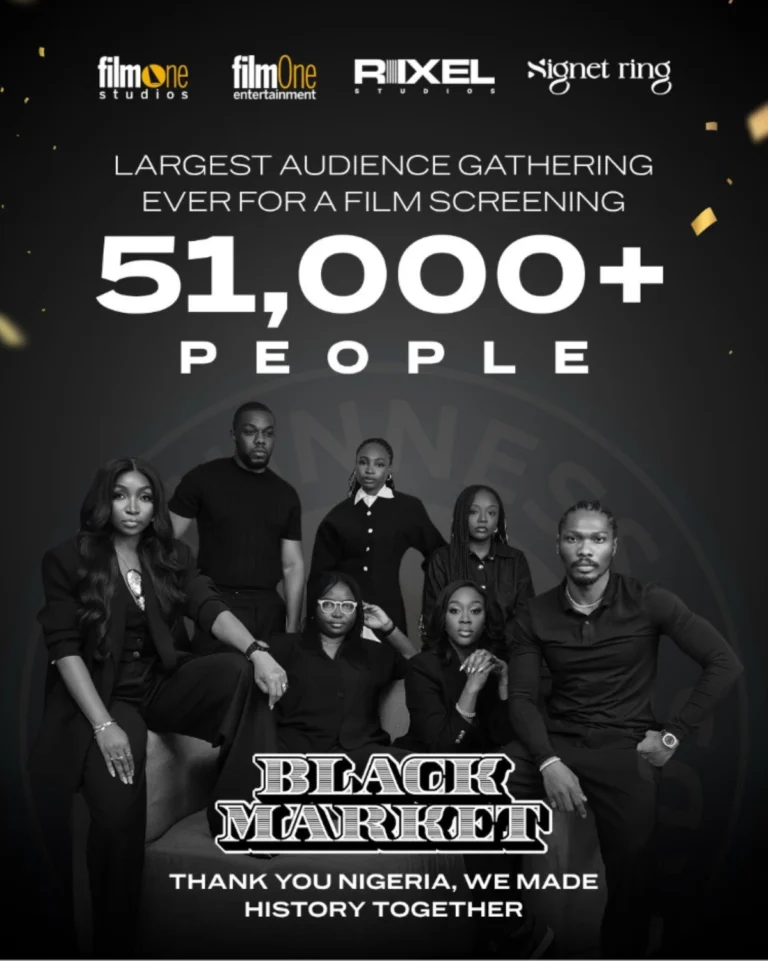
Nollywood has officially etched its name into the global entertainment history books after the gritty crime thriller Black Market drew a verified crowd of 51,000 attendees to the iconic Tafawa Balewa Square (TBS) in Lagos, Nigeria, setting a new Guinness World Record for the largest attendance at a film screening at a single venue.
The monumental mass screening, which took place on Saturday, September 26, 2026, not only surpassed the ambitious targets set by the film’s organizers but also eclipsed a nearly eleven-year-old global record. The previous benchmark of 43,624 attendees had stood since July 2015, when the Philippine Arena hosted a massive screening of the Filipino biographical drama Felix Manalo. By drawing a verified audience well beyond that threshold, the Black Market screening has signaled a potent shift in how African cinema engages mass audiences, combining traditional cinematic distribution with large-scale live entertainment spectacles.
While the official Guinness World Records adjudication team verified 51,000 people who strictly met the stringent monitoring and participation requirements of the record attempt, local government estimates suggested an even larger physical turnout. Lagos State Deputy Governor Obafemi Hamzat, speaking at the event, noted that approximately 64,000 people were present within the expansive grounds of TBS. The discrepancy between the total crowd size and the officially recognized figure is attributed to the rigorous auditing processes required by Guinness World Records adjudicators, which mandate that participants remain fully accounted for throughout the duration of the screening rather than merely being present on the venue grounds.
The Journey to the Record-Breaking Night
The path to breaking a global attendance record requires meticulous planning, cross-sector collaboration, and deep community engagement. For the producers and promotional team behind Black Market, the vision was clear from the onset: to target a minimum of 50,000 simultaneous viewers to ensure the record attempt cleared the previous Asian benchmark by a comfortable margin.
Planning for the event began months in advance, involving high-level security coordination with the Lagos State Government, crowd management specialists, technical logistics teams, and digital ticketing and verification platforms. Tafawa Balewa Square, a historic landmark in central Lagos capable of holding massive crowds, was retrofitted with state-of-the-art outdoor projection screens, high-fidelity surround sound systems, and multiple access control gates designed to handle the influx of tens of thousands of moviegoers smoothly.
As Saturday, September 26, 2026, approached, anticipation reached a fever pitch across Lagos. Promotional campaigns leveraged social media, radio broadcasts, and influencer partnerships to build excitement around the premiere of the crime thriller. By late afternoon on the day of the event, thousands of citizens from all walks of life—ranging from avid Nollywood enthusiasts and industry stakeholders to curious residents—streamed into TBS. The atmosphere was festive yet orderly, underscored by heavy security presence and volunteer support staff who ensured that entry protocols met the strict compliance standards required by the international record-keeping body.
Creative and Production Excellence Behind Black Market
Beyond the record-breaking spectacle of the evening, Black Market represents a significant artistic triumph for modern Nollywood. The crime thriller was directed by Fatimah Binta Gimsay, whose distinct directorial vision brought a gritty, fast-paced narrative to life. Gimsay also co-wrote the screenplay alongside Abdul Tijani-Ahmed, crafting a complex web of underground economies, moral dilemmas, and high-stakes survival in the urban underworld.
The film’s plot delves into the perilous mechanics of illicit trade networks, exploring themes of desperation, loyalty, and redemption. Industry critics have noted that Black Market departs from conventional Nollywood storytelling by blending high-octane action sequences with psychological depth, a creative choice that clearly resonated with the massive crowd at TBS. The production values—spanning cinematography, sound design, and pacing—were custom-built for a theatrical experience, proving that contemporary Nigerian filmmakers are increasingly capable of delivering cinematic spectacles that demand large-scale public engagement.
Star-Studded Attendance and Official Government Backing
The historical significance of the evening drew a constellation of VIPs, government dignitaries, and Nollywood royalty to Tafawa Balewa Square. The high-profile turnout underscored the cultural and economic importance of the creative industries to the Nigerian state.
Among the prominent political figures in attendance were Lagos State Deputy Governor Obafemi Hamzat and the Lagos State Commissioner for Tourism, Arts and Culture, Toke Benson. Their presence highlighted the state government’s active partnership with the creative sector, viewing large-scale cultural events as vital drivers of tourism, civic pride, and local economic activity.
The red carpet and VIP enclosure were equally luminous, featuring a who’s who of Nollywood actors, directors, and producers. Celebrated film personalities such as Lateef Adedimeji, Kunle Remi, Stan Nze, Linda Ejiofor, Gabriel Afolayan, and Kunle Afolayan were present to witness the historic screening and celebrate the collective milestone with the creative team and their fans. Their attendance served as a powerful testament to industry solidarity, demonstrating that the success of one project is widely celebrated as a victory for the entire Nigerian film ecosystem.
Nigeria’s Growing Legacy of Guinness World Records
The triumph of Black Market does not stand in isolation; rather, it is the latest chapter in a remarkable wave of Guinness World Records achievements by Nigerian individuals, businesses, and cultural institutions. Over recent years, Nigerians have increasingly turned their sights toward global platforms, leveraging tenacity, massive local support bases, and organizational prowess to claim international titles.
Most notably, in January 2026, celebrity chef Hilda Baci secured her third Guinness World Record title, cementing her status as a global culinary phenomenon. Baci and her dedicated team were recognized for preparing the world’s largest serving of rice, a monumental feat that involved cooking 8,780 kilograms of rice during a public record attempt held in Victoria Island, Lagos, in September 2025. That achievement followed her legendary 2023 cook-a-thon, which single-handedly revitalized public interest in long-form endurance records across the West African nation.
Similarly, corporate entities and cultural brands in Nigeria have utilized large-scale public events to break barriers and promote local heritage. From mass culinary feats to massive consumer engagement projects utilizing thousands of kilograms of raw materials to celebrate indigenous snacks, the country has cultivated a thriving culture of public-driven world record attempts. These milestones reflect a broader demographic confidence, vibrant community mobilization, and a burgeoning desire to showcase Nigerian talent on the world stage.
Broader Impact and Economic Implications for Nollywood
The successful setting of a new attendance record by Black Market carries profound implications for the future of Nollywood and African cinema as a whole. For decades, the Nigerian film industry has grown exponentially, evolving from the informal "Home Video" era of the 1990s into a globally recognized commercial powerhouse—often dubbed "Nollywood"—that ranks among the largest film producers in the world by volume.
However, despite its massive output and international streaming footprint, the industry has historically faced infrastructure challenges, particularly regarding traditional theatrical distribution networks. Nigeria possesses a relatively low number of cinema screens per capita compared to Western nations or emerging Asian markets. This bottleneck has often limited the box office potential of local films, making innovative distribution models essential.
The massive turnout at Tafawa Balewa Square demonstrates the viability of alternative exhibition models, such as open-air mega-screenings, community pop-up cinemas, and large-scale public entertainment events. By bringing cinema directly to the masses in a communal, festival-like environment, the organizers of Black Market proved that massive untapped audiences exist beyond the confines of traditional suburban malls and multiplexes.
Furthermore, this record-breaking event serves as a major marketing catalyst. Global media attention, increased brand sponsorship interest, and heightened international visibility will likely translate into stronger commercial returns for the film, opening doors for broader international distribution deals, streaming acquisitions, and cross-border collaborations. It signals to international investors that African content possesses not only high cultural resonance but also the power to mobilize massive, enthusiastic crowds in physical spaces.
As the dust settles on Tafawa Balewa Square and the Guinness World Records certificate finds its home among the proud creators of Black Market, the Nigerian film industry stands at an inspiring crossroads. By shattering a record that stood for over a decade, Nollywood has once again demonstrated its boundless creativity, organizational ambition, and unyielding cultural momentum, leaving an indelible mark on the global cinematic landscape.