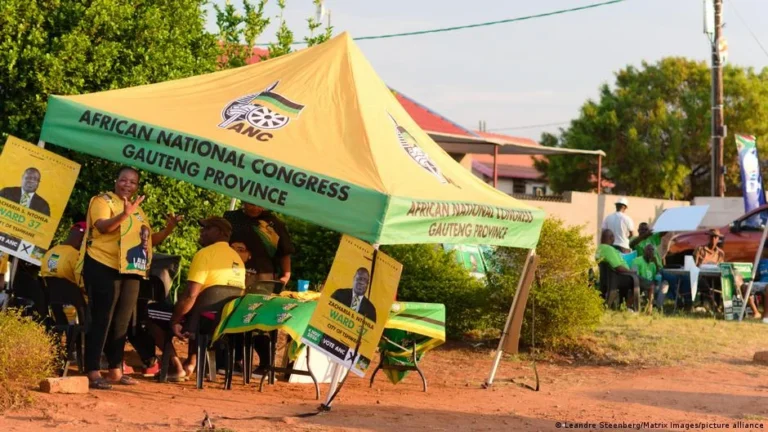
The African National Congress (ANC), the party that once dismantled the machinery of apartheid and steered South Africa into its democratic era, has recorded its most dismal electoral performance in history. Final tallies published this Sunday from Wednesday’s municipal polls reveal the party garnered less than 31% of the national vote, a staggering decline that signals the end of the liberation movement’s undisputed hegemony. As the dust settles on these municipal contests, the political landscape of South Africa is shifting toward an era of fragmented governance, characterized by the necessity of complex coalition building and a palpable rejection of the status quo by an increasingly disillusioned electorate.
The Democratic Alliance (DA), the nation’s primary center-right opposition, secured just under 25% of the vote, cementing its position as the dominant alternative in major urban centers. More critically, the Electoral Commission of South Africa (IEC) confirmed that the ANC has lost its majority in six of the country’s eight metropolitan municipalities. With no single party achieving an outright mandate in several major economic hubs, the immediate future of local governance will be defined by grueling negotiations to form viable, stable coalitions.
A Chronology of Declining Influence
The trajectory of the ANC’s decline is not a sudden phenomenon but rather the culmination of a decade-long erosion of public trust. The party’s historical dominance, which spanned from 1994 to the present, began to show cracks well before the current cycle.
- 1994–2009: The ANC enjoys overwhelming electoral support, winning comfortable majorities in both national and municipal elections under the leadership of Nelson Mandela, Thabo Mbeki, and the early years of Jacob Zuma.
- 2016: The party loses control of key metros—including Johannesburg, Tshwane (Pretoria), and Nelson Mandela Bay—for the first time, signaling a shift toward a more competitive urban landscape.
- 2021: In local government elections, the ANC’s share of the vote dips to approximately 46%, forcing it into precarious coalition arrangements across dozens of municipalities.
- May 2024: In a landmark national election, the ANC fails to secure a parliamentary majority for the first time since 1994, necessitating the formation of a Government of National Unity (GNU).
- Late 2026: The current municipal polls confirm the downward trend, with the party’s support cratering to sub-31% levels, leaving it without a clear path to governance in most of the country’s most populous cities.
The Anatomy of Voter Backlash
The current electoral outcome is driven by a convergence of systemic crises that have paralyzed South African municipalities. Voters have increasingly conflated the ANC’s national leadership with the crumbling state of basic services at the local level.
Central to the voter frustration are chronic power shortages—locally known as "load shedding"—which have decimated small businesses and disrupted daily life for years. Compounded by severe water infrastructure failures, the inability of municipal governments to provide consistent sanitation and clean water has become a flashpoint for public anger. In many regions, citizens are now forced to rely on private water delivery or endure multi-day outages, fueling a sentiment that the state has abandoned its primary responsibilities.
Beyond service delivery, the macroeconomic environment remains bleak. South Africa faces one of the highest unemployment rates in the world, with youth unemployment figures consistently exceeding 50%. This economic stagnation, coupled with rampant violent crime and high-profile corruption scandals, has created a fertile ground for smaller, populist parties to siphon off the ANC’s traditional support base. The emergence of parties like the uMkhonto weSizwe (MK) party, which has tapped into nationalist and anti-establishment sentiment, has further fractured the ANC’s once-monolithic coalition of voters.
Official Responses and Internal Reflection
The response from the ANC leadership has been one of solemn admission. Secretary-General Fikile Mbalula addressed the media on Saturday, characterizing the results as "catastrophic." His remarks represented a departure from the party’s historical narrative, which often relied on its credentials as the liberator of South Africa to secure support.
"We cannot ask the people to trust us merely because of our history," Mbalula acknowledged, signaling an internal recognition that the party’s liberation-era legacy is no longer a sufficient shield against current performance failures.
President Cyril Ramaphosa, while maintaining a more measured tone, acknowledged the systemic crisis in his weekly presidential communique. He admitted that "municipal failures have contributed to declining public trust and confidence in democratic governance." While he has not yet held a full press briefing regarding the specific numbers, his acknowledgement suggests that the party is aware that its traditional rhetoric of "revolutionary transformation" is failing to resonate with a population demanding immediate, tangible results.
The DA and the Challenge of Governance
For the Democratic Alliance, the results are a tactical victory, though they present their own set of challenges. By holding onto Cape Town with an absolute majority and performing strongly in the Tshwane and Johannesburg metros, the DA has positioned itself as the manager of South Africa’s economic engine.
DA leader Geordin Hill-Lewis has moved quickly to initiate talks, emphasizing that the focus must now shift from electoral campaigning to the administrative realities of running cities. "All of the cut and thrust that comes with the election is now over, and it is time now to put together governments that can actually fix these towns and cities," Hill-Lewis stated.
The DA’s strategy appears to be one of "pragmatic coalition building." By actively reaching out to smaller, like-minded parties, the DA hopes to exclude the ANC from power in these key regions, effectively creating "opposition-led" zones of governance that can serve as a template for what they argue is a more efficient, service-oriented style of administration.
Implications for the 2029 General Election
Political analysts view the 2026 municipal results as a definitive bellwether for the 2029 general election. According to Daniel Silke, a prominent political analyst, the result is the "most severe" outcome the ANC could have feared, effectively stripping the party of its ability to command authority both locally and nationally.
The implications are twofold. First, the ANC is now forced to operate within a permanent state of negotiation. The stability of the current national Government of National Unity is likely to be tested by the fallout from these municipal results, as constituent parties may reassess their allegiances based on their local performance.
Second, the political landscape is becoming increasingly localized. Voters are demonstrating a willingness to experiment with alternative parties, even those on the fringes, to punish the ANC for its perceived inertia. If the ANC cannot reform its service delivery model and address the corruption allegations that have plagued its ranks for over a decade, the 2029 election could see the party relegated to a secondary player in the national parliament.
Looking Ahead: A New Era of Coalition Politics
As the various political parties enter into closed-door negotiations to form municipal councils, the primary question remains whether these coalitions will be stable enough to survive the electoral term. Historically, South African municipal coalitions have been notoriously volatile, often collapsing under the weight of ideological differences or the opportunistic shifting of smaller parties.
For the citizens of South Africa, the immediate future holds uncertainty. The transition from a dominant-party state to a multi-party, coalition-dependent system is historically fraught with risks, including bureaucratic paralysis and policy inconsistency. However, it also represents a potential maturation of South Africa’s democracy, where the electorate is no longer bound by historical loyalties and is instead demanding accountability through the ballot box.
The ANC finds itself at a crossroads. It can either undergo a radical transformation to address the governance failures that have eroded its standing, or it can continue to decline as it struggles to adapt to the new, pluralistic reality of South African politics. For now, the verdict from the voters is clear: the era of ANC exceptionalism has ended, and the era of competitive, high-stakes coalition governance has begun.