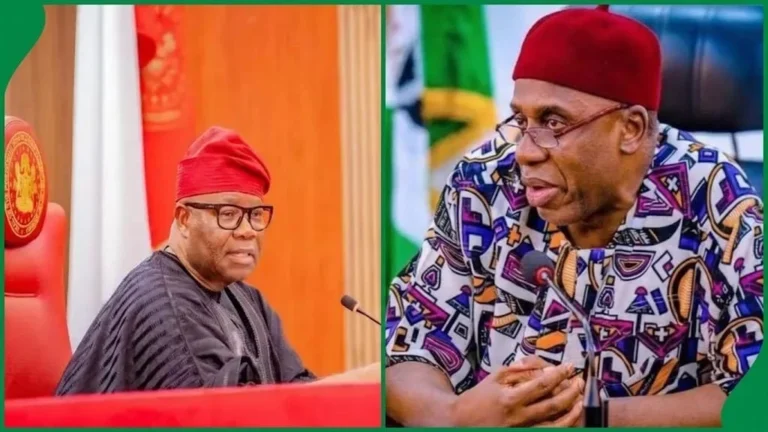
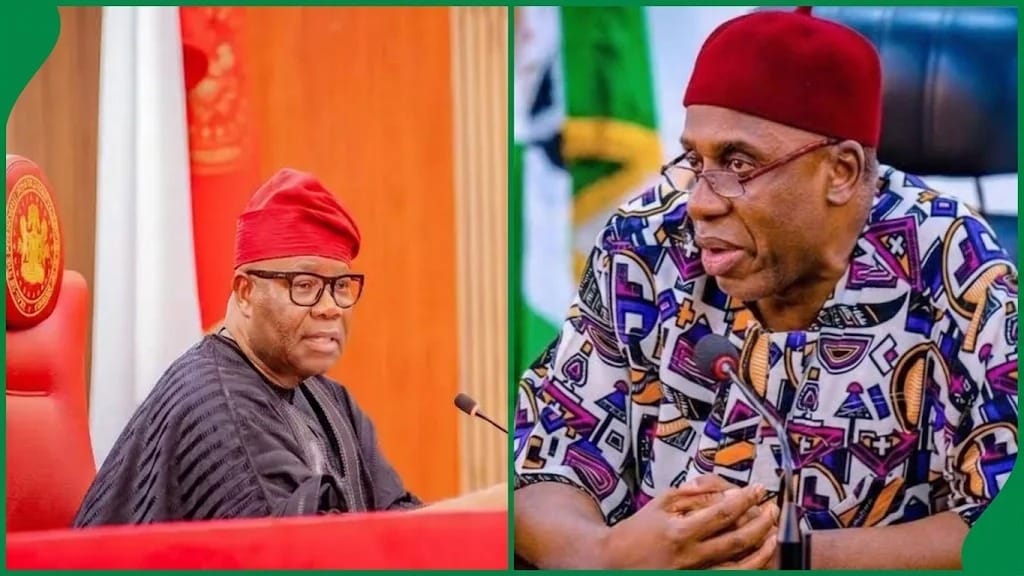
The political atmosphere in Nigeria grew increasingly volatile on Saturday, November 14, 2026, as former Rivers State Governor and erstwhile Minister of Transportation, Rotimi Amaechi, leveled serious allegations of financial impropriety against the President of the Senate, Godswill Akpabio. Speaking before a crowd of supporters at the Tafawa Balewa Stadium in Bauchi State, Amaechi claimed that Akpabio, during his tenure and oversight of the Niger Delta Development Commission (NDDC), was responsible for the introduction of a systemic 50 per cent deduction from payments made to contractors. These claims, delivered during an African Democratic Congress (ADC) campaign event, have sent shockwaves through the political establishment, signaling a hardening of opposition rhetoric as the country looks toward the 2027 general elections.
Amaechi’s assertions represent a significant escalation in the ongoing friction between the two prominent political figures. The former governor, who has recently repositioned himself within the ADC, framed his accusation as a direct response to recent disparaging remarks he alleged Akpabio made during a visit to Port Harcourt, Rivers State. By linking the Senate President to a specific mechanism of corruption—the alleged "half-pay" policy for contractors—Amaechi has invited a direct challenge to the integrity of the National Assembly’s leadership.
Contextualizing the NDDC Controversy
The Niger Delta Development Commission has long been a focal point for allegations of financial mismanagement and political patronage. Established in 2000 to spearhead the development of the oil-rich but infrastructure-starved Niger Delta region, the commission has frequently been audited and subjected to legislative investigations. Between 2020 and 2022, the NDDC was the subject of intense scrutiny by the National Assembly, involving forensic audits and investigations into contract awards.
Akpabio, who served as the Minister of Niger Delta Affairs from 2019 to 2022, oversaw the commission during a period of massive operational overhaul. Critics and political opponents have frequently targeted this period, questioning the transparency of project execution and the disbursement of funds. Amaechi’s claim that a 50 per cent deduction rate was instituted suggests a systemic siphon of public resources, though he provided no immediate evidentiary documentation during the rally. The severity of the accusation lies in the claim that it was an institutionalized practice rather than an isolated incident of graft.
Economic Policy Shift and the 2027 Campaign Trail
Beyond the personal conflict with the Senate President, Amaechi’s address in Bauchi focused heavily on the economic anxieties currently gripping the nation. The former minister utilized the platform to draw a stark contrast between his party’s proposed policies and the current administration’s trajectory under President Bola Tinubu.
Amaechi’s most notable policy promise—the restoration of fuel and electricity subsidies—strikes at the heart of the current government’s fiscal reform agenda. Since 2023, the Tinubu administration has removed the long-standing fuel subsidy and moved toward a market-determined exchange rate, citing the need to prevent national bankruptcy and encourage foreign investment. However, these reforms have led to record-high inflation, significantly impacting the purchasing power of the average Nigerian.
By pledging to reverse these policies, Amaechi is positioning the ADC as a populist alternative. He argued that the high cost of living is not merely a global phenomenon but a direct result of government policies that have "collected all the money," leaving citizens in a state of perpetual struggle. "We will bring back subsidy, the price of everything will go down," Amaechi declared. This narrative is strategically aimed at the demographic most affected by the current economic downturn—low-to-middle-income earners in Northern states like Bauchi, where the cost of transportation and food staples has surged in recent months.
Broader Implications and Political Stability
The timing of these allegations is critical. As the 2027 election cycle approaches, the political landscape is witnessing a realignment of power blocks. Amaechi’s move to the ADC and his aggressive rhetoric against both the executive and legislative leadership suggests that the opposition is seeking to consolidate a platform based on anti-corruption and economic relief.
However, the lack of immediate evidence provided by the former governor has prompted calls for caution from political analysts. In the Nigerian legal and political environment, accusations of such magnitude without supporting documentation often lead to prolonged litigation or, conversely, are dismissed as mere political theater. Should the Senate President choose to respond, the matter could potentially lead to an ethics committee review within the Senate or, at the very least, a series of public rebuttals that will further polarize the electorate.
Furthermore, the accusation impacts the reputation of the NDDC itself, an agency already struggling with public perception. If these claims gain traction, they may force the federal government to launch an independent investigation to clear the air, or risk seeing the commission become a primary campaign issue in 2027.
The Electoral Strategy in Bauchi
The choice of Bauchi for such a high-profile announcement is not coincidental. Bauchi State has historically been a significant electoral battleground. By speaking at the Tafawa Balewa Stadium, Amaechi is attempting to leverage the state’s regional influence to amplify his message. The ADC is currently seeking to build a coalition of voters who feel disenfranchised by the mainstream political parties.
Amaechi’s instructions to voters—to stay at their polling units after casting their ballots to monitor the counting process—reflects a growing trend of "defensive voting" in Nigeria. This practice aims to prevent electoral fraud at the grassroots level and suggests that the opposition believes the integrity of the 2027 polls will be determined at the ward and local government levels.
Analysis of the Political Landscape
The conflict between Amaechi and Akpabio is symptomatic of a deeper fissure within the Nigerian political elite. Both men have served at the highest levels of government—Amaechi as a former Governor and Minister, and Akpabio as a former Governor, Minister, and current Senate President. Their public confrontation signals the end of any potential for a unified front and sets the stage for a bitter campaign season.
Economically, the promise of restoring subsidies is a high-risk, high-reward strategy. While it appeals to the masses struggling with the current cost of living, it also invites intense scrutiny from international financial institutions and economic experts who argue that the fiscal deficit caused by such subsidies was one of the primary drivers of Nigeria’s debt crisis. Amaechi’s promise to "wipe out corruption" as a means to fund these subsidies will likely be tested by critics who will demand a detailed fiscal plan rather than broad ideological strokes.
As the situation develops, the public will be looking for one of three outcomes: a formal denial and rebuttal from the Senate President’s office, a presentation of evidence from the Amaechi camp, or a strategic silence that allows the rhetoric to fade. For now, the allegation remains a potent weapon in the ADC’s arsenal, serving to frame the upcoming election as a referendum on both the economic management of the current administration and the personal integrity of the legislative leadership.
The coming weeks will likely reveal whether these charges hold weight or if they are simply the opening salvos in a long, arduous, and potentially transformative campaign period for the Nigerian electorate. With the 2027 horizon fast approaching, the intersection of regional interest, economic policy, and personal rivalry will undoubtedly continue to dictate the rhythm of the nation’s political pulse.