The arrest of Artur Danielyan, leader of the opposition Adekvad party, in early October has reignited a fierce debate regarding the state of democratic governance and the rule of law in Armenia. Danielyan’s detention, triggered by inflammatory social media commentary directed at Prime Minister Nikol Pashinyan and national security institutions, serves as a flashpoint in a deepening national discourse concerning the boundaries of free speech and the legitimacy of state-led criminal prosecutions. As Armenian authorities increasingly lean on the judiciary to address political dissent, civil society organizations and international observers are raising alarms about what they describe as a calculated trend toward democratic backsliding and the silencing of critical voices.
The detention of Danielyan follows a period of heightened sensitivity within the Armenian government. The controversy surrounding his arrest centers on his vocal opposition to the Prime Minister’s policies, specifically regarding the handling of a prisoner exchange scenario involving an Azerbaijani soldier accused of violent crimes against civilians in the village of Shaki. In an exchange that escalated into criminal charges, Danielyan publicly insulted the Prime Minister, accusing him of negligence regarding the fate of Armenian citizens currently held in detention centers in Baku.
A Chronology of Increasing Tensions
The friction between the Pashinyan administration and its opposition did not emerge in a vacuum. To understand the current climate, one must look at the trajectory of Armenian politics following the 2020 Nagorno-Karabakh War and the subsequent 2023 military offensive by Azerbaijan that resulted in the displacement of over 100,000 ethnic Armenians.
- April 2020: The Armenian government introduces Article 226.2 to the Criminal Code, designed to penalize public calls for violence or the promotion of such acts. Critics argue the law is frequently weaponized to target political opponents rather than genuine threats.
- 2023: Following the collapse of the de facto administration in Nagorno-Karabakh, Azerbaijan detains several high-ranking Armenian officials, further straining domestic political stability in Yerevan.
- June 2026 (Pre-election period): Tensions peak during the parliamentary election cycle. Artur Osipyan, a prominent activist from Nagorno-Karabakh, is arrested following a public confrontation with the Prime Minister, leading to charges of inciting violence and disrupting public order.
- October 2026: Artur Danielyan is taken into custody, marking a significant escalation in the government’s response to digital dissent.
The Problem of Selective Prosecution
Data provided by independent monitoring groups, including the 2025 Freedom House report, indicates a stark imbalance in how Armenian law enforcement applies the law. The report suggests that nearly 95% of cases brought under the 2020 amendment regarding incitement to violence were directed at critics of Prime Minister Pashinyan. Conversely, instances of hostile rhetoric from supporters of the ruling Civil Contract party—including the use of derogatory language toward displaced Nagorno-Karabakh refugees—have rarely resulted in similar criminal scrutiny.
This discrepancy has led to accusations of "selective justice." Over a dozen prominent Armenian civil society organizations recently issued a joint statement condemning the prosecution of Danielyan. They characterized the state’s actions as "patently illegal, disproportionate, and politically motivated," warning that the use of the judicial system to settle political scores serves as a "chilling effect" on public discourse. The coalition argued that such measures are not intended to maintain public order, but rather to eliminate the space for legitimate political disagreement.
Geopolitics and the European Silence
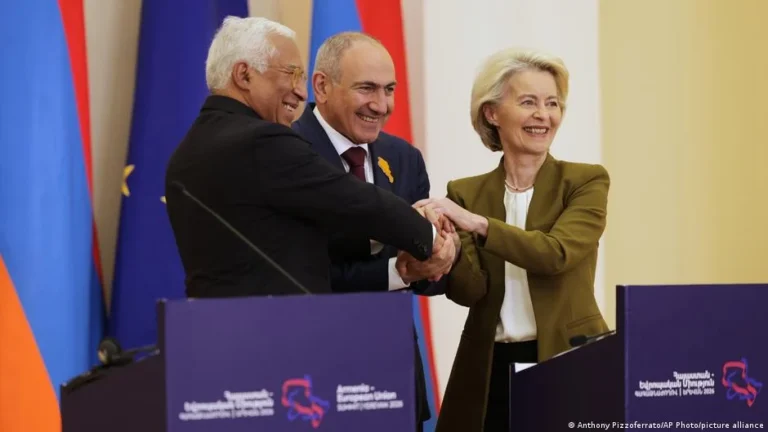
The international dimension of this issue is equally complex. As Armenia attempts to pivot away from its historical dependence on Russia and toward closer integration with the European Union, the domestic democratic climate has become a point of diplomatic tension. Yet, Brussels has been notably cautious in its public assessments.

Political analyst Tigran Grigoryan notes that the European Union is currently operating under a "pragmatic and geopolitically driven" framework. Given the volatility in the Caucasus, particularly the recent developments in neighboring Georgia, the EU views the current Armenian government as its most viable partner in the region. This strategic necessity has, in the eyes of many, led to a degree of "geopolitical blind-spotting."
Stefan Meister, an expert at the German Council on Foreign Relations (DGAP), suggests that the EU’s approach is fundamentally motivated by its "Russia policy." By focusing heavily on reducing Russian influence in Armenia, the EU may be inadvertently validating the Pashinyan government’s tendency to label any internal criticism as a form of "pro-Russian" sabotage. Meister cautions that this narrative is a dangerous oversimplification; many of those currently targeted by the state, such as Karabakh activists, possess ideological positions that are entirely independent of Moscow’s agenda. By failing to hold the current administration to the same democratic standards it applies to other regional partners, the EU risks undermining its own core values of human rights and the rule of law.
The Legal and Institutional Perspective
In response to queries regarding these trends, an EU spokesperson stated that democracy, the rule of law, and fundamental rights remain the cornerstones of the EU-Armenia Comprehensive and Enhanced Partnership Agreement (CEPA). The official position remains that all criminal investigations in Armenia must be conducted in a manner that is "independent, impartial, and free from political considerations."
However, the gap between these official diplomatic statements and the reality on the ground in Yerevan continues to widen. The Regional Center for Democracy and Security (RCDS) has documented a consistent pattern where state resources are leveraged to manage the digital information space. Pro-government influencers often operate with impunity, while opposition voices are subjected to rigorous investigation. This environment has fostered a climate of self-censorship, where journalists and activists must weigh the risk of criminal prosecution against the value of their public statements.
Implications for Armenian Democracy
The trend of using the criminal justice system to address political grievances holds significant implications for the long-term stability of Armenia. When the judiciary is perceived as an extension of the executive branch, it loses the capacity to act as a neutral arbiter. For a nation attempting to consolidate its democratic institutions while navigating an extremely precarious security environment, the erosion of these checks and balances could be counterproductive.
If the Armenian government continues to prioritize the suppression of dissent over the maintenance of an inclusive democratic process, it may face a decline in public trust. Furthermore, if the international community continues to ignore these trends in favor of narrow geopolitical gains, it may find itself supporting a "stable" partner that is increasingly authoritarian, potentially creating a new set of risks for regional security.
As it stands, the case of Artur Danielyan is likely to remain a litmus test for the country’s democratic trajectory. Whether the Armenian authorities choose to recalibrate their approach to dissent or continue on the current path of heightened legal intervention will depend on both domestic pressure from civil society and the willingness of international partners to demand adherence to the democratic commitments enshrined in their partnership agreements. For now, the divide between the government’s narrative of stability and the opposition’s cry for freedom of expression remains a defining feature of the Armenian political landscape.