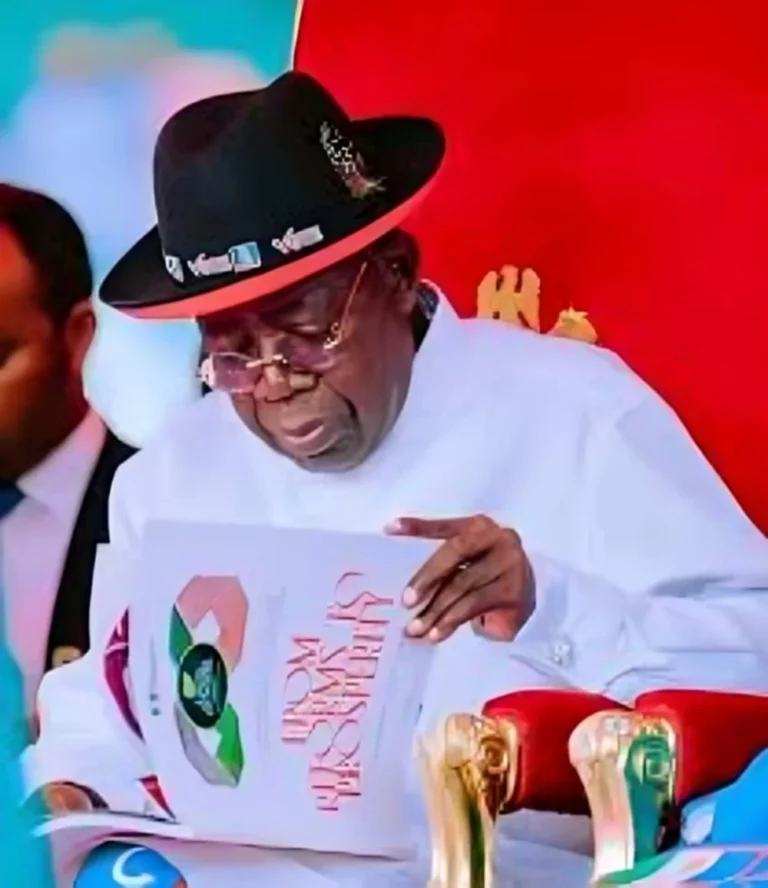
President Bola Ahmed Tinubu has delivered a powerful political address in Port Harcourt, Rivers State, emphasizing that the ultimate destiny of Nigerian youths is intrinsically tied to the outcome of the upcoming 2027 general elections. Addressing a massive gathering of supporters, party stalwarts, and stakeholders during an All Progressives Congress (APC) presidential campaign rally, the President issued a passionate plea for active civic engagement, urging eligible citizens—particularly the younger demographic—to secure their Permanent Voter Cards (PVCs) as the primary instrument of democratic change.
The high-stakes event, held in the oil-rich Niger Delta hub, served as a multifaceted platform for the President. Beyond mobilizing the electorate for future polls, President Tinubu used the occasion to evaluate his administration’s sweeping economic reforms, publicly reaffirming his strategic partnership with the Minister of the Federal Capital Territory (FCT), Nyesom Wike. Furthermore, the President directly addressed the delicate political landscape of Rivers State, publicly commending Governor Siminalayi Fubara for his administrative maturity and his willingness to embrace peace in the wake of severe executive-legislative friction that had previously threatened the state’s stability.
The Presidential Appeal to Nigerian Youth
Placing the youth demographic at the center of his political and governance vision, President Tinubu underscored that the trajectory of Nigeria over the next decade will be determined by the choices young voters make at the polls. Pointing to the statistical reality that young people constitute the largest segment of Nigeria’s voting-age population, the President framed the PVC not merely as a piece of identification, but as a potent political weapon capable of shaping governance outcomes.
"To the youth of Nigeria, this election is about you. Your future depends on this election," President Tinubu told the cheering crowd in Port Harcourt. Emphasizing the urgency of the moment, he made a direct, emotionally charged appeal for administrative compliance regarding voter registration. "It is left for you to use the weapon you have, and that weapon is the PVC. If you have not collected yours, please go ahead and collect it. Please, I beg you, I take God beg you."
This call to action aligns with broader data from the Independent National Electoral Commission (INEC), which consistently highlights youth as the most vibrant demographic in Nigeria’s electoral landscape. Political analysts note that as the 2027 cycle approaches, mobilizing this demographic will remain a decisive factor for any political party seeking victory. President Tinubu reiterated that his administration remains deeply committed to youth empowerment, qualitative education, and comprehensive social welfare programs designed to transition young Nigerians from economic vulnerability to sustainable prosperity.
Nyesom Wike as a Cornerstone of Infrastructural Development
A central highlight of the President’s address was his enthusiastic endorsement of the Minister of the Federal Capital Territory, Barrister Nyesom Wike. Describing the former Rivers State governor as an indispensable development partner, Tinubu credited Wike’s visionary leadership and relentless work ethic with accelerating the current administration’s infrastructural agenda, both within the nation’s capital and across the broader national framework.
"Nyesom Wike is already a development partner of the Bola Tinubu administration," the President stated. "He is doing a wonderful job, committed, very, very hardworking. A man with vision who combines that with a mission. Help me thank him for his contribution to the infrastructural development of our country."
Wike’s inclusion in the federal cabinet under an APC-led administration, despite his enduring affiliation with the Peoples Democratic Party (PDP), has long been a subject of intense political analysis. Proponents of this bipartisan synergy argue that governance must transcend party lines to deliver tangible dividends of democracy. Under Wike’s leadership in the FCT, the administration has launched numerous high-profile infrastructural projects, ranging from extensive road networks and light rail revivals to urban renewal initiatives, earning him both praise from the executive branch and occasional scrutiny from political opponents.
Commending Governor Fubara and Navigating Rivers State Politics
Perhaps the most politically sensitive segment of President Tinubu’s address centered on the internal political dynamics of Rivers State. The state had previously been gripped by a bitter, highly publicized rift between Governor Siminalayi Fubara and his predecessor, Minister Nyesom Wike, which resulted in factionalization within the state legislature, legal battles, and palpable tension across the region.
Stepping into this volatile atmosphere, President Tinubu directly commended Governor Fubara for choosing the path of maturity, restraint, and adherence to national peace interventions. The President’s public acknowledgment was widely interpreted as a stabilizing endorsement of the current governor’s leadership style.
"Fubara, Your Excellency, the host governor of today, I want to thank you specifically for your maturity, understanding, and respect for the wisdom of elders," President Tinubu remarked. "When we intervened, you respected our position, you maintained peace, and you are a committed democrat. Fubara, you will not regret what you have done as long as all of us are alive."
Political analysts have observed that the fragile peace in Rivers State is critical not only for local governance and security but also for national economic stability, given the state’s strategic position as a primary contributor to Nigeria’s oil and gas revenue. Governor Fubara’s decision to scale back hostilities and submit to presidential mediation has been credited with averting a total breakdown of law and order in the oil-rich state.
Economic Reforms and Fiscal Turnaround
Transitioning from local politics to macro-economic governance, President Tinubu used the platform to vigorously defend his administration’s ongoing economic reforms, contrasting his fiscal scorecard with the challenging conditions inherited when he assumed office in May 2023.
The President reminded the audience of the dire financial straits faced by sub-national governments at the inception of his tenure. According to official data from the period, no fewer than 27 out of Nigeria’s 36 states struggled significantly to meet basic financial obligations, including the timeous payment of civil service salaries and pensions. Tinubu highlighted that his administration implemented deliberate fiscal interventions—including the removal of the petrol subsidy and the unification of foreign exchange rates, which substantially boosted federal allocations to states through the Federation Account Allocation Committee (FAAC)—to rescue states from insolvency.
"When we came in, 27 out of 36 states were unable to pay civil service salaries," the President noted. Through strategic fiscal recalibrations, he asserted that his administration has successfully reversed this negative trend, enabling state governments to clear long-standing salary backlogs, service their debts, and embark on localized capital projects.
While acknowledging the temporary economic hardship and inflationary pressures triggered by these bold reforms, the President maintained that the policies are foundational prerequisites for long-term economic resilience, wealth creation, and sustainable growth. Economic experts point out that while increased FAAC allocations have provided states with unprecedented financial liquidity, the ultimate test for governors remains translating these windfalls into impactful social safety nets and infrastructure that directly alleviate poverty at the grassroots level.
Implications of the Port Harcourt Rally
The APC presidential rally in Port Harcourt holds profound implications for Nigeria’s evolving political alignment ahead of the 2027 electoral cycle. By simultaneously embracing FCT Minister Nyesom Wike for his executive delivery and commending Rivers State Governor Siminalayi Fubara for political restraint, President Tinubu projected an image of a pragmatic leader capable of bridging partisan divides for the sake of national stability.
Furthermore, the urgent call for youth voter registration signals an early recognition that the 2027 polls will likely be fought and won on the battleground of demographic enthusiasm and digital-age political mobilization. As political parties begin positioning themselves for the grueling electoral marathon ahead, the developments in Rivers State serve as a microcosm of Nigeria’s complex political chessboard—where federal influence, regional power dynamics, and grassroots economic realities continuously intersect.