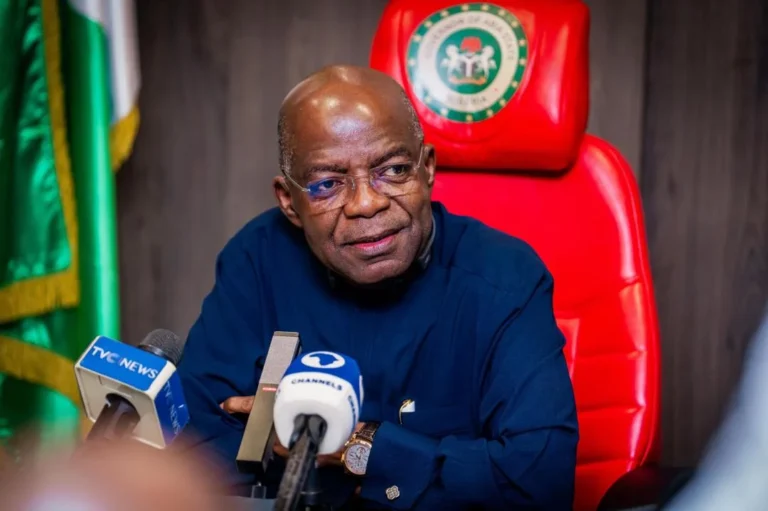
Abia State Governor, Dr. Alex Otti, has boldly asserted that the notable infrastructural, economic, and institutional milestones recorded by his administration over the past three years serve merely as a preliminary foundation for the comprehensive transformation of the state. Speaking passionately to a gathering of faith leaders, citizens, and stakeholders, the governor emphasized that the ultimate vision for "a new Abia" is still unfolding, promising that the upcoming tenure will be dedicated to institutionalizing structural reforms that are deeply rooted, sustainable, and entirely irreversible.
Addressing the congregation and dignitaries at the South-East Conference of Dominion City Global, held in the commercial hub of Aba, Governor Otti characterized his administration’s governance so far as a foundational "dress rehearsal" designed to prove capacity, restore public trust, and demonstrate what is achievable through disciplined resource management and transparent leadership. The event, which drew thousands of participants from across the region, provided a significant platform for the state chief executive to account for his stewardship, outline his long-term strategic roadmap, and reaffirm his unwavering commitment to meritocratic and inclusive governance.
The declaration comes at a critical juncture in the political and economic evolution of Abia State. Long plagued by infrastructural deficits, systemic administrative bottlenecks, and developmental inertia in preceding decades, the state has increasingly emerged as a focal point for governance innovation under Otti’s watch. By framing the achievements of his first three years as a mere prologue, the administration seeks to manage public expectations while simultaneously signaling a resolute shift toward deeper, more structural interventions in the remaining period of his mandate.
A Foundation Built on Structural Reforms and Fiscal Discipline
When Governor Otti assumed office, the state faced severe developmental challenges, ranging from decayed urban infrastructure in Aba and Umuahia to entrenched civil service inefficiencies and fiscal stress. Over the last 36 months, his administration has sought to reverse these trends through targeted investments in road construction, healthcare rehabilitation, educational system upgrades, and the systematic clearing of salary and pension backlogs that had long burdened the state’s workforce.
However, during his address in Aba, the governor underscored that physical infrastructure—while vital—is only part of the equation. True transformation, he argued, requires a fundamental overhaul of administrative processes, legal frameworks, and societal values to ensure that future regressions are structurally prevented.
"What has happened here is what I call a dress rehearsal, to let people know that they haven’t seen anything yet. What we have built in the last three years is just the foundation," Otti stated, drawing enthusiastic applause from the audience. "The next four and a half years, we will use them to consolidate. And when I say consolidation, I mean consolidation—changes that are irreversible."
This emphasis on "irreversible changes" addresses a historical concern in Nigerian governance: the vulnerability of capital projects and policy reforms to administrative truncation whenever a new government assumes power. By institutionalizing reforms through legal frameworks, transparent procurement processes, and digitalization of civil service operations, the Otti administration aims to create a governance template that outlives individual officeholders.
Energy Security and Infrastructure as Catalysts for Economic Renewal
Central to Governor Otti’s developmental blueprint is the deliberate focus on practical, high-impact policies rather than populist rhetoric. During the conference, the governor drew specific attention to ongoing strategic initiatives aimed at resolving perennial utility deficits, most notably the pursuit of a reliable and constant electricity supply across Abia State.
Energy poverty has historically crippled industrialization, particularly in Aba—a renowned manufacturing and entrepreneurial powerhouse often described as the SME capital of Nigeria. Small and medium-scale enterprises in the city have routinely faced existential threats due to erratic power supply and high operational costs associated with self-generated fossil fuel energy.
By prioritizing strategic partnerships with independent power producers and leveraging regulatory frameworks enabled by the recent decentralization of electricity generation and distribution in Nigeria, the Abia State government is actively working to establish independent power grids. Economists and business analysts note that a steady power supply in Aba and its environs could exponentially boost industrial productivity, attract foreign and domestic investments, and significantly reduce unemployment rates within the South-East region.

Meritocracy and Inclusivity: Redefining Citizenship in Abia State
Beyond infrastructural and economic metrics, Governor Otti used the platform to champion a progressive socio-political philosophy centered on equity, fairness, and the total abolition of state-of-origin discrimination. In a multicultural and cosmopolitan commercial center like Aba, where residents from diverse ethnic and religious backgrounds live and conduct business, the governor’s stance marks a significant departure from historical exclusionary practices.
Otti declared unequivocally that anyone residing, paying taxes, and contributing to the socio-economic development of Abia is recognized fully as an Abian, entitled to the same rights, privileges, and opportunities as indigenes. He reinforced this policy by pointing to his administration’s appointment criteria, which strictly prioritizes professional competence, integrity, and merit over religious affiliations, ethnic origins, or political patronage.
This inclusive approach to governance has been widely cited by political observers as a stabilizing factor, fostering social cohesion and minimizing identity-based tensions within the state. By embedding meritocracy into public service recruitment and political appointments, the administration aims to optimize bureaucratic efficiency and restore public confidence in state institutions.
Church and State: A Call for Practical Faith and Servant Leadership
The venue of the governor’s address—a major Christian conference—provided an apt setting for Otti to draw parallels between spiritual conviction and civic responsibility. Challenging the congregants, he emphasized that faith must manifest through tangible, positive actions that impact society, reiterating the theological axiom that "faith without works is dead." He called upon religious leaders and citizens alike to hold public office holders accountable while actively participating in the civic duty of nation-building.
The host and President of Dominion City Church, Reverend David Ogbueli, delivered a glowing assessment of Governor Otti’s leadership trajectory. Ogbueli commended the governor for embodying the principles of servant leadership, describing him as a direct answer to the earnest prayers of Abians for a purposeful, visionary, and compassionate leader.
Emphasizing the societal necessity of acknowledging excellence in public service, Ogbueli urged citizens and leaders to cultivate a culture where exemplary performance is openly commended, just as failure or corruption is condemned.
"If you want society to work, condemn what is bad and those that do it, praise what is good and those that do it," Ogbueli noted. He further observed that Abia State has increasingly commanded positive national headlines, transitioning from a symbol of governance challenges to a beacon of progressive urban renewal, infrastructural revival, and a rapidly improving ease-of-doing-business climate.
Broader Implications and the Road Ahead
As Governor Otti enters the crucial consolidation phase of his administration, political analysts and economic strategists are closely monitoring the trajectory of Abia State. The pledge to deliver irreversible reforms raises the stakes for the remaining years of his mandate, shifting public scrutiny from policy formulation to implementation and sustainability.
The success of this consolidation phase will largely depend on sustained fiscal discipline, the successful execution of critical power and infrastructural projects, and the institutionalization of the merit-based reforms currently championed by the executive. If successful, the model being forged in Abia could redefine sub-national governance in Nigeria, offering a compelling template of how targeted infrastructural investment, coupled with inclusive socio-political policies, can revitalize a struggling regional economy.
For the residents of Abia State, the message from the governor is clear: the turbulent years of developmental stagnation are receding, and the groundwork has been laid. However, the true test of the "new Abia" lies in the durability of the structures currently being erected—transformations that must prove robust enough to withstand future political transitions and deliver enduring prosperity to generations to come.