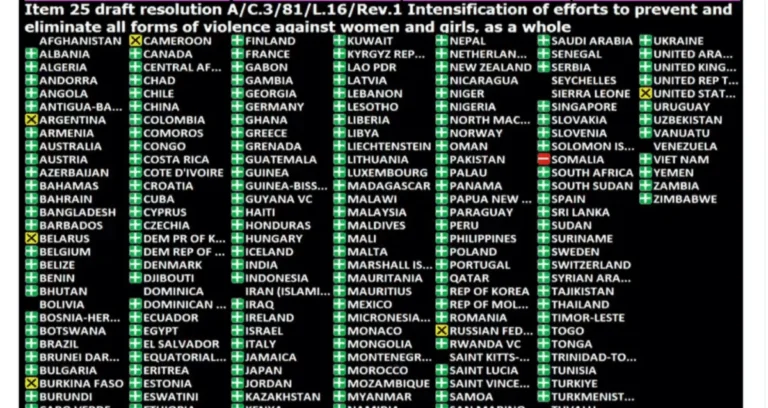
The United Nations General Assembly committee room witnessed a rare mix of overwhelming international solidarity and profound ideological fracture as member states convened to vote on a critical human rights text. In a decisive 175 to 1 vote, the international community advanced a sweeping resolution aimed at intensifying efforts to prevent and eliminate all forms of violence against women and girls. However, the veneer of global consensus was pierced by deep-seated political and cultural divisions, highlighted by Somalia casting the sole dissenting vote, alongside a cluster of key abstentions from superpowers and regional actors, including the United States, Russia, Argentina, Burkina Faso, Belarus, and Cameroon.
Co-sponsored by France and the United Kingdom, the resolution frames gender-based violence not merely as an isolated criminal justice issue, but as a systemic global emergency demanding comprehensive, gender-responsive legislative frameworks. Yet, the path to committee approval was fraught with intense diplomatic brinkmanship, reflecting a broader global pushback against established human rights frameworks concerning gender, bodily autonomy, and digital safety.
Anatomy of Modern Peril: The Digital Extension of Gender-Based Violence
At the heart of the newly advanced text is an urgent modernization of how the international community conceptualizes violence against women. Traditionally anchored in physical and domestic abuse paradigms, the resolution expands its operational definition to encompass the rapidly evolving digital landscape. Introducing the draft to the committee, French delegates underscored a harrowing reality: over half of women in various regions of the world have directly experienced some form of online violence, harassment, or technological abuse.
This legislative focus is heavily backed by empirical data from the United Nations. A comprehensive report released by the UN Secretary-General in August underscored the catastrophic scale of the crisis, revealing that nearly 50,000 women and girls were intentionally killed globally in 2024 by intimate partners or other family members. This equates to an average of one woman losing her life to domestic violence every ten minutes—a statistic repeatedly invoked by European and British diplomats during the debates as a moral call to action.
The Secretary-General’s report articulated how modern technology acts as both a precursor and an accelerator of lethal violence. Digital surveillance, online stalking, and the weaponization of personal data have effectively shattered the boundaries of traditional coercive control. Perpetrators increasingly exploit consumer technologies—such as GPS trackers, covert spyware, and specialized monitoring applications—to track, harass, and terrorize victims across physical and virtual spaces alike.
Consequently, the UN resolution explicitly mandates that member states enact robust national legislation and proactive policies to protect women and girls from digital defamation, targeted hate speech, online intimidation, and technological surveillance.
The Battle Over Sovereignty and Multilateral Norms
Beyond the substantive focus on digital safety, the drafting process was marred by intense ideological skirmishes. Conservative and nationalist blocs launched multiple amendments aimed at watering down or outright neutralizing core human rights protections.

The most aggressive challenge came via a proposed amendment that sought to subject the entire resolution to the overarching principle of national sovereignty. Civil society groups reacted with immediate alarm. A coalition of nine prominent international organizations—including Amnesty International, the Center for Reproductive Rights, Human Rights Watch, the International Planned Parenthood Federation, and the International Service for Human Rights—issued an urgent joint statement warning that the sovereignty caveat would strike a fatal blow to multilateralism.
The coalition argued that inserting a general sovereignty loophole would dismantle the foundational international human rights framework. They noted that if such an opt-out mechanism were legitimized for gender-based violence, it could dangerously cascade into a universal precedent, allowing states to evade compliance with any human rights treaty under the guise of cultural, regional, or political particularities.
The civil society groups anchored their defense in the historic Vienna Declaration and Programme of Action. They reiterated that while historical, cultural, and religious backgrounds hold regional significance, it remains the absolute duty of all states—regardless of their internal political or economic systems—to universally promote and protect all human rights and fundamental freedoms. Ultimately, the sovereignty amendment was defeated, preserving the integrity of the international human rights architecture, though the attempt laid bare the growing fragility of global consensus on gender equality.
Ideological Fault Lines: Abortion, Reproductive Health, and the Backsliding Debate
The ideological polarization was further magnified by fierce debates surrounding terminology. Several member states systematically pushed to excise phrases perceived as progressive or culturally contentious. Targets for removal included references to "multiple and intersecting forms of discrimination," "intimate partner violence," and "marital rape."
However, the fiercest ideological battles were fought over reproductive rights. Conservative delegations fiercely contested terms such as "sexual and reproductive health" and "safe abortion," arguing that these concepts lack universal international consensus.
This friction was epitomized by the position of the United States. While the U.S. ultimately chose to abstain from the final vote rather than oppose the resolution outright, Washington issued a formal explanatory statement detailing its deep reservations. The U.S. delegation expressed profound disappointment at the inclusion of what it termed "controversial terminology," explicitly declaring that there is no international right to abortion, whether referenced directly or veiled under broader public health terminology like "sexual and reproductive health."
Conversely, progressive delegations and major European powers lambasted these conservative maneuvers, categorizing them as dangerous backsliding. They argued that sanitizing the text to appease regressive domestic policies strips the resolution of its practical utility, leaving vulnerable populations unprotected against structural discrimination and domestic abuse.
Official Reactions and the Global Landscape
The international community’s response to the committee-level vote reflected a stark dichotomy between celebration and ideological dissent.
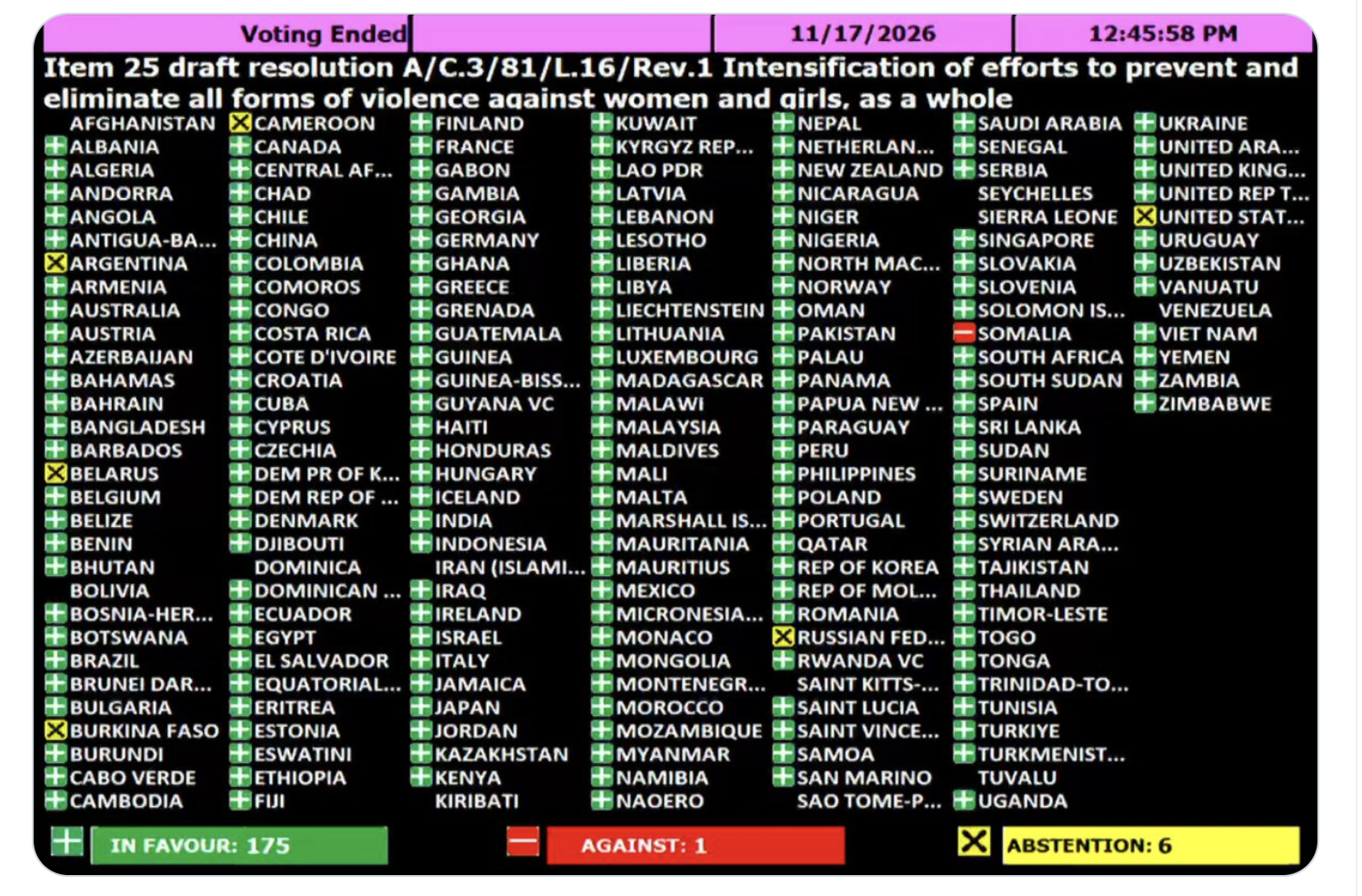
The European Union’s delegation at the UN issued a strong statement celebrating the milestone: "Gender-related killings are a global scourge. Today’s vote: 175 to 1 marks the international community’s commitment to end violence against women and girls worldwide."
British representatives echoed this sentiment, emphasizing the sheer urgency of tackling what they termed an intolerable global epidemic. "Every 10 minutes, a woman is killed by her partner or a family member. This is appalling. And it must end," stated the UK mission following the vote.
On the other end of the spectrum, Somalia’s lone negative vote highlighted persistent national resistance to international mandates on gender relations. Meanwhile, the abstaining bloc—featuring regional heavyweights like Russia and the U.S., alongside Argentina, Burkina Faso, Belarus, and Cameroon—signaled that geopolitical fragmentation continues to impede unified global action on human rights.
Implications and the Road to the General Assembly
As the resolution successfully clears its preliminary hurdle at the committee level during the United Nations General Assembly’s 81st session, it enters a crucial transitional phase. The text is scheduled for formal, plenary adoption by the full General Assembly in December.
While committee-level approval strongly indicates that the resolution will pass the plenary vote given the overwhelming 175-vote margin, the intense diplomatic bruising witnessed in November carries profound implications for global governance.
The proceedings underscore a hardening global backlash against women’s rights, driven by a resurgence of nationalist governance and socially conservative alliances. The systematic attempts to undermine concepts like marital rape and intersectional discrimination demonstrate that international norms are increasingly contested terrain. Furthermore, the focus on digital violence establishes a critical precedent for future international law, forcing governments to grapple with the reality that human rights abuses in the twenty-first century transcend physical borders and manifest increasingly through algorithms, spyware, and virtual harassment.
Ultimately, while the impending UN resolution represents a significant normative victory for gender equality and the protection of women and girls worldwide, its long-term efficacy will depend entirely on the political will of member states to translate international consensus into enforceable domestic legislation, bridging the wide chasm between global declarations and the grim daily realities faced by millions of women globally.